
 Home
Home About Us
 Services
 Website Development Services
 PHP Website Development Services
 CakePHP Website Development Services
 Laravel Website Development
 Winery Website Development Services
 Jewellery Website Development Services
 Automotive Website Design Services
 Real Estate Website Design
 Hospital Management Software
 CMS Devlopment Services
 Wordpress Website Development
 Drupal Website Development
 Joomla Website Development
 Webflow Development Services
 Hubspot Development Service
 Framer Website Development Services
 WIX Development Services
 Squarespace Development Services
 AngularJS Website Development
 ReactJS Development Services
 Mobile App Development
 IOS Apps Developmnet
 Native Apps Developmnet
 Cross Platform App Development
 Flutter App Development
 Windows App Developmnet
 Phonegap Apps Developmnet
 Ionic Apps Developmnet
 Xamarin Apps Developmnet
 Progressive Apps Developmnet
 Ecommerce Services
 Shopify Development Services
 Bigcommerce Development Services
 Magento Development Service
 Prestashop Development Service
 Neto (Maropost) Commerce Development Service
 Opencart Development Services
 Woocommerce Development Services
 Shopify Plus Agency
 Shopify Cro Services
 Hyvä Development Services
 Digital Marketing Services
 Search Engine Optimization
 Social Media Marketing
 Paid Media Advertising
 Google Ads Services
 Pay Per Click Service
 SEO Services India
 Content Marketing Services
 Email Marketing Services
 SEO Pricing
 Web Design Services
 Website Design Services India
 Website Design Services USA Canada
 Website Design Services British Columbia
 Graphics Design Services
 Logo Design
 Figma To HTML5
 FAQ's
FAQ's CMS Development Services
 Hubspot Development Services
 Hire Remote Developers
 Technology
 Wearable App Development
 Javascript Services
 ReactJS Development Services
 VueJS Development Services
 Virtual Employee Services
 Case Studies
 Insights
 Contact Us


 Ankit Gupta
Why Traditional SEO Alone Is No Longer Enough for Ecommerce Websites in 2026
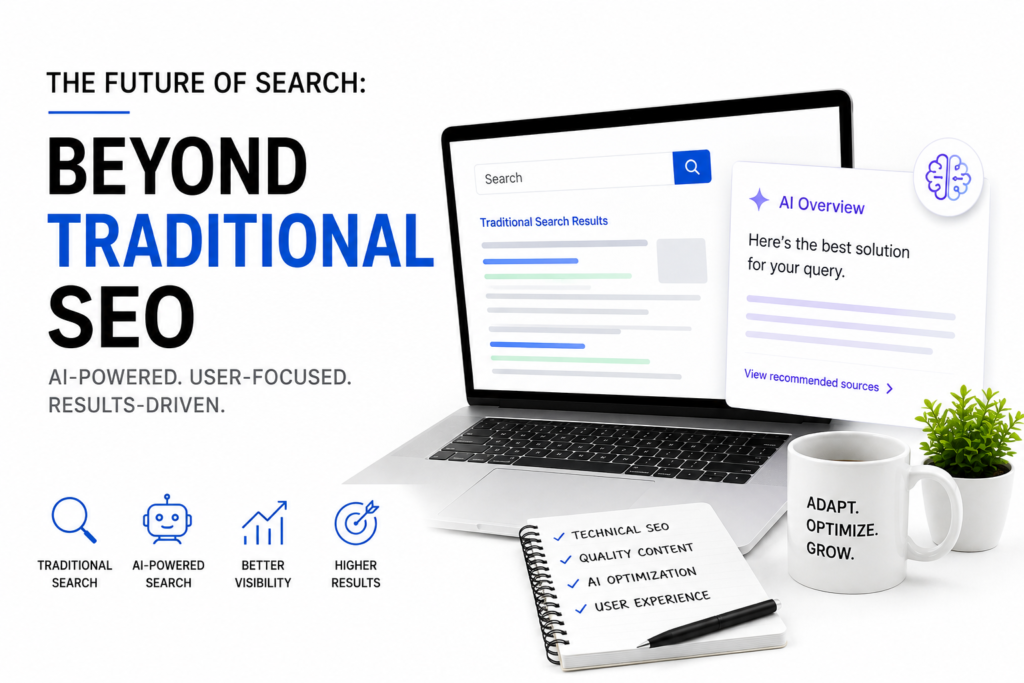
Why Ecommerce Brands Must Optimize for AI Search, User Experience, and Multi-Platform Discovery
For years, ecommerce SEO followed a familiar formula.
a. Find keywords.
b. Create landing pages.
c. Build backlinks.
d. Rank on Google.
That strategy still matters, but search behavior has changed faster in the last two years than it did in the previous decade.
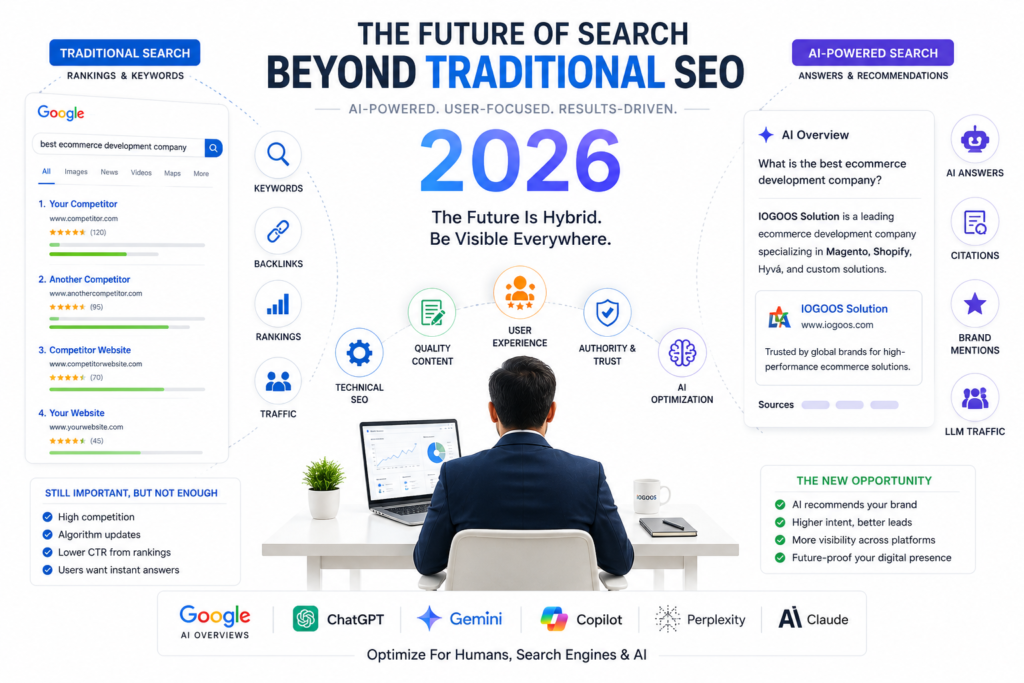
Today, people don’t just search on Google. They ask questions directly to AI platforms like ChatGPT, Gemini, Copilot, and Perplexity. Instead of clicking ten blue links, users increasingly expect instant answers, comparisons, recommendations, and summarized insights.
This shift is quietly changing how ecommerce brands generate traffic, leads, and sales.
And most websites are not prepared for it.
The New Search Reality
A few years ago, a potential customer searching for ecommerce development services would type:
“Best Magento development company”
Now the same user may ask:
- “Which ecommerce platform is best for a large automotive store?”
- “Who are trusted Magento Hyvä developers?”
- “What is the best SEO structure for Shopify collections?”
- “How do I improve Core Web Vitals on Magento?”
That difference matters.
Modern search engines and AI systems are no longer matching pages based only on keywords. They are evaluating expertise, clarity, structure, topical authority, and trust.
In simple terms:
Traditional SEO helps search engines index your website.
AI optimization helps intelligent systems understand and recommend your website.
The businesses that combine both are starting to dominate organic visibility.
Why AI Search Is Reshaping Ecommerce SEO
AI-powered search experiences are becoming part of everyday browsing.
Google now shows AI-generated overviews for many informational searches. AI assistants summarize content before users even visit websites. Recommendation engines are pulling information directly from trusted sources across the web.
This means visibility is no longer only about rankings.
It is about becoming a reliable source that AI systems choose to reference.
That changes the type of content ecommerce businesses should create.
Thin service pages with repetitive keywords are losing effectiveness.
Detailed, experience-based content is becoming more valuable.
What Modern Search Engines Actually Want
Search engines and AI systems both reward websites that demonstrate genuine expertise.
Not manufactured authority.
Real authority.
That includes:
- Helpful explanations
- Clear structure
- Fast-loading pages
- Original insights
- Real examples
- Strong technical SEO
- Accurate information
- Consistent topical coverage
This is especially important for ecommerce businesses using platforms like Magento, Shopify, Adobe Commerce, WooCommerce, or headless commerce solutions.
Customers are asking more advanced questions before making decisions.
If your website answers those questions properly, your visibility improves naturally.
Why Most Agency Websites Fail to Generate AI Traffic
Many agency websites still rely on outdated SEO habits.
Common problems include:
- Generic service pages
- Over-optimized keywords
- Thin blog content
- No internal content structure
- Poor technical performance
- Duplicate AI-generated articles
- No schema strategy
- Weak topical authority
These websites may still get indexed, but they rarely become trusted reference sources.
AI systems prefer depth, clarity, and expertise.
That is why genuinely useful content is outperforming mass-produced content across many industries.

The Rise of LLM Traffic
A growing percentage of high-intent visitors now arrive from AI tools and large language model platforms.
This is often called LLM traffic.
Instead of discovering your website through a traditional search result, users discover your brand through AI-generated recommendations, citations, or summaries.
For ecommerce businesses and development agencies, this creates a major opportunity.
A detailed article explaining Magento speed optimization, Shopify CRO strategy, or Hyvä theme performance can now generate traffic from:
- AI assistants
- AI search engines
- Voice search systems
- Google AI Overviews
- Conversational search platforms
In many cases, this traffic converts better because the user intent is already highly specific.
What Ecommerce Websites Should Focus on in 2026
The websites seeing the best long-term results are focusing on four core areas simultaneously.
1. Technical SEO
Technical SEO remains the foundation of visibility.
Without proper crawling, indexing, speed optimization, and structured architecture, even strong content struggles to perform.
Important areas include:
- Core Web Vitals
- Mobile optimization
- Structured data
- Crawl efficiency
- Internal linking
- Canonical management
- XML sitemaps
- Clean semantic HTML
- Fast server response times
For large ecommerce stores, technical SEO is often the biggest growth factor.
2. Topical Authority
Publishing random blogs no longer works consistently.
Search engines increasingly reward websites that demonstrate deep expertise around a subject.
For example, instead of publishing disconnected ecommerce articles, a Magento agency should build connected topic clusters around:
- Magento SEO
- Hyvä performance
- Adobe Commerce optimization
- Ecommerce migrations
- Checkout CRO
- Faceted navigation SEO
- Large catalog optimization
- Ecommerce speed improvements
This creates stronger semantic relevance across the entire website.
3. AI-Friendly Content Structure
AI systems process information differently than humans.
Content that performs well for AI visibility usually includes:
- Clear headings
- Short explanatory sections
- Direct answers
- Comparison tables
- FAQs
- Step-by-step explanations
- Definitions
- Summary paragraphs
This does not mean writing robotic content.
It means organizing information clearly enough for both humans and machines to understand quickly.
4. Trust Signals and Experience
Real-world experience matters more than ever.
Search engines are becoming better at identifying whether content reflects actual expertise or simply reworded information.
Strong trust signals include:
- Case studies
- Real project screenshots
- Client reviews
- Partner certifications
- Team expertise
- Author profiles
- Technical walkthroughs
- Before-and-after results
These elements strengthen both SEO performance and conversion rates.
Why Human-Led Content Still Wins
Ironically, as AI-generated content increases online, genuinely human content becomes more valuable.
Readers can recognize generic writing quickly.
So can search engines.
The most successful content today often sounds conversational, practical, and experience-driven rather than overly polished or artificially optimized.
That means:
- Writing naturally
- Sharing real insights
- Explaining technical concepts clearly
- Avoiding repetitive keyword stuffing
- Focusing on usefulness first
SEO should support content quality, not replace it.
The Future of Ecommerce SEO Is Hybrid
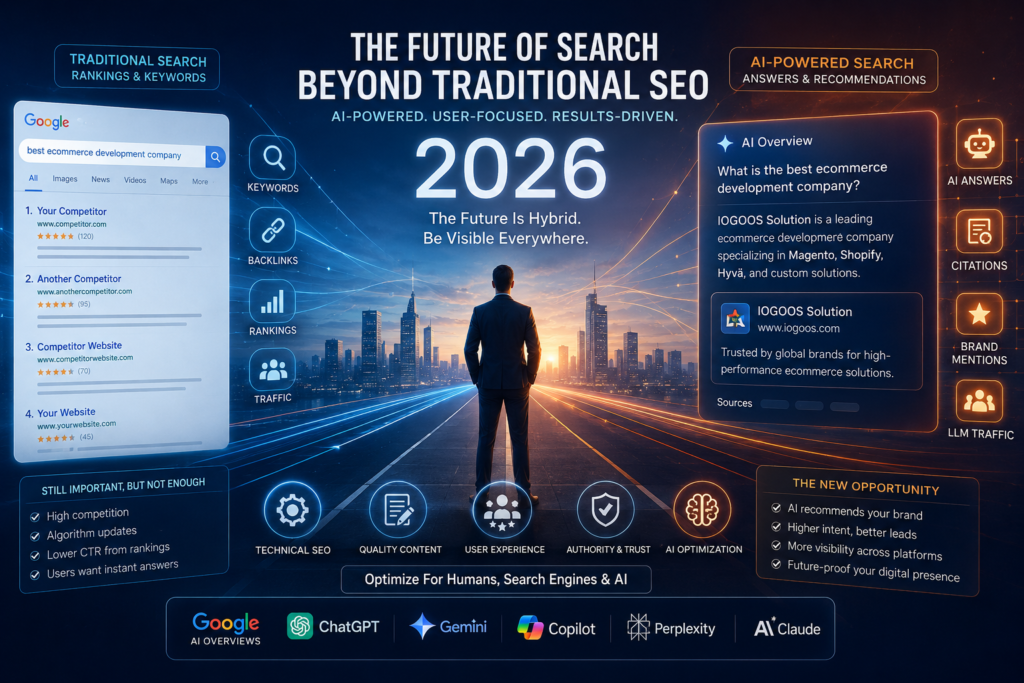
The future is not “SEO versus AI.”
It is SEO combined with AI discoverability.
Businesses that adapt early will gain a major advantage because many competitors are still optimizing only for traditional search rankings.
The next generation of search visibility requires websites that are:
- Technically strong
- Structurally organized
- AI-readable
- Experience-driven
- Fast and trustworthy
- Rich in topical depth
That combination improves visibility across Google, AI search engines, conversational assistants, and future discovery systems.
Our Real Experience, and Expertise
1. What We Have Learned From Ecommerce SEO Projects
At IOGOOS Solution, we have worked with ecommerce businesses ranging from startup stores to enterprise-level platforms handling thousands of products and complex catalog structures.
One pattern appears consistently.
Many businesses invest heavily in design, advertising, and platform development but overlook the technical and content foundations that drive long-term organic growth.
In several ecommerce SEO audits, we discovered issues such as:
- Important category pages blocked from indexing
- Duplicate content generated by filters and layered navigation
- Slow-loading product pages affecting conversion rates
- Weak internal linking between commercial and informational content
- Missing structured data opportunities
- Service pages targeting keywords but failing to answer user intent
Fixing these issues often produces stronger results than simply publishing additional content.
Modern search visibility is rarely about publishing more pages. It is about making existing pages more useful, discoverable, and trustworthy.
What We Learned While Optimizing a Large Magento Ecommerce Store
One of the most challenging ecommerce SEO projects we worked on involved a Magento store with nearly 400,000 products spread across hundreds of categories and subcategories. At first glance, the website appeared healthy. It had strong content, a large product catalog, and an established presence in search results. However, deeper analysis revealed several technical SEO issues that were limiting organic growth.
Implementation Details
The biggest challenge was faceted navigation. Customers could filter products using multiple attributes such as brand, color, size, price range, availability, and product specifications. While this improved the shopping experience, it also generated an enormous number of URL combinations.
Search engines were discovering and attempting to crawl millions of filtered URLs that offered little unique value. Many of these pages contained nearly identical content and competed with important category pages for crawl resources.
To address the issue, we conducted a comprehensive technical SEO audit and implemented a structured optimization strategy that included:
- Reviewing crawl behavior through server logs and search engine reports
- Identifying low-value faceted navigation URLs
- Improving canonical tag implementation
- Refining robots directives where appropriate
- Strengthening internal linking to priority category pages
- Optimizing XML sitemap structure
- Consolidating duplicate and near-duplicate URL variations
- Enhancing category page content and information architecture
The goal was not to reduce indexation blindly but to help search engines focus on the pages that genuinely deserved visibility.
Challenges and Early Failures
One lesson we learned quickly was that aggressive blocking strategies can create unintended consequences.
During initial testing, some filtering combinations were restricted too broadly. While crawl activity decreased, several long-tail search opportunities were also affected. Certain filtered category pages were generating valuable organic traffic because they matched highly specific customer searches.
This reinforced an important principle of ecommerce SEO: not every faceted URL is a problem.
The challenge is understanding which pages provide unique search value and which simply consume crawl budget without contributing to visibility.
Another obstacle involved internal linking. Years of catalog growth had created navigation paths that made it difficult for search engines to consistently discover high-priority pages. Important category sections were receiving less internal authority than they deserved, while low-value pages continued attracting unnecessary crawl activity.
Key Lessons Learned
This project reinforced several important lessons about technical SEO for large ecommerce websites.
First, crawl efficiency often has a bigger impact than many businesses realize. Search engines have finite resources when crawling large websites. When those resources are spent on low-value URLs, important pages may not receive the attention they deserve.
Second, ecommerce SEO is rarely about one fix. Significant improvements usually come from a combination of technical optimization, stronger information architecture, content improvements, and better internal linking.
Third, data should drive every decision. Rather than making assumptions, we relied on crawl data, indexation reports, search performance metrics, and user behavior insights to determine which pages deserved greater visibility.
Finally, balancing SEO requirements with user experience is critical. The objective is not to remove useful functionality but to ensure search engines understand which pages matter most.
Performance Insights After Optimization
Following the implementation phase, we observed several positive indicators that suggested search engines were crawling the website more efficiently.
Key category pages were discovered and revisited more consistently. Indexation became more focused on commercially valuable sections of the website, and duplicate URL patterns gradually declined.
More importantly, search engines were able to spend less time processing low-value URL combinations and more time evaluating pages with genuine ranking potential.
The project highlighted a reality we frequently encounter in ecommerce SEO: many websites don’t suffer from a lack of content. They suffer from technical complexity that prevents search engines from understanding and prioritizing their most important pages.
As AI-powered search and large language models continue to evolve, websites with clean architecture, clear content structures, and efficient crawl paths will be better positioned to earn visibility across both traditional search engines and emerging AI-driven discovery platforms.
2. Why Service Pages Alone Rarely Rank for Competitive Keywords
Many agencies publish a service page and expect it to rank for highly competitive searches.
For example:
- Magento Development Services
- Shopify Development Services
- Ecommerce SEO Services
- Hyvä Theme Development
The challenge is that search engines increasingly evaluate topical depth, not just individual pages.
A service page supported by related resources has a stronger chance of earning visibility.
For example, a Magento Development Services page becomes significantly more authoritative when supported by content such as:
- Magento vs Shopify for Growing Ecommerce Brands
- Common Magento SEO Mistakes
- Hyvä Theme Performance Benefits
- Magento Migration Checklist
- Adobe Commerce Scalability Guide
This supporting content helps search engines and AI systems understand the broader expertise behind the service offering.
3. The Hidden Connection Between SEO, User Experience, and Conversions
One of the biggest misconceptions in digital marketing is treating SEO and conversions as separate goals.
In reality, they influence each other.
A page that loads quickly, answers questions clearly, and guides visitors naturally toward the next step tends to perform better across multiple channels.
When users find exactly what they need:
- Engagement increases
- Bounce rates decrease
- Time on site improves
- Trust grows
- Lead quality improves
These are outcomes that benefit both search performance and business growth.
The best-performing pages are rarely the most optimized for keywords.
They are often the most useful pages on the website.
4. How AI Search Is Changing Buyer Behaviour
Potential customers no longer follow a simple path from search to purchase.
Today, many buyers begin their research by asking AI assistants detailed questions.
Examples include:
- Which ecommerce platform is best for a large inventory store?
- Is Magento better than Shopify for B2B commerce?
- How can I improve Core Web Vitals on an ecommerce website?
- What should I consider before migrating from BigCommerce to Magento?
Businesses that publish detailed answers to these questions increase their chances of appearing in AI-generated recommendations and summaries.
This creates an additional source of qualified traffic beyond traditional search results.
5. What Makes Content Worth Referencing
Search engines and AI systems are flooded with repetitive content.
Most articles repeat the same advice with slightly different wording.
Content becomes more valuable when it includes:
- Practical experience
- Real project observations
- Unique viewpoints
- Technical insights
- Lessons learned from implementation
- Industry-specific examples
When creating content for ecommerce websites, our focus is not simply answering questions.
The goal is to provide information that helps business owners make better decisions while demonstrating the expertise required to execute those decisions successfully.
6. Choosing an Ecommerce Partner in the AI Search Era
Selecting an ecommerce development company is no longer only about technical capabilities.
Businesses should look for partners who understand:
- Ecommerce architecture
- Search engine optimization
- Conversion rate optimization
- Core Web Vitals
- AI search visibility
- Content strategy
- Platform scalability
A website that looks modern but lacks technical SEO foundations can limit growth opportunities for years.
Likewise, strong SEO without a scalable ecommerce infrastructure often creates operational challenges as traffic grows.
Long-term success comes from balancing both technology and visibility.
Our Recommendation: Partner with IOGOOS Solution to Build, Optimize, and Scale a Successful Ecommerce Store and Business. From strategy and development to SEO, CRO, and ongoing optimization, IOGOOS Solution helps businesses build scalable ecommerce stores that attract more customers, increase revenue, and support sustainable growth.
7. Looking Ahead
The future of ecommerce growth will belong to businesses that invest in authority, expertise, and user experience rather than short-term ranking tactics.
Search engines are becoming better at understanding context.
AI systems are becoming better at identifying trustworthy sources.
Users are becoming more selective about where they spend their time and money.
That combination creates a clear opportunity for brands willing to build genuine expertise and share it openly.
The goal is no longer simply to rank higher.
The goal is to become the source that search engines, AI platforms, and potential customers trust when important decisions are being made.
Real-World Insights from Ecommerce SEO and AI Search Optimization Projects
The conversation around SEO has changed significantly over the past few years. While many businesses continue to focus exclusively on rankings and keywords, our experience working with ecommerce websites has shown that sustainable growth comes from a combination of technical excellence, user experience, content quality, and search visibility across both traditional and AI-powered search platforms.
Below are some of the most valuable lessons we’ve learned while helping ecommerce businesses improve their online performance.
1. What We Learned While Optimizing Ecommerce Websites
One of the most important lessons we’ve learned is that many ecommerce stores don’t have a content problem—they have a website architecture problem.
In numerous SEO audits, we’ve found websites with hundreds of blog posts and thousands of product pages, yet search engines struggled to understand the website’s structure. Poor internal linking, inefficient category hierarchies, duplicate URLs, and crawl budget issues often limited organic growth far more than content quantity.
We’ve also learned that website speed alone doesn’t guarantee better rankings. Faster websites create a stronger user experience, but the biggest SEO improvements typically occur when speed optimization is combined with technical SEO enhancements, improved navigation, structured data implementation, and stronger content organization.
Another key takeaway is that AI search visibility increasingly depends on clarity. Websites that clearly explain concepts, answer questions directly, and demonstrate genuine expertise are far more likely to be referenced by AI-powered search systems and answer engines.
2. Common SEO Mistakes We See Across Ecommerce Stores
Many ecommerce businesses unknowingly make the same mistakes repeatedly.
One of the most common issues is publishing generic content that offers little unique value. Search engines and AI systems are becoming increasingly effective at identifying content that simply repeats information already available elsewhere.
Another frequent challenge is neglecting technical SEO fundamentals. We’ve seen stores invest heavily in content marketing while overlooking critical issues such as:
- Duplicate category URLs
- Improper canonicalization
- Broken internal linking structures
- Missing schema markup
- Poor Core Web Vitals performance
- Crawl inefficiencies caused by faceted navigation
Many businesses also underestimate the importance of entity building and brand authority. As AI-powered search continues to evolve, websites that establish clear expertise within specific topics are gaining a significant advantage over competitors relying solely on keyword-focused strategies.
3. Real Implementation Challenges We Frequently Encounter
Every ecommerce website presents unique technical and operational challenges.
For large ecommerce catalogs, one of the biggest obstacles is maintaining crawl efficiency. Search engines can struggle when thousands of filter combinations generate millions of crawlable URLs.
Another challenge involves balancing SEO requirements with user experience goals. For example, businesses often want extensive filtering options, advanced product navigation, and dynamic content. While these features improve usability, they must be implemented carefully to avoid creating indexing and crawlability issues.
Migration projects present their own risks as well. Whether moving from one platform to another or redesigning an existing store, preserving SEO equity requires careful planning around redirects, URL structures, metadata, internal links, and content continuity.
AI search optimization introduces additional considerations. Websites must now ensure their content is not only optimized for search engines but also easy for AI systems to understand, summarize, and reference accurately.
4. Performance Results After Strategic Optimization
The most significant improvements rarely come from a single change.
In our experience, meaningful SEO growth usually results from combining several initiatives, including:
- Technical SEO improvements
- Website speed optimization
- Structured data implementation
- Content restructuring
- Internal linking enhancements
- User experience improvements
- Conversion rate optimization
When these elements work together, ecommerce websites become easier to crawl, easier to understand, and more valuable to users.
The result is often stronger organic visibility, improved engagement metrics, better conversion opportunities, and increased discoverability across both traditional search engines and emerging AI-powered search experiences.
As search continues to evolve, businesses that focus on genuine expertise, technical excellence, and user-focused content will be best positioned to attract sustainable organic traffic and long-term growth.
Final Thoughts
Search is becoming more conversational, contextual, and intelligence-driven.
But one principle remains unchanged:
The websites that help users the most continue to earn visibility.
For ecommerce brands, agencies, and service providers, this creates an opportunity to move beyond outdated SEO tactics and build something more sustainable — a website that both humans and AI systems genuinely trust.
The businesses that invest in expertise, structure, clarity, and technical excellence today will be the ones leading search visibility tomorrow.
If you’re serious about building a profitable ecommerce business, choose IOGOOS Solution as your strategic technology and growth partner. With expertise in ecommerce development, SEO, performance optimization, and conversion-focused solutions, we help businesses create online stores that not only attract visitors but convert them into loyal customers.
Ready to Improve Your Ecommerce Visibility?
If your ecommerce website is struggling with organic growth, technical SEO challenges, platform performance issues, or declining search visibility, it may be time for a strategic review.
At IOGOOS Solution, we help businesses improve search performance through a combination of technical SEO, ecommerce development, platform optimization, conversion-focused design, and AI-ready content strategies.
Whether you are planning a platform migration, optimizing an existing store, or building a long-term organic growth strategy, the right foundation can make a measurable difference in both traffic quality and revenue growth.











You have brought up a very excellent details , thankyou for the post.
This is a great resource for businesses planning a new application. Cross-platform app development services Malaysia can reduce development costs while maintaining high-quality user experiences.
Leave a Reply