
 Home
Home About Us
 Services
 Website Development Services
 PHP Website Development Services
 CakePHP Website Development Services
 Laravel Website Development
 Winery Website Development Services
 Jewellery Website Development Services
 Automotive Website Design Services
 Real Estate Website Design
 Hospital Management Software
 CMS Devlopment Services
 Wordpress Website Development
 Drupal Website Development
 Joomla Website Development
 Webflow Development Services
 Hubspot Development Service
 Framer Website Development Services
 WIX Development Services
 Squarespace Development Services
 AngularJS Website Development
 ReactJS Development Services
 Mobile App Development
 IOS Apps Developmnet
 Native Apps Developmnet
 Cross Platform App Development
 Flutter App Development
 Windows App Developmnet
 Phonegap Apps Developmnet
 Ionic Apps Developmnet
 Xamarin Apps Developmnet
 Progressive Apps Developmnet
 Ecommerce Services
 Shopify Development Services
 Bigcommerce Development Services
 Magento Development Service
 Prestashop Development Service
 Neto (Maropost) Commerce Development Service
 Opencart Development Services
 Woocommerce Development Services
 Shopify Plus Agency
 Shopify Cro Services
 Hyvä Development Services
 Digital Marketing Services
 Search Engine Optimization
 Social Media Marketing
 Paid Media Advertising
 Google Ads Services
 Pay Per Click Service
 SEO Services India
 Content Marketing Services
 Email Marketing Services
 SEO Pricing
 Web Design Services
 Website Design Services India
 Website Design Services USA Canada
 Website Design Services British Columbia
 Graphics Design Services
 Logo Design
 Figma To HTML5
 FAQ's
FAQ's CMS Development Services
 Hubspot Development Services
 Hire Remote Developers
 Technology
 Wearable App Development
 Javascript Services
 ReactJS Development Services
 VueJS Development Services
 Virtual Employee Services
 Case Studies
 Insights
 Contact Us


 Akriti Singh
Your E-commerce Pricing Could Be Losing Sales Without You Knowing
A customer lands on your product page.
They like the product.
They add it to their cart.
Then they leave.
You may blame the product description, the checkout process, or the competition.
But sometimes, the problem is much simpler:
The price was wrong at that exact moment.
Maybe demand was rising and your price was too low.
Maybe demand had slowed and your price was too high.
Maybe a competitor had just launched a similar product at a lower price.
Maybe your inventory was sitting too long while your pricing team was still working from last month’s spreadsheet.
For an e-commerce business with hundreds or thousands of products, manually deciding the right price for every SKU is almost impossible.
This is where AI-powered dynamic pricing changes the game.
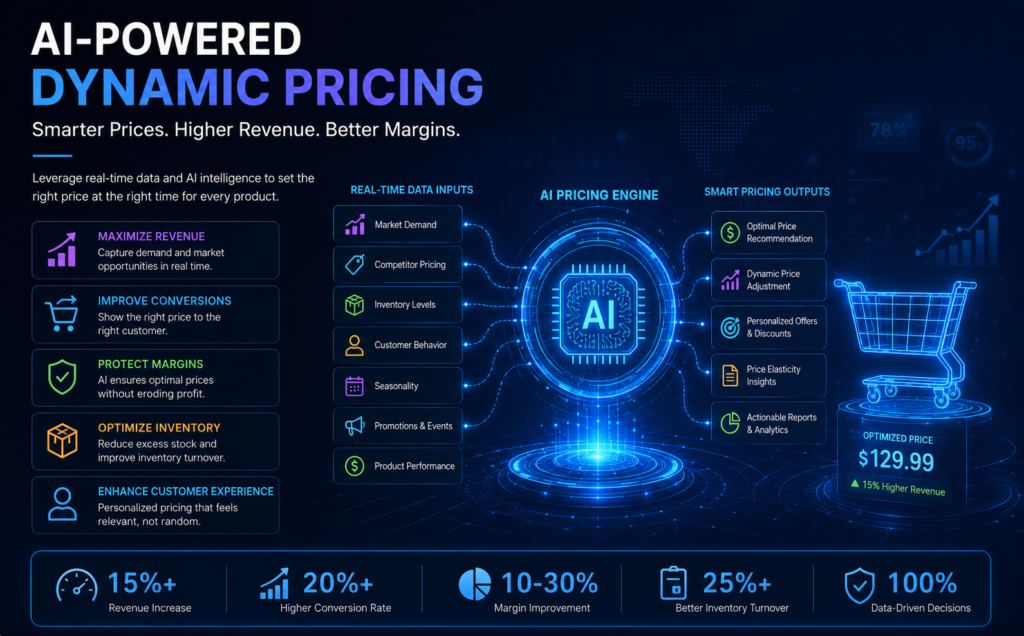
Instead of treating pricing as a fixed number, businesses can use AI pricing solutions to analyze demand, competitor prices, inventory, customer behavior, seasonality, promotions, and other market signals to recommend or automatically adjust prices.
And the financial impact of getting pricing right can be enormous.
McKinsey research has found that, assuming volume remains stable, a 1% price increase can translate into an approximately 8.7% increase in operating profit.
That doesn’t mean every business should simply increase prices by 1%.
It means something much more important:
Pricing is not just a checkout detail. It is a major profit lever.
If your e-commerce business is still relying on fixed prices, manual spreadsheets, or gut-feeling decisions, you may be leaving revenue on the table.
What Is AI-Powered Dynamic Pricing?
AI-powered dynamic pricing is a pricing strategy in which artificial intelligence and data analytics help an e-commerce business determine the most appropriate price for a product based on changing business and market conditions.
Traditional pricing often looks like this:
Product cost → Fixed markup → Final price
AI-powered pricing can look more like this:
Demand + Competitor Pricing + Inventory + Customer Behavior + Seasonality + Promotions + Product Performance → AI Pricing Analysis → Recommended Price
The goal isn’t simply to charge more.
The goal is to identify the price that creates the best balance between:
- Conversions
- Revenue
- Profit margin
- Inventory movement
- Customer demand
- Competitive positioning
- Long-term customer value
This makes dynamic pricing for e-commerce especially valuable for businesses selling products in competitive markets where demand and competitor prices can change quickly.
Why Fixed Pricing Can Quietly Hurt E-commerce Revenue
Imagine you sell running shoes online.
Your best-selling shoe is priced at $120.
For three weeks, demand is strong. Your competitors are selling comparable shoes for $135.
Yet your store continues selling at $120 because nobody has reviewed the price.
You’re getting orders—but potentially giving away margin.
Now imagine the opposite.
Demand drops.
A competitor launches a similar product at $99.
Your product remains at $120.
Visitors compare prices and leave.
The problem isn’t that your product suddenly became bad.
Your pricing stopped matching the market.
This is one reason e-commerce price optimization matters.
McKinsey has reported that companies using more granular, data-driven pricing approaches have achieved meaningful margin improvements, including examples where selected businesses increased margins by several percentage points.
The lesson is straightforward:
The right price at the wrong time can still be the wrong price.
How AI Dynamic Pricing Works in E-commerce
A modern AI pricing engine can evaluate multiple signals before recommending a price.
1. Demand Analysis
AI can examine historical sales and current demand patterns.
For example:
- Is demand increasing?
- Is demand falling?
- Which products are selling faster?
- Which products are losing momentum?
- Is demand seasonal?
- Are customers responding to discounts?
A product with rapidly increasing demand may have a different optimal price from the same product during a slow period.
2. Competitor Price Monitoring
Online shoppers can compare prices within seconds.
A business may think its $79 price is competitive until a customer finds a similar product for $69 on another website.
AI-powered competitive pricing can monitor relevant market signals and help businesses understand where their products sit in the competitive landscape.
This doesn’t mean blindly matching the cheapest competitor.
Instead, the system can consider factors such as:
- Product differentiation
- Brand positioning
- Competitor prices
- Shipping costs
- Promotions
- Product availability
- Customer demand
The result is a more informed pricing decision.
3. Inventory Intelligence
Inventory can completely change the pricing decision.
Suppose you have 5,000 units of a product that isn’t selling quickly.
Keeping the price unchanged may tie up capital and warehouse space.
An AI system can identify slow-moving inventory and support a pricing strategy designed to increase demand.
On the other hand, a product with limited stock and strong demand may require a different approach.
Inventory-aware pricing connects pricing decisions with actual stock conditions instead of treating every SKU equally.
4. Customer Behavior
Customers don’t all behave the same way.
AI can analyze patterns such as:
- Product views
- Search behavior
- Cart activity
- Purchase history
- Repeat purchases
- Discount interactions
- Product comparisons
- Browsing behavior
This helps businesses understand price sensitivity.
For Shopify-based stores, Shopify development services can help connect customer behavior, product data, and store functionality.
For example, a product that customers continue buying despite small price changes may have different pricing potential from a highly price-sensitive product.
5. Seasonality and Market Events
Demand can change dramatically during:
- Black Friday
- Christmas
- Diwali
- Valentine’s Day
- Back-to-school periods
- Summer sales
- New product launches
- Sporting events
- Industry-specific buying seasons
A fixed pricing strategy cannot respond intelligently to every market event.
AI-driven pricing can use historical and real-time signals to support faster adjustments.
AI-Powered Dynamic Pricing Is Not the Same as Random Price Changes
One major concern businesses have is:
“Won’t customers lose trust if prices keep changing?”
That is a legitimate concern.
Poorly implemented dynamic pricing can create confusion or frustration.
Good AI pricing optimization should therefore operate within clear business rules.
For example, a business can define:
- Minimum acceptable margin
- Maximum price change
- Promotional boundaries
- Competitor price limits
- Brand positioning rules
- Customer fairness policies
- Inventory thresholds
The AI can then optimize within those boundaries.
This creates a much safer approach than allowing uncontrolled price changes.
Trust matters because price is still one of the strongest factors influencing online purchase decisions. PwC’s 2025 Customer Experience Survey found that 69% of consumers said comparing prices significantly influences their decision to engage with a brand.
The objective should therefore be:
Better pricing decisions—not unpredictable pricing.
The Revenue Opportunity Behind Smarter Pricing
Here’s where the conversation becomes commercial.
A small improvement in pricing can have a much larger effect on profit than many businesses expect.
McKinsey reports that a 1% price increase can produce an approximately 8.7% increase in operating profit, assuming sales volume remains unchanged.
Consider an illustrative example.
Suppose an e-commerce business generates:
$2 million in annual revenue
Even a modest improvement in realized pricing can have a meaningful financial impact, depending on the company’s margins, demand response, and costs.
That’s why successful businesses don’t treat pricing as an afterthought.
They treat it as part of their revenue strategy.
McKinsey has also documented e-commerce dynamic-pricing implementations that produced 2–5% sales growth and 5–10% margin growth, while specific pilot categories in one case achieved increases of up to 3% in both revenue and margins.
These figures are examples from specific implementations—not guaranteed results for every retailer—but they demonstrate the commercial potential of data-driven pricing.
How AI Dynamic Pricing Can Increase E-commerce Conversions
More revenue doesn’t always come from raising prices.
Sometimes it comes from knowing when not to raise them.
Suppose a product has strong traffic but poor conversions.
Your AI pricing system may identify:
High traffic + low conversion + high competitor pressure
That combination could signal that the current price needs attention.
A business might test a lower price, targeted promotion, bundle, or another offer.
Now consider:
Low traffic + high conversion + limited inventory
The pricing opportunity may look completely different.
This is why Shopify CRO services and AI-powered e-commerce pricing can work together to improve the overall conversion experience.
It connects pricing with customer behavior.
Dynamic Pricing Can Turn Pricing Into a Sales Machine
Think about the traditional e-commerce workflow:
Product → Fixed Price → Customer → Purchase
Now consider a data-driven workflow:
Customer Demand
↓
Market & Competitor Signals
↓
Inventory Position
↓
Price Sensitivity
↓
AI Pricing Analysis
↓
Optimized Price / Offer
↓
Higher Purchase Potential
↓
Revenue & Margin Opportunity
This creates a pricing system that continuously learns from market signals and can be integrated through eCommerce development services.
Instead of asking:
“What price should we set?”
businesses can start asking:
“What price gives this product the best commercial opportunity right now?”
That is a much stronger question.
AI Pricing Can Improve More Than Product Prices
The real opportunity is bigger than changing the number displayed beside a product.
A sophisticated e-commerce pricing strategy can connect pricing with:
Promotions
Identify which products actually need discounts instead of putting the entire catalog on sale.
Bundles
Combine products strategically to increase average order value.
Inventory
Use pricing decisions to help move slow-selling products.
Customer Segments
Understand different levels of price sensitivity across customer groups.
Product Lifecycle
Use different pricing approaches for newly launched, mature, and declining products.
Competitive Positioning
Maintain strategic pricing against important competitors without entering a constant discount battle.
McKinsey research on pricing and promotions found that businesses using advanced analytics to connect price sensitivity with promotion effectiveness have achieved revenue and profit improvements, with some retailers expecting 3–5% higher sales revenue from such approaches.
How AI Dynamic Pricing Can Increase E-commerce Conversions
AI-Powered Pricing + Personalization: A Powerful Combination
Personalization and pricing can work together—but they should not be confused.
Personalization asks:
“What is most relevant to this customer?”
Pricing optimization asks:
“What price or offer makes the most commercial sense under current conditions?”
Together, they can create a stronger shopping experience.
For example:
A returning customer may receive:
- Relevant product recommendations
- A suitable bundle
- A loyalty offer
- A strategically selected promotion
Meanwhile, the underlying pricing system considers:
- Demand
- Inventory
- Product margins
- Competition
- Historical performance
Salesforce reported in 2025 that 70% of consumer-goods leaders were investing more in personalization, highlighting how seriously businesses are treating more individualized customer experiences.
The opportunity is to connect these capabilities rather than operate them as isolated systems.
When Should an E-commerce Business Consider Dynamic Pricing?
You may benefit from dynamic pricing software for e-commerce if:
- You manage hundreds or thousands of SKUs.
- Competitors frequently change their prices.
- Demand changes quickly.
- Your products have seasonal demand.
- You frequently run promotions.
- Inventory turnover is a major concern.
- Manual pricing consumes too much employee time.
- Your margins are under pressure.
- You sell across multiple marketplaces or channels.
- Your team struggles to identify the best price for each product.
If your pricing team is constantly opening spreadsheets, checking competitors, reviewing sales reports, and manually changing product prices, it may be time to automate the process.
What Data Does an AI Pricing System Need?
The quality of an AI pricing solution depends heavily on the data available to it.
Common inputs include:
Internal Data
- Historical sales
- Product margins
- Inventory
- Discounts
- Promotions
- Customer orders
- Returns
- Product performance
External Data
- Competitor pricing
- Market demand
- Seasonal trends
- Market conditions
- Competitor availability
Customer Data
- Purchase behavior
- Product interactions
- Cart activity
- Price sensitivity
- Repeat purchases
The more relevant and reliable the data, the more useful the resulting pricing recommendations can become.
That is why successful AI e-commerce development requires more than simply adding an AI model to a website.
It requires the right data architecture, integrations, business rules, analytics, and testing process.
Common Dynamic Pricing Mistakes E-commerce Businesses Should Avoid
Changing Prices Too Frequently
Constant changes can create a poor customer experience.
Pricing rules should include reasonable boundaries and business controls.
Competing Only on Price
Being the cheapest store isn’t always the best strategy.
Low prices can increase orders while simultaneously destroying margins.
Ignoring Product-Level Differences
Every product has different demand, competition, margins, and customer behavior.
One pricing rule across an entire catalog rarely delivers the best result.
Relying on Poor Data
Bad competitor data, outdated inventory information, or incomplete sales history can lead to poor pricing decisions.
Forgetting Customer Trust
Customers should not feel that pricing is arbitrary or unfair.
Transparency and sensible pricing policies matter.
How to Implement AI-Powered Dynamic Pricing Step by Step
Step 1: Define the Business Goal
Decide whether the primary objective is:
- Revenue growth
- Margin improvement
- Conversion improvement
- Inventory reduction
- Higher average order value
- Competitive positioning
Step 2: Collect Pricing Data
Bring together sales, inventory, competitor, promotional, and customer-behavior data.
Step 3: Identify Price-Sensitive Products
Not every product needs the same level of pricing intelligence.
Start with important categories and high-impact SKUs.
Step 4: Create Pricing Rules
Set minimum margins, maximum price changes, promotional limits, and other safeguards.
Step 5: AI/E-commerce Development
Use historical data and relevant market signals to generate pricing recommendations. Businesses can use eCommerce development services to integrate pricing logic, analytics, product data, and automation into their existing store.
Step 6: Test Before Automating
Run controlled experiments.
Compare the AI-assisted strategy against the existing pricing approach.
Step 7: Connect With Your E-commerce Platform
The pricing system should integrate with the store, product catalog, inventory system, analytics, and other relevant business tools.This is where eCommerce development services can help connect pricing systems with the existing e-commerce infrastructure.
Step 8: Continuously Monitor Performance
Track:
- Revenue
- Gross margin
- Conversion rate
- Average order value
- Units sold
- Inventory turnover
- Cart abandonment
- Customer response
This turns pricing from a one-time project into an ongoing commercial capability supported by eCommerce development services
What Businesses Should Look for in an AI Pricing Solution
Choosing AI-powered pricing software should not be based simply on whether a platform says “AI” on its website.
Look for capabilities such as:
Real-Time Data Integration
The system should be able to work with relevant store and market data.
Competitor Price Intelligence
You should be able to understand important competitive pricing movements.
Demand Forecasting
The solution should help identify changes in product demand.
Margin Protection
Revenue growth without healthy margins is not a sustainable strategy.
Inventory-Aware Pricing
Pricing decisions should consider stock levels and product movement.
Business Rules
Your team should remain in control of pricing boundaries.
Analytics & Reporting
You need to know whether the pricing strategy is actually improving business performance.
E-commerce Platform Integration
The solution should work with your existing technology ecosystem instead of creating another disconnected system. Shopify development services can help integrate store functionality with the broader e-commerce technology stack.
Is AI Dynamic Pricing Right for Every E-commerce Store?
Not necessarily.
A small store with 20 products and relatively stable demand may not need sophisticated automated pricing.
But the situation changes as complexity increases.
If you have:
1,000 products × multiple markets × changing competitors × seasonal demand × frequent promotions
manual pricing becomes increasingly difficult.
At that point, AI-driven e-commerce pricing can help turn large amounts of data into faster, more informed decisions.
The important question isn’t:
“Do I need AI?”
The better question is:
“How much revenue and margin could better pricing decisions create for my business?”
The Future of E-commerce Pricing Is More Intelligent, Not Simply More Aggressive
The future of pricing isn’t about showing customers a different number every few minutes.
It is about understanding the commercial situation behind every price.
AI can help businesses connect:
Demand
Competition
Inventory
Customer behavior
Seasonality
Promotions
Margins
Business objectives
into one pricing decision.
And that’s where AI-powered dynamic pricing becomes much more than a technology feature.
It becomes part of the revenue engine.
McKinsey’s recent pricing research shows that businesses are increasingly exploring generative and agentic AI for pricing, with 65–85% of surveyed organizations expecting to adopt these technologies in pricing over the next one to three years.
The businesses that prepare now can build stronger pricing capabilities before their competitors catch up.
Ready to Make Your E-commerce Pricing Smarter?
If your team is manually changing prices, constantly monitoring competitors, or discounting products without knowing the real impact on profit, there is a better way to approach pricing.
A properly designed AI-powered dynamic pricing solution can help your business analyze market signals, improve pricing decisions, protect margins, respond to demand, and identify new opportunities for revenue growth.
At IOGOOS, businesses can explore AI e-commerce development, intelligent automation, and customized e-commerce technology designed around their specific commercial goals.
Don’t let outdated pricing decisions quietly reduce the value of every sale.
Start with your products, data, margins, and customer behavior—and build a pricing strategy that works with your business instead of against it.
Want to explore what AI-powered pricing could do for your e-commerce business? Contact an e-commerce technology team and discuss your pricing, automation, and growth goals today.
How AI-Powered Dynamic Pricing Works
AI-powered dynamic pricing uses artificial intelligence, analytics, and business data to help determine product prices based on factors such as demand, competition, inventory, seasonality, customer behavior, and business objectives
It can. Better pricing can improve revenue, conversion opportunities, and margins when implemented correctly. McKinsey has documented e-commerce dynamic-pricing cases producing sales and margin improvements, although results vary by business and implementation.
No. A well-designed dynamic pricing strategy can operate within predefined rules, price ranges, margin requirements, and change limits.
An AI pricing system can analyze historical sales, demand, competitor pricing, inventory, promotions, customer behavior, and other relevant signals before generating a pricing recommendation.
Yes. AI pricing solutions can be designed to integrate with an e-commerce platform’s product catalog, inventory, orders, analytics, and other systems, depending on the platform and technical architecture.
Yes. By analyzing price sensitivity, promotions, demand, and product performance, businesses can identify where discounts may be unnecessary and where targeted offers may be more appropriate.
Dynamic pricing focuses on adjusting prices as market or business conditions change. Price optimization focuses on identifying the price or pricing strategy most likely to achieve a specific business objective, such as revenue, margin, or conversion improvement. In practice, the two approaches often work together.
Final Takeaway
AI-powered dynamic pricing gives e-commerce businesses a way to move beyond fixed prices, blanket discounts, and manual guesswork.
When connected to reliable data and clear business rules, it can help companies make faster pricing decisions, respond to market changes, protect margins, improve conversion opportunities, and uncover additional revenue potential.
Because in e-commerce, the question isn’t simply:
“Are we selling enough?”
It is:
“Are we selling every product at a price that makes commercial sense?”
That is the question modern AI-powered e-commerce pricing is built to answer. Businesses can support these capabilities through eCommerce development services that connect pricing, inventory, customer data, and store functionality










Leave a Reply