
 Home
Home About Us
 Services
 Website Development Services
 PHP Website Development Services
 CakePHP Website Development Services
 Laravel Website Development
 Winery Website Development Services
 Jewellery Website Development Services
 Automotive Website Design Services
 Real Estate Website Design
 Hospital Management Software
 CMS Devlopment Services
 Wordpress Website Development
 Drupal Website Development
 Joomla Website Development
 Webflow Development Services
 Hubspot Development Service
 Framer Website Development Services
 WIX Development Services
 Squarespace Development Services
 AngularJS Website Development
 ReactJS Development Services
 Mobile App Development
 IOS Apps Developmnet
 Native Apps Developmnet
 Cross Platform App Development
 Flutter App Development
 Windows App Developmnet
 Phonegap Apps Developmnet
 Ionic Apps Developmnet
 Xamarin Apps Developmnet
 Progressive Apps Developmnet
 Ecommerce Services
 Shopify Development Services
 Bigcommerce Development Services
 Magento Development Service
 Prestashop Development Service
 Neto (Maropost) Commerce Development Service
 Opencart Development Services
 Woocommerce Development Services
 Shopify Plus Agency
 Shopify Cro Services
 Hyvä Development Services
 Digital Marketing Services
 Search Engine Optimization
 Social Media Marketing
 Paid Media Advertising
 Google Ads Services
 Pay Per Click Service
 SEO Services India
 Content Marketing Services
 Email Marketing Services
 SEO Pricing
 Web Design Services
 Website Design Services India
 Website Design Services USA Canada
 Website Design Services British Columbia
 Graphics Design Services
 Logo Design
 Figma To HTML5
 FAQ's
FAQ's CMS Development Services
 Hubspot Development Services
 Hire Remote Developers
 Technology
 Wearable App Development
 Javascript Services
 ReactJS Development Services
 VueJS Development Services
 Virtual Employee Services
 Case Studies
 Insights
 Contact Us


 Akriti Singh
How Is AI Automation Helping E-commerce Businesses Drive Digital Growth?
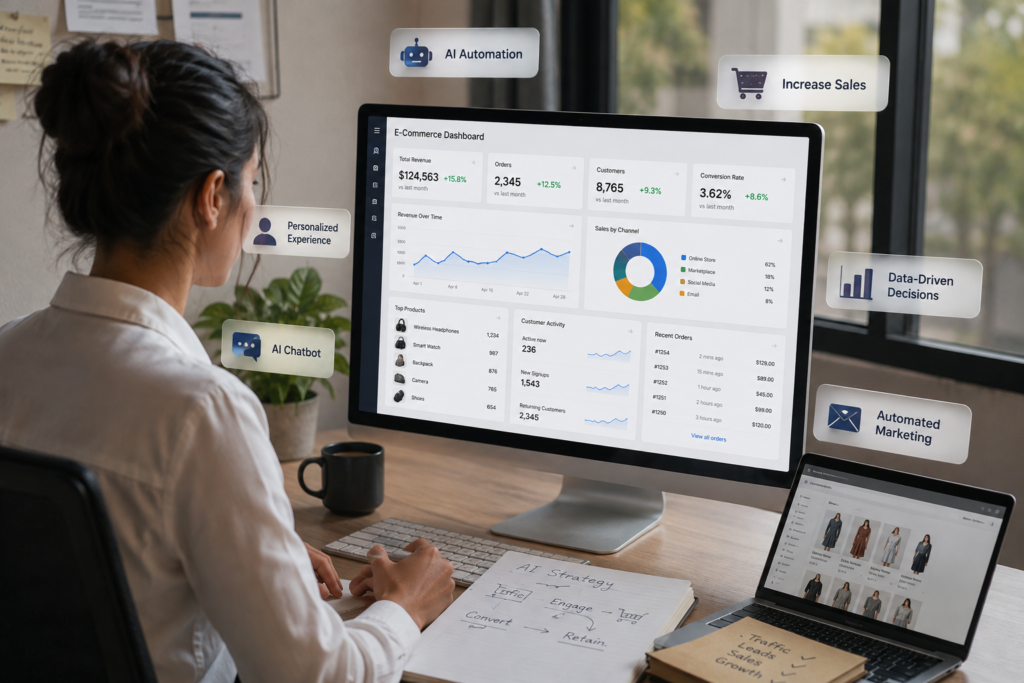
Primary SEO Keywords: AI Automation for E-commerce, E-commerce AI Solutions, AI-powered e-commerce, E-commerce Automation, AI E-commerce Development, E-commerce Development Services, AI-powered personalization, E-commerce Chatbot Development, AI Sales Automation, E-commerce Digital Growth
Search Intent: Informational + Commercial
Suggested Meta Title: AI Automation for E-commerce: Drive Traffic, Leads & Revenue
Suggested Meta Description: Discover how AI automation for e-commerce helps businesses attract high-intent traffic, generate leads, increase conversions, automate sales, and drive measurable digital growth
Your E-commerce Store May Be Losing Sales While You Sleep
A customer visits your online store at 11:47 PM.
They search for a product, compare two options, ask a question, hesitate at checkout—and leave.
Without timely follow-up, potential customers may leave without completing their purchase.
A salesperson may not be available to recommend a better product.
Similarly, nobody may remind the customer about an abandoned cart.
As a result, by morning, that potential sale may already belong to a competitor.
This is where AI Automation for E-commerce is changing the game.
AI is no longer limited to generating product descriptions or answering basic customer questions. Modern E-commerce AI Solutions can influence the entire customer journey—from product discovery and SEO to personalized recommendations, lead qualification, customer support, remarketing, and sales conversion.
The opportunity is becoming impossible to ignore.
Salesforce reported that during the 2025 holiday season, AI and agents influenced 20% of global retail sales, representing $262 billion in revenue. Even more interesting, shoppers referred to retailers from AI-powered search channels converted nine times more often than shoppers referred from social media.
As a result, AI is becoming more than simply another technology trend.
It is becoming part of the path between a customer’s search and your revenue.
AI Automation Is Turning E-commerce Stores Into Always-On Sales Machines
Traditional e-commerce depends heavily on people manually managing marketing campaigns, customer questions, product recommendations, follow-ups, inventory updates and sales activities.
That approach becomes difficult as the business grows.
As your product range grows, you need more pages.
At the same time, more visitors bring more customer questions.
In addition, more leads require timely follow-ups.
As order volume increases, your support requests can grow as well.
As a result, E-commerce Automation connects these activities so that your store can respond faster without requiring your team to manually handle every interaction
An AI-powered e-commerce system can:
- Identify high-intent visitors
- Personalize product recommendations
- Answer customer questions instantly
- Capture and qualify leads
- Recover abandoned carts
- Recommend complementary products
- Automate email and remarketing campaigns
- Predict customer purchasing behaviour
- Assist with inventory forecasting
- Analyze customer data
- Support sales teams with qualified prospects
- Deliver personalized offers
- Improve post-purchase engagement
The result is not simply less manual work.
The real goal is to create more opportunities to convert the traffic you already have.
AI Can Help E-commerce Businesses Capture More Valuable Search Traffic
Getting traffic is no longer enough.
However, a store can receive thousands of visitors every month and still struggle to generate sales if those visitors are not finding the right products or landing on relevant pages
This is where AI-powered e-commerce can support modern SEO strategies.
AI can analyze:
- Search intent
- Customer questions
- Product-related queries
- Long-tail keywords
- Product attributes
- Content gaps
- Competitor topics
- Internal linking opportunities
- Frequently asked questions
Instead of creating content simply because a keyword has search volume, businesses can build content around what customers are actually trying to solve.
For example, rather than targeting only:
“running shoes”
an e-commerce brand could create content around searches such as:
“best running shoes for beginners”
“running shoes for long-distance training”
“how to choose running shoes for flat feet”
“lightweight running shoes for daily running”
This creates multiple opportunities to attract customers at different stages of the buying journey.
AI Search Is Creating Another Traffic Opportunity
The search journey itself is changing.
According to Salesforce, agentic search had grown 200% year over year by July 2026. Meanwhile, traffic referred from AI chats increased between 150% and 428% year over year across measured quarters.
For e-commerce businesses, this creates a new SEO priority:
Therefore, your product information needs to be understandable not only to search engines, but also to AI-driven discovery systems.
That means clear product descriptions, useful comparison content, FAQs, structured product information and genuinely helpful answers can become increasingly important.
Want your e-commerce website to attract more qualified organic traffic? A technically strong SEO strategy combined with AI-ready content can help turn search visibility into commercial opportunities.
AI Personalization Can Turn Browsing Into Buying
Imagine two customers entering the same online store.
Customer A regularly buys premium skincare products.
Customer B usually searches for affordable skincare products.
However, showing both customers the exact same products, offers and messaging wastes valuable information.
Additionally, AI-powered personalization can analyze customer behaviour and adjust the shopping experience based on signals such as:
- Previous purchases
- Browsing history
- Search behaviour
- Product interactions
- Location
- Purchase frequency
- Cart activity
- Customer preferences
Instead of presenting a generic shopping experience, the store can display more relevant recommendations.
This matters because relevance reduces friction.
As a result, when customers find products that match their needs faster, they have fewer reasons to leave.
Furthermore, McKinsey notes that AI-driven next-best-offer engines can produce double-digit uplifts compared with static customer segmentation, while conversational shopping assistants can directly improve conversion and basket size.
Better relevance → better engagement → stronger purchase intent → more opportunities for revenue.
AI Chatbots Can Capture Leads 24/7
However, one of the most expensive problems in e-commerce is losing customers because nobody responds at the right moment.
A visitor might ask:
“Which product should I choose?”
“Does this come in another size?”
“When will my order arrive?”
“Is this suitable for beginners?”
If the customer has to wait several hours for an answer, they may simply purchase elsewhere.
An E-commerce Chatbot Development strategy can provide immediate assistance.
Modern AI assistants can help with:
- Product discovery
- Product comparisons
- FAQs
- Shipping information
- Order status
- Returns
- Product recommendations
- Lead capture
- Customer qualification
- Sales assistance
And the biggest advantage?
They don’t close when your office closes.
Salesforce reports that around 43% of consumers stop shopping with a brand after a poor customer-service experience, highlighting why fast and relevant support matters to e-commerce businesses. E-commerce Development Services can help businesses build better customer experiences through faster support, personalization, and automation.
Additionally, for high-value products, an AI assistant can ask qualifying questions before passing a lead to a human sales representative..
That means your sales team spends less time answering repetitive questions and more time speaking with prospects who are genuinely interested.
AI Can Turn Abandoned Carts Into Revenue Opportunities
A customer adds three products to their cart.
Then they disappear.
For many e-commerce businesses, this is where the sales journey ends.
But AI Sales Automation can identify behavioural signals and trigger personalized follow-ups.
Instead of sending the same generic:
“You left something in your cart!”
the system can consider:
- What the customer added
- How frequently they visit
- Whether they previously purchased
- Whether they viewed similar products
- Whether price may be a concern
- Which communication channel they respond to
- Whether a complementary product should be recommended
As a result, the follow-up can then be more relevant.
For example:
“Still deciding between these two options? Here’s a quick comparison to help you choose.”
That is more useful than simply pushing a discount.
The objective is not to send more messages.
It is to send better messages at the moment they are most likely to influence a purchase.

AI Recommendations Can Increase Average Order Value
Getting the first sale is important.
Increasing the value of that sale can be equally important.
This is where intelligent product recommendations become powerful.
Instead of displaying random products, AI can identify relationships between products and customer behaviour.
For example:
A customer purchases a camera.
The store can recommend:
- Memory card
- Camera bag
- Extra battery
- Tripod
- Lens
- Cleaning kit
This creates opportunities for:
Cross-selling
and
Upselling.
Salesforce’s 2025 Cyber Week data found that AI and agents influenced 20% of global orders, with personalized recommendations and conversational customer service contributing to $67 billion in sales during the period.
For e-commerce brands, that demonstrates an important point:
Personalization can directly connect customer experience with commercial performance.
AI Automation Can Help Your Marketing Work Harder
Running an e-commerce marketing operation manually can become exhausting.
You need product campaigns.
Email campaigns.
Retargeting.
Customer segmentation.
Promotional messages.
Content.
Social posts.
Offers.
Follow-ups.
And reporting.
E-commerce Automation can connect many of these activities.
AI can help identify customer segments such as:
- First-time visitors
- Returning customers
- High-value buyers
- Cart abandoners
- Inactive customers
- Frequent buyers
- Product-specific shoppers
Each group can receive different messaging.
For example:
A new visitor might receive educational content.
A returning visitor might receive product recommendations.
A previous customer might receive a complementary-product offer.
An inactive customer might receive a re-engagement campaign.
This creates a much more targeted marketing journey than sending one campaign to everyone.
AI Can Help Businesses Generate More Qualified Leads
Traffic without leads is a missed opportunity.
A visitor who spends five minutes comparing products, reads multiple pages and interacts with an AI assistant is not the same as someone who leaves after five seconds.
AI can analyze these signals and help identify higher-intent prospects.
A lead-generation workflow can look like this:
Visitor arrives → AI understands intent → personalized content appears → visitor interacts with AI assistant → contact details are captured → lead is qualified → sales team receives the opportunity → automated follow-up begins.
That is where AI E-commerce Development becomes more than a technology project.
It becomes a revenue process.
Instead of asking:
“How can we get more visitors?”
businesses can start asking:
“How can we convert a larger percentage of the visitors we already attract?”
That is a much more valuable question.
AI Helps E-commerce Teams Make Faster Decisions
E-commerce generates enormous amounts of data.
Orders.
Returns.
Searches.
Clicks.
Customer interactions.
Product views.
Cart activity.
Email engagement.
Conversion rates.
Inventory movement.
Trying to interpret all of this manually can delay important decisions.
AI can identify patterns much faster and help businesses understand:
- Which products are gaining demand
- Which customers are most valuable
- Which campaigns are performing
- Where customers abandon the buying journey
- Which products are frequently purchased together
- Which inventory may require attention
- Which customers are likely to purchase again
Salesforce reports that AI saves e-commerce professionals an average of 6.4 hours per week, while 29% of e-commerce organizations are already fully leveraging AI and another 48% are experimenting with it.
Those saved hours can be redirected toward strategy, customer relationships and growth.
AI Can Improve the Experience After the Sale
Digital growth doesn’t end when the payment is completed.
A profitable e-commerce business needs repeat customers.
AI can continue the relationship after purchase by helping automate:
- Order updates
- Product-care information
- Review requests
- Replenishment reminders
- Cross-sell recommendations
- Personalized offers
- Customer feedback
- Re-engagement campaigns
For example, if a customer buys a product that typically needs replacement after several months, an automated system can send a relevant reminder when the timing makes sense.
The customer receives something useful.
The business receives another sales opportunity.
That is how automation can turn one transaction into a longer customer relationship.
AI Traffic Is Becoming More Valuable for E-commerce
One of the biggest reasons e-commerce brands should pay attention to AI is not only what happens inside their website.
It is what happens before the visitor arrives.
Adobe reported that traffic to U.S. retail websites from generative AI sources increased 1,300% year over year during the 2024 holiday shopping season. Its research also found that visitors arriving from generative AI sources viewed 12% more pages per visit and had a 23% lower bounce rate than visitors from non-AI sources.
More recent Adobe data found AI referrals converting 31% higher than other traffic sources during the 2025 holiday season, while AI-driven revenue per visit increased 254% year over year.
This changes the SEO conversation.
E-commerce brands need content that answers real buying questions—not pages created only to insert keywords.
Product pages, buying guides, comparisons, FAQs and category content should make it easy for both people and AI-driven search systems to understand:
What is the product?
Who is it for?
Why is it different?
How does it compare?
What problem does it solve?
Why should someone buy it?
AI Automation Is Not About Replacing Your Sales Team
This is an important distinction.
The strongest E-commerce AI Solutions do not necessarily remove humans from the sales process.
They remove unnecessary friction.
AI can answer repetitive questions.
It can also identify buying intent and qualify leads.
In addition, the system can recommend products and automate follow-ups.
Your team can then use customer-behaviour insights to focus on high-value opportunities.
Your team can then focus on:
Complex conversations.
Strategic decisions.
High-value customers.
Partnerships.
Revenue opportunities.
Salesforce data shows that 83% of sales teams using AI reported revenue growth in the previous year compared with 66% of teams without AI, while 76% of e-commerce teams using AI credited it with revenue growth.
The opportunity is therefore not “AI versus people.”
It is:
AI + people versus manual processes.
What Does an AI-Powered E-commerce Growth System Look Like?
A well-planned system can connect the entire customer journey:
SEO & AI Search Visibility
↓
Qualified Organic & AI Traffic
↓
Personalized Product Experience
↓
AI Shopping Assistant
↓
Lead Capture & Qualification
↓
Automated Follow-Up
↓
Conversion
↓
Upselling & Cross-Selling
↓
Retention & Repeat Purchases
When these components work together, your website stops functioning as a simple digital catalogue.
It becomes an active sales and marketing channel.
Why Businesses Need a Practical AI Strategy—Not Just Another AI Tool
Adding an AI chatbot to an e-commerce website does not automatically create growth.
The technology needs to be connected to a clear business objective.
For one business, the priority may be:
Increase organic traffic.
For another:
Generate more qualified leads.
For another:
Increase conversion rates.
For another:
Reduce customer-support workload.
And for another:
Increase repeat purchases and customer lifetime value.
That is why successful AI E-commerce Development should begin with the customer journey and revenue goals—not with a list of trendy AI tools.
The right solution may combine:
- AI-powered personalization
- Conversational commerce
- SEO automation
- Customer-data analysis
- Lead-generation automation
- Marketing automation
- Recommendation engines
- Predictive analytics
- CRM integration
- E-commerce platform integration
- Automated customer support
The technology should serve the business.
Not the other way around.
The Real Competitive Advantage: Speed + Relevance + Consistency
E-commerce competition does not slow down.
Your competitors can launch products faster.
They can publish more content.
Competitors can launch products faster and publish more content.
They can personalize offers.
They may also respond to customers more quickly and personalize their offers.
At the same time, AI can help them analyze customer behaviour and automate follow-ups.
The brands that win will increasingly be those that can combine technology with a genuinely useful customer experience.
AI gives businesses the ability to respond to customer intent faster and more consistently.
But the competitive advantage comes from implementing it properly.
The goal isn’t to “use AI.”
The goal is to use AI to create more qualified traffic, more conversations, more conversions, more repeat customers and ultimately more revenue.
Is Your E-commerce Website Ready to Become a Sales Machine?
If your website is attracting visitors but not enough of them are becoming customers, adding more traffic alone may not solve the problem.
You may need to improve what happens after the click.
That could mean better product discovery.
Stronger SEO content.
AI-powered recommendations.
Smarter lead capture.
Conversational shopping.
Automated follow-ups.
Personalized offers.
Better customer support.
Or a combination of all of them.
A properly designed AI Automation for E-commerce strategy can connect these pieces and create a customer journey that works around the clock.
More relevant traffic can bring stronger growth opportunities.
In addition, qualified leads give your sales team better prospects to pursue.
Better customer conversations can create more purchase opportunities.
As a result, businesses can increase conversions and build stronger customer relationships.
Ultimately, this can lead to more repeat business and sustainable growth.
That is the real promise of AI-powered digital growth.
Ready to Build a Smarter E-commerce Growth Engine?
If you want to attract high-intent traffic, improve customer engagement, generate more qualified leads, and turn your online store into a stronger revenue channel, now is the time to evaluate where automation can make the biggest commercial difference
Don’t let valuable visitors leave without a conversation. Turn more of them into customers.
In simple terms, AI Automation for E-commerce uses artificial intelligence to automate and improve activities such as product recommendations, customer support, lead qualification, marketing, sales follow-ups, personalization, analytics and customer retention
Yes. AI can improve product discovery, personalize shopping experiences, identify high-intent customers, automate follow-ups and recommend relevant products. Salesforce reported that AI and agents influenced $262 billion in global retail revenue during the 2025 holiday season.
Yes. AI-powered chat assistants can engage visitors, answer questions, identify purchase intent, collect contact information and qualify prospects before sending them to a sales team.
AI can help businesses understand search intent, identify content opportunities, organize product information, create useful supporting content and improve the relevance of product and category pages. With AI-driven search becoming a larger part of product discovery, making content clear and useful is increasingly important.
AI can help identify abandoned-cart behaviour and trigger personalized follow-ups based on customer activity, product interest and purchase history. The objective is to bring customers back with relevant information rather than generic reminders.
Yes. AI can be integrated with e-commerce platforms to support product recommendations, customer service, marketing automation, analytics, personalization, lead generation and other parts of the customer journey.
Start by identifying the biggest revenue bottleneck—traffic, conversion, customer support, abandoned carts, lead qualification or retention. Then choose automation around that specific problem and measure the commercial outcome.
Not necessarily. The strongest use cases allow AI to handle repetitive tasks while sales professionals focus on complex customer conversations, high-value prospects and strategic revenue opportunities.
Explore professional E-commerce Development Services and discover how AI-powered solutions can be integrated into your store, marketing, customer journey and sales process.
Final Takeaway
AI automation is changing e-commerce from a website-driven model into a customer-intent-driven growth model.
The businesses that use AI only to create content may gain efficiency.
The businesses that connect AI with SEO, traffic acquisition, personalization, lead generation, sales automation, customer service and retention can build something much more valuable:
an e-commerce operation that continuously finds opportunities to attract, engage and convert customers.
And that is why AI-powered e-commerce is no longer simply about adopting new technology.
It is about building a better path from search → visit → conversation → purchase → repeat customer → revenue.








Leave a Reply