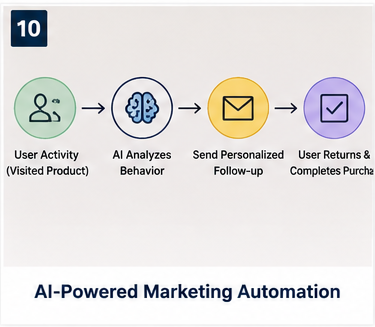
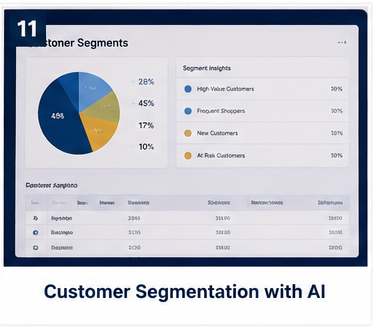
Top AI Automation Use Cases for eCommerce Businesses

Top AI Automation Use Cases for eCommerce Businesses That Drive Traffic, Leads, and Revenue

As the digital marketplace continues to evolve, running an eCommerce business has become more demanding than ever.

Getting visitors to a website is already difficult. But traffic alone does not pay the bills. The real challenge begins after a potential customer lands on your online store.

Will they find the right product?

How quickly can they get answers to their questions?

Will they trust your brand enough to make a purchase?

What makes customers return after their first order?

Additionally, for many eCommerce businesses, these questions reveal a major problem: too many important processes still depend on manual work, disconnected tools, and delayed decision-making.

A customer leaves without finding a product. A support ticket waits for hours. A marketing campaign reaches the wrong audience. Inventory runs low without warning. A potential buyer abandons their cart and never comes back.

These small problems can quietly cost an online business valuable traffic, leads, customers, and revenue.

This is where AI Automation for eCommerce is becoming increasingly valuable.

AI automation can help businesses create more relevant shopping experiences, reduce repetitive manual tasks, understand customer behavior, improve operations, and support customers at the right moment. The goal is not simply to add AI to a website because it is trending. The real opportunity is to use technology where it solves a genuine business problem.

Building these capabilities on a strong foundation often starts with professional eCommerce Development Services that support custom features, integrations, automation, and better customer experiences.

Additionally, according to DHL’s 2025 research, AI adoption is becoming increasingly common among eCommerce businesses, with companies using AI for personalization, content creation, and customer service.

In this guide, we will explore the top AI Automation Use Cases for eCommerce Businesses, how they can support growth, and where businesses can focus their investment for better customer experiences and stronger commercial results.

To understand the broader impact of AI on online business, you can also explore our guide on AI automation for eCommerce digital growth.


Why AI Automation Has Become Important for eCommerce Businesses

Imagine two online stores selling similar products at similar prices.

The first store provides the same experience to every visitor.

Every customer sees identical product suggestions. Questions are answered only during business hours. Marketing campaigns are sent to everyone. The team manually checks inventory, customer behavior, abandoned carts, and sales reports.

The second store understands what customers are looking for.

A visitor receives relevant product suggestions. Additionally, a customer can get quick answers before making a purchase The marketing system can respond to customer behavior. The business receives useful insights that help the team make better decisions.

Which business has a stronger opportunity to convert interest into revenue?

The answer is obvious.

Modern customers expect speed, relevance, and convenienceCustomers do not want to spend twenty minutes searching through hundreds of products. Waiting a day for a simple answer is equally frustrating. Irrelevant promotional emails filling their inbox only make the experience worse.

Research from Mastercard reported that 67% of global eCommerce brands consider personalization a top priority and plan to invest more in it.

AI automation gives businesses a practical way to respond to these expectations.

However, successful implementation requires more than installing a chatbot or using an AI content tool.

The best results come from identifying:

  • Where customers experience friction
  • Which manual processes consume the most time
  • Where leads are being lost
  • Which tasks create operational delays
  • What information the business needs to make better decisions
  • Which customer interactions have the greatest impact on conversions

That is where AI in eCommerce becomes a business strategy rather than just another technology investment.

1. AI-Powered Product Recommendations

One of the most valuable AI Automation Use Cases for eCommerce Businesses is personalized product recommendations.

Think about what happens when a customer visits a large online store.

They may have hundreds or thousands of products available. Without guidance, the customer can become overwhelmed and leave without making a purchase.

Want to improve product discovery and create a more personalized shopping journey? Explore professional Shopify Development Services that can help businesses integrate intelligent features and create better online shopping experiences.

AI-powered recommendation systems can analyze relevant information such as:

  • Browsing behavior
  • Previous purchases
  • Product interests
  • Similar customer behavior
  • Frequently viewed products
  • Related products
  • Purchase patterns

The purpose is simple: help customers discover products that are genuinely relevant to their interests.

How AI Product Recommendations Can Support Revenue

A customer looking at running shoes may also need:

  • Sports socks
  • Running apparel
  • Fitness accessories
  • Shoe care products

Instead of expecting the customer to search manually, an intelligent recommendation system can present relevant options during the shopping journey.

This creates opportunities for:

  • Higher average order value
  • Cross-selling
  • Upselling
  • Better product discovery
  • Improved customer experience
  • More repeat purchases

McKinsey has reported that companies that excel at personalization can generate significantly more revenue from those activities than average performers.

The Important Lesson

Product recommendations should not feel random or aggressive.

Customers can quickly lose trust when every page pushes unrelated products.

Effective AI Product Recommendations should answer one important question:

What would genuinely help this customer make a better buying decision?

That approach can turn recommendations from a simple sales feature into a useful part of the customer experience.

Want to improve product discovery and create a more personalized shopping journey? Explore professional eCommerce development solutions that can help integrate intelligent features into your online store.


2. AI Chatbots and Automated Customer Support

A customer is ready to buy a product.

But before completing the order, they have one question.

“Will this product arrive before Friday?”

They cannot find the answer easily.

They send a message.

Nobody responds.

A few minutes later, they leave the website.

The business may never know that a simple unanswered question resulted in a lost sale.

This is one reason AI Chatbots for eCommerce have become an important customer service tool.

AI-powered assistants can help customers with common questions such as:

  • Where is my order?
  • What are your return policies?
  • Is this product available?
  • Which product is suitable for me?
  • How long will delivery take?
  • Can I change my order?
  • What payment options are available?

The goal is not to replace every human interaction.

Some customer situations require a real person.

Instead, AI automation can handle routine questions and direct more complex conversations to the appropriate team member.

IBM identifies customer and order experiences among the important areas where AI is transforming B2B and B2C commerce.

Why This Can Improve Conversions

Customers often need information immediately before making a decision.

If your website can provide clear and useful answers at that moment, you reduce unnecessary friction.

However, trust matters.

A 2025 Clutch study found that consumers see value in AI tools when they help solve real problems, but poorly designed AI experiences can also create frustration.

That means businesses should focus on:

  • Accurate answers
  • Clear escalation to human support
  • Helpful product information
  • Fast responses
  • Honest communication
  • Easy navigation

A chatbot should feel helpful.

It should not trap customers in endless automated conversations.

3. AI Automation for Abandoned Cart Recovery

Cart abandonment is one of the most frustrating problems for online businesses.

A customer visits your website.

After finding a product, they add it to their cart.

They add it to their cart.

They may even begin the checkout process.

But then, they disappear.

Why?

There could be many reasons:

  • They were distracted
  • They wanted to compare prices
  • The checkout process was complicated
  • Delivery information was unclear
  • They were not ready to purchase
  • They experienced a technical issue
  • They simply forgot

DHL’s 2025 eCommerce research found that delivery options can have a major impact on purchase decisions, with missing preferred delivery options contributing to cart abandonment.

This is where AI Automation for eCommerce Marketing can help.

Instead of sending every abandoned cart customer the same message, businesses can create more relevant follow-up strategies based on behavior.

For example:

Customer A

Viewed one product and left quickly.

Customer B

Added three products to the cart.

Customer C

Reached the payment page but did not complete the purchase.

These customers may need different messages.

AI-supported automation can help businesses identify behavioral patterns and trigger relevant communication.

Possible Recovery Actions

  • Personalized email reminders
  • Relevant product suggestions
  • Back-in-stock notifications
  • Limited-time offers
  • Delivery information
  • Product reviews
  • Customer support assistance
  • Alternative product recommendations

The goal should not always be to offer a discount.

Sometimes the customer simply needs more information or reassurance.

A strong abandoned cart strategy can recover opportunities that would otherwise disappear without the business ever understanding why.

Are visitors reaching your store but leaving without buying? Review your customer journey, checkout process, and automation opportunities before spending more money on traffic.

4. AI-Powered Customer Personalization

Personalization is no longer limited to adding a customer’s first name to an email.

Modern eCommerce Personalization can involve understanding where customers are in their buying journey and providing more relevant experiences.

For example:

A first-time visitor may need:

  • Product education
  • Category recommendations
  • Customer reviews
  • Buying guides

A returning customer may need:

  • Related products
  • Reorder reminders
  • Personalized offers
  • New product updates

A high-value customer may expect:

  • Exclusive recommendations
  • Priority support
  • Early product access
  • Relevant loyalty benefits

AI can help businesses analyze patterns and organize customer information to support more relevant experiences.

Furthermore, Contentful’s 2025 review of eCommerce personalization research highlights how strongly retailers connect personalization with business outcomes such as average order value and customer loyalty.

Why Personalization Matters Emotionally

Customers want to feel understood.

They do not want to feel like another number in a database.

When a website helps a customer quickly find something relevant, the experience becomes easier and more comfortable.

That can improve:

  • Customer engagement
  • Product discovery
  • Repeat visits
  • Brand loyalty
  • Purchase confidence
  • Customer lifetime value

The important word is relevant.

More personalization is not automatically better.

Collecting unnecessary data or making recommendations that feel intrusive can damage trust.

Businesses should focus on delivering genuine value while respecting customer privacy.

5. AI Automation for eCommerce Marketing Campaigns

Marketing teams often spend a huge amount of time managing repetitive tasks.

They may manually:

  • Create audience segments
  • Schedule campaigns
  • Analyze results
  • Follow up with leads
  • Track customer behavior
  • Prepare reports
  • Identify inactive customers

This becomes more difficult as an eCommerce business grows.

AI Marketing Automation for eCommerce can help teams organize and respond to customer behavior more efficiently.

For example, automation workflows can support campaigns for:

Welcome Campaigns

New visitors or customers can receive helpful information about:

  • Your brand
  • Popular products
  • Key benefits
  • Buying guides
  • Customer support

Re-Engagement Campaigns

Customers who have not visited recently can receive relevant updates.

Post-Purchase Campaigns

Customers can receive:

  • Product care information
  • Usage guides
  • Related products
  • Review requests
  • Reorder reminders

Product Interest Campaigns

Visitors who show interest in a particular category may receive relevant content or product information.

Why This Can Generate Better Leads

Generic campaigns often fail because they treat every customer the same way.

Better automation helps businesses move toward more relevant communication.

Instead of asking:

“How many emails should we send?”

Businesses should ask:

“What information would help this customer take the next step?”

That mindset can improve both marketing quality and customer trust.


6. AI-Powered Search and Product Discovery

Many eCommerce businesses invest heavily in SEO and paid advertising to bring visitors to their website.

But what happens after visitors arrive?

If customers cannot find what they want, the traffic may produce very little revenue.

This is why AI-Powered Search for eCommerce is becoming increasingly important.

Traditional search often depends heavily on exact keywords.

But customers do not always search that way.

A visitor might search:

  • “Shoes for long-distance running”
  • “Gift for a person who loves coffee”
  • “Affordable laptop for graphic design”
  • “Black dress for a wedding”

AI-supported search can help businesses better understand customer intent and connect searches with relevant products.

According to Clutch research published in 2025, AI-powered search assistants were among the AI tools consumers found useful for eCommerce experiences.

Benefits of Better Product Search

  • Faster product discovery
  • Fewer irrelevant search results
  • Better customer experience
  • More engagement
  • Higher purchase opportunities
  • Reduced frustration

A good search experience can feel almost like having a knowledgeable sales assistant inside your website.

The customer asks what they need.

Your store helps them find it.

That can be a powerful conversion advantage.

7. AI Automation for Inventory Management

Imagine running a successful marketing campaign.

Traffic increases.

Orders begin coming in.

Then customers discover that your most popular product is out of stock.

Or imagine the opposite situation.

Your warehouse is full of products that are not selling.

Both problems can affect profitability.

AI Inventory Management for eCommerce can help businesses analyze sales patterns and support better inventory decisions.

Potential applications include:

  • Demand forecasting
  • Low-stock alerts
  • Product performance analysis
  • Seasonal demand insights
  • Inventory planning
  • Reorder recommendations

The purpose is to help businesses move from reactive decisions to more informed planning.

Why Inventory Problems Hurt Customer Trust

When customers repeatedly see:

Out of Stock

they may not return.

If an item is unavailable, customers may immediately purchase from a competitor.

Inventory management is not just an operational issue.

It directly affects the customer experience and revenue opportunity.

AI can help businesses connect operational data with real customer demand.

However, accurate inventory automation depends on accurate data.

Poor product information or disconnected systems can create unreliable recommendations.

This is why businesses should review their existing data and technology before implementing advanced automation.


8. AI for Sales Forecasting and Business Decisions

Many business decisions are still based on assumptions.

A team may ask:

  • Which product will sell best next month?
  • Which customers are likely to purchase again?
  • Which marketing campaign deserves more investment?
  • Which category is losing demand?
  • When should we reorder inventory?

Without useful data, these decisions can become expensive guesses.

AI Data Analytics for eCommerce can help identify patterns across large amounts of information.

Businesses may analyze:

  • Sales history
  • Customer behavior
  • Product demand
  • Seasonal patterns
  • Marketing performance
  • Website engagement
  • Purchase frequency

The value is not simply having more dashboards.

Most businesses already have plenty of data.

The real challenge is understanding what that data means.

Example

Your analytics report may show:

Product sales increased by 20%.

That sounds positive.

But why did they increase?

Was it because of:

  • Organic traffic?
  • Paid advertising?
  • Email marketing?
  • Seasonal demand?
  • A new product launch?
  • Repeat customers?

AI-supported analysis can help teams identify meaningful patterns and investigate where attention is needed.

Better information can lead to:

  • Smarter marketing decisions
  • Better inventory planning
  • Improved product strategies
  • More efficient budgets
  • Stronger customer retention

Looking for an eCommerce website that supports better data, automation, and customer experiences? A strong technology foundation should come before adding multiple disconnected AI tools.

Enterprise businesses with complex operations and high-volume sales may also require advanced solutions from a professional Shopify Plus Agency to support integrations, automation, and customized eCommerce experiences.

9. AI Automation for Dynamic Pricing and Promotions

Pricing decisions can have a direct impact on conversion and profitability.

Price a product too high, and customers may leave.

Price it too low, and profit margins may suffer.

AI-supported systems can help businesses analyze factors such as:

  • Product demand
  • Customer behavior
  • Inventory levels
  • Seasonal trends
  • Promotional performance
  • Market conditions

This can help teams make more informed pricing decisions.

Important: Automation Needs Human Oversight

Dynamic pricing should not operate without clear business rules.

A poorly configured system could:

  • Create confusing price changes
  • Damage customer trust
  • Reduce margins
  • Cause compliance issues
  • Create inconsistent experiences

The best approach combines intelligent analysis with human business control.

AI can process information quickly.

Business teams still need to decide what is appropriate for their customers and brand.


10. AI Automation for Fraud Detection and Payment Security

Trust is one of the most important factors in eCommerce.

A customer may love your products.

Your website may look professional.

Your marketing may be excellent.

But if customers do not trust your checkout process, they may never complete their purchase.

AI can help businesses identify unusual patterns and potential risks related to transactions and customer activity.

Potential areas include:

  • Suspicious transactions
  • Unusual purchasing behavior
  • Account activity
  • Payment risks
  • Fraud patterns

IBM identifies payments and security as one of the important areas where AI can support modern commerce experiences.

Why Security Supports Revenue

Security is not only about preventing losses.

It can also support:

  • Customer confidence
  • Brand reputation
  • Repeat purchases
  • Safer transactions
  • Long-term customer relationships

However, businesses should never make unrealistic security promises.

AI is one layer of protection.

Strong security also requires:

  • Secure development practices
  • Reliable payment systems
  • Data protection
  • Regular monitoring
  • Access controls
  • Human review

Building a secure online store requires the right technical foundation, reliable integrations, and secure development practices. Professional eCommerce Development Services can help businesses create eCommerce solutions with stronger website architecture and customer experiences.

Trust is built through consistent actions, not marketing claims.


11. AI-Powered Content and Product Information Automation

Large eCommerce stores often manage hundreds or thousands of products.

Each product may require:

  • Titles
  • Descriptions
  • Specifications
  • Categories
  • Tags
  • SEO information
  • FAQs
  • Product attributes

Managing all of this manually can be time-consuming.

AI Content Automation for eCommerce can help teams speed up repetitive content tasks.

However, there is an important warning.

Automatically generated content should not be published without review.

Poor-quality product content can create:

  • Incorrect information
  • Duplicate content
  • Generic descriptions
  • Customer confusion
  • Weak brand messaging
  • SEO problems

AI can help teams prepare and organize content.

But human review remains essential.

A Better Workflow

AI Assistance → Human Review → Brand Editing → Accuracy Check → SEO Optimization → Publishing

This approach can help businesses save time without sacrificing quality.

The best product content should answer real customer questions.

Instead of simply writing:

“High-quality premium product.”

Explain:

  • What problem does it solve?
  • Who is it for?
  • What makes it useful?
  • What are the specifications?
  • How should it be used?
  • What should customers know before buying?

That type of content can support both SEO and conversions.

12. AI Automation for Customer Retention

Getting a new customer is only one part of eCommerce growth.

A more important question is:

What happens after the first purchase?

Does the customer disappear?

Or do they return?

AI automation can help businesses identify opportunities for customer retention.

For example:

Reorder Predictions

Customers who regularly purchase the same product may receive a reminder at an appropriate time.

Personalized Recommendations

Previous purchases can help identify relevant products.

Customer Win-Back Campaigns

Inactive customers can receive relevant communication.

Loyalty Engagement

High-value customers can receive personalized experiences and offers.

Post-Purchase Support

Customers can receive useful product information after buying.

This is where automation can become more than a marketing tool.

It can support the entire customer relationship.

The Revenue Opportunity

A customer who trusts your brand and returns does not need to discover your business from the beginning again.

You already understand part of their journey.

The customer already understands your brand.

That relationship can become extremely valuable over time.


13. AI Automation for Order Processing and Operations

Behind every successful online order, there are many processes.

Depending on the business, these may include:

  • Order confirmation
  • Inventory updates
  • Payment verification
  • Warehouse communication
  • Shipping updates
  • Customer notifications
  • Return processing

Manual operations can create delays and errors.

AI and automation can help businesses connect workflows and reduce repetitive tasks. Professional eCommerce Development Services can help businesses build and integrate the technology needed to support smoother order processing and connected workflows.

Businesses with complex product catalogs, inventory systems, and operational workflows may also benefit from Magento Development Services for building customized eCommerce solution

Example

When an order is placed:

  1. The order is confirmed.
  2. Inventory is updated.
  3. The warehouse receives information.
  4. The customer receives an update.
  5. Shipping information is added.
  6. Post-purchase communication begins.

Automation can help these processes move more efficiently.

This does not mean every business needs a complex AI system.

Sometimes simple workflow automation can solve the biggest problem.

Businesses should start with the areas where manual work is:

  • Repetitive
  • Time-consuming
  • Error-prone
  • High-volume

That is often where automation provides the clearest business value.


14. AI Automation for SEO and Content Opportunities

AI can support SEO teams, but a successful strategy still requires technical expertise, quality content, and a strong understanding of customer search intent. Professional SEO Services can help businesses improve these areas strategically.

Search engines remain an important source of traffic for many eCommerce businesses.

But SEO requires consistent work.

Businesses need to understand:

  • What customers are searching for
  • Which pages need improvement
  • Where technical problems exist
  • Which products need better content
  • Which topics can attract relevant visitors

AI can support SEO teams with:

  • Content research
  • Keyword analysis
  • Topic organization
  • Content improvement
  • Product information
  • Internal linking opportunities
  • Customer question analysis

But AI should not replace SEO strategy.

Publishing hundreds of generic pages will not automatically create meaningful traffic.

The goal should be to create useful pages that answer genuine search intent.

Informational Search Intent

Examples:

  • How to choose the right product
  • Product comparison guides
  • Buying guides
  • How-to content
  • Product education

Commercial Search Intent

Examples:

  • Best products for a specific need
  • Product comparisons
  • Service comparisons
  • Solution pages
  • Development services

A strong eCommerce content strategy should connect these two journeys.

First, help the customer.

Then, make the next step clear.

Need help building an SEO-friendly eCommerce website with strong technical foundations and conversion-focused customer journeys? Professional eCommerce development can help bring technology, performance, SEO, and user experience together.

15. AI Automation for Better Customer Journey Analysis

Customers rarely follow a perfect path.

They may:

  • Discover your brand on Google
  • Visit your website
  • Leave
  • Return through social media
  • Read reviews
  • Subscribe to your newsletter
  • Compare products
  • Purchase later

Understanding this journey can be difficult.

AI can help businesses analyze patterns across different customer interactions.

This can help answer questions such as:

  • Where are customers leaving?
  • Which pages create interest?
  • Which products are frequently compared?
  • What questions appear before purchase?
  • Which marketing channels attract better leads?
  • Where does the buying journey become difficult?

Why This Matters

Businesses often spend more money trying to generate additional traffic.

But sometimes the fastest opportunity is improving what already exists.

If 10,000 visitors arrive every month but customers struggle to:

  • Find products
  • Understand pricing
  • Get answers
  • Complete checkout

then increasing traffic alone may not solve the problem.

AI automation can help identify friction.

Your team can then focus on fixing it.

That is a much smarter approach to growth.

How AI Automation Can Work Like a Digital Sales Assistant

AI automation should not be viewed as a magic solution.

It cannot fix:

  • Poor products
  • Weak customer service
  • Slow websites
  • Confusing navigation
  • Broken checkout processes
  • Bad pricing
  • Inaccurate data

But when implemented correctly, AI automation can support your sales process throughout the customer journey, especially when supported by a strong eCommerce development strategy and the right technology foundation.

Attract

AI can support content, SEO research, audience understanding, and marketing.

Engage

AI can help personalize website experiences and answer customer questions.

Guide

AI-powered search and recommendations can help customers discover relevant products. Professional Shopify Development Services can also help businesses create better product discovery and shopping experiences.

Convert

Automation can reduce friction and support customers during their decision-making process.

Retain

AI can support post-purchase communication, recommendations, and customer engagement.

This is why businesses increasingly view AI Automation for eCommerce as part of their broader digital growth strategy.

The strongest approach is not:

“Where can we add AI?”

The stronger question is:

“Where are we losing customers, wasting time, or missing revenue opportunities?”

Then use automation to solve that problem.

AI Automation Statistics eCommerce Businesses Should Know

Here are several important statistics and trust signals that show why AI and personalization are receiving increased attention in eCommerce:

67% of Global eCommerce Brands

Mastercard reported that 67% of global eCommerce brands consider personalization a top priority and plan to invest more in it.

Nearly Half of Businesses Integrating AI

DHL’s 2025 business research found that almost half of surveyed eCommerce businesses were integrating AI into operations, with B2B usage reported even higher.

AI Tools Are Becoming Part of Shopping Experiences

A 2025 Clutch study found that 81% of consumers found one or more AI tools for eCommerce helpful, particularly when they provided useful answers and simplified tasks.

Personalization Can Have a Major Commercial Impact

McKinsey reported that companies excelling at personalization can generate 40% more revenue from those activities than average players.

AI Shopping Tools Are Increasingly Expected

DHL’s 2025 consumer research reported that 7 in 10 shoppers want AI-driven shopping tools to help guide their decisions.

These numbers do not mean every AI tool will generate instant results.

They do show something important:

Customers and businesses are changing how they shop, sell, search, and interact online.

The businesses that understand where automation genuinely improves the experience may have stronger opportunities to attract, convert, and retain customers.

How to Choose the Right AI Automation Solution for Your eCommerce Business

Do not begin by purchasing the most expensive AI platform.

Start with your problems.

Ask your team:

Where Do We Lose the Most Customers?

Look at:

  • Product pages
  • Website search
  • Cart abandonment
  • Checkout
  • Customer support

Which Tasks Take Too Much Time?

Identify repetitive work such as:

  • Customer questions
  • Order updates
  • Product information
  • Reporting
  • Marketing follow-ups

What Data Do We Already Have?

Review:

  • Customer information
  • Sales data
  • Product data
  • Inventory information
  • Website analytics

What Result Do We Want?

Be specific.

For example:

  • Improve product discovery
  • Reduce support response time
  • Increase repeat purchases
  • Improve inventory planning
  • Recover abandoned carts

Clear goals make it easier to measure whether an AI solution is actually working.

Common AI Automation Mistakes eCommerce Businesses Should Avoid

1. Adding AI Without a Business Goal

Do not add technology simply because competitors are talking about it.

Every implementation should solve a meaningful problem.


2. Ignoring Customer Trust

Customers should understand when they are interacting with automated systems where appropriate.

Trust can be damaged by:

  • Incorrect answers
  • Hidden automation
  • Poor data practices
  • Overly aggressive personalization

3. Automating a Broken Process

Automation does not automatically improve a poor workflow.

First understand the process.

Then improve it.

Then automate where appropriate.


4. Using AI Without Human Review

AI-generated information can be inaccurate.

This is especially important for:

  • Product information
  • Pricing
  • Customer support
  • Legal information
  • Security decisions

Human oversight remains important.


5. Measuring Activity Instead of Results

Do not celebrate AI implementation just because a tool is live.

Measure outcomes such as:

  • Conversion rate
  • Customer satisfaction
  • Average order value
  • Repeat purchases
  • Support resolution time
  • Revenue
  • Cost savings

Business results matter more than technology buzz.

Build an AI-Ready eCommerce Website Before Adding More Tools

There is another important point many businesses overlook.

Your AI tools are only as useful as your existing eCommerce foundation.

If your website has:

  • Slow loading times
  • Poor mobile usability
  • Disconnected systems
  • Weak product data
  • Confusing navigation
  • Technical errors

then adding multiple AI tools may create more complexity.

A strong eCommerce Development Strategy supported by professional eCommerce Development Services should consider:

  • Website performance
  • User experience
  • Mobile responsiveness
  • Platform architecture
  • Product management
  • Integrations
  • Security
  • SEO
  • Automation readiness

AI automation works best when it connects with a well-planned digital ecosystem

FAQ Section for SEO

Frequently Asked Questions About AI Automation in eCommerce

1. What is AI automation in eCommerce?

AI automation in eCommerce uses artificial intelligence and automated technology to support tasks such as product recommendations, customer service, marketing, inventory management, data analysis, and customer personalization. It helps businesses reduce repetitive work and create more relevant customer experiences.

2. How can AI automation help eCommerce businesses?

AI automation can help eCommerce businesses improve customer support, personalize shopping experiences, automate marketing activities, improve product discovery, support inventory planning, and analyze customer behavior. When implemented correctly, it can also help identify opportunities to improve conversions and customer retention.

3. What are the most common AI automation use cases for eCommerce?

Common AI automation use cases include AI-powered product recommendations, chatbots, personalized marketing, abandoned cart recovery, inventory management, product search, sales forecasting, fraud detection, content automation, and customer journey analysis.

4. Can AI automation improve eCommerce sales?

AI automation can support sales by helping businesses improve product discovery, personalize customer experiences, respond to customer questions faster, recover abandoned carts, and provide more relevant marketing communication. Results depend on the business strategy, website experience, data quality, and how automation is implemented.

5. How does AI help with eCommerce customer service?

AI-powered chatbots and automated support tools can help answer common customer questions, provide order updates, assist with product information, and offer support outside normal business hours. Complex questions can still be transferred to human support teams.

6. Is AI automation suitable for small eCommerce businesses?

Yes. Small eCommerce businesses can begin with simple automation such as chat support, marketing workflows, product recommendations, and customer follow-ups. Businesses should start with a clear problem instead of implementing multiple tools at once.

7. What should businesses consider before implementing AI automation?

Before implementing AI automation, businesses should review their website, customer journey, existing technology, data quality, business goals, integrations, and security requirements. Starting with a clear problem makes it easier to select the right solution.

Ready to Turn Your eCommerce Website Into a Better Lead and Revenue Channel?

Your website should do more than display products.

It should help your business:

  • Attract relevant traffic
  • Answer customer questions
  • Guide product discovery
  • Capture leads
  • Support buying decisions
  • Reduce unnecessary manual work
  • Encourage repeat purchases

The right combination of eCommerce Development Services, automation, SEO, and customer experience can help create a stronger digital foundation for long-term business growth.

If your business is exploring AI automation, personalization, advanced integrations, or improvements to your eCommerce customer journey, start by identifying where your current website is losing opportunities.

A professional eCommerce strategy can help you connect technology decisions with real business goals.

👉 Looking to improve your online store? Contact our experienced eCommerce development team to discuss your website requirements, automation opportunities, integrations, and conversion challenges.

Final Thoughts: AI Automation Should Solve Real eCommerce Problems

The future of eCommerce will not be won simply by businesses that use the most AI tools.

It will be shaped by businesses that understand their customers and remove unnecessary friction from the buying journey.

The most valuable AI Automation Use Cases for eCommerce Businesses include:

  1. AI-Powered Product Recommendations
  2. AI Chatbots and Customer Support
  3. Abandoned Cart Automation
  4. Customer Personalization
  5. AI Marketing Automation
  6. AI-Powered Product Search
  7. Inventory Management
  8. Sales Forecasting
  9. Dynamic Pricing Support
  10. Fraud Detection
  11. Content and Product Information Automation
  12. Customer Retention
  13. Order Processing Automation
  14. SEO and Content Opportunities
  15. Customer Journey Analysis

The opportunity is significant, but businesses should avoid treating AI as a shortcut.

Start with a real problem.

Understand your customers.

Use reliable data.

Keep humans involved where judgment matters.

Measure commercial results.

Most importantly, build technology around the customer experience.

Because at the end of the day, the purpose of AI Automation in eCommerce is not to make a business look more advanced.

It is to help businesses serve customers better, create more efficient operations, generate stronger leads, improve conversions, and build lasting customer relationships.

Want to understand how AI automation is changing the future of online business? Read our complete guide on how AI automation is helping eCommerce businesses drive digital growth and discover how intelligent technology can support your next stage of digital success.

AI-Powered Personalization in E-commerce: How AI Is Creating Smarter Shopping Experiences

Imagine a customer visits an online store looking for running shoes.

Instead of seeing the same products displayed to every visitor, the store immediately understands that this shopper previously viewed lightweight shoes, prefers a particular price range, and regularly purchases fitness products.

The homepage changes.

The product recommendations change.

The search results become more relevant.

Even the promotional message can change according to the shopper’s interests.

That is the difference between a traditional online store and an AI-powered personalized e-commerce experience.

Today, customers have thousands of products and hundreds of online stores to choose from. If they cannot quickly find something relevant, they can leave with a single click. For e-commerce businesses, this creates a serious challenge: attracting visitors is no longer enough. Businesses need to understand what each shopper wants and make the buying journey easier.

This is where AI-powered personalization in e-commerce becomes commercially valuable.

AI can analyze browsing behavior, previous purchases, product searches, cart activity, customer preferences, and other signals to deliver more relevant experiences. When implemented correctly, personalization can help businesses improve engagement, increase conversions, encourage repeat purchases, and generate more revenue from existing traffic.

Why E-commerce Personalization Has Become a Revenue Priority

The biggest problem facing many online stores is not always a lack of traffic.

It is irrelevant traffic and poor customer experiences.

A visitor may arrive through Google, an advertisement, social media, or an AI assistant. But if the website shows the same products, offers, and content to everyone, the customer still has to do all the work.

That creates friction.

A customer may think:

  • “Which product is right for me?”
  • “Is there a better option?”
  • “Why am I seeing products I don’t need?”
  • “Does this store understand what I’m looking for?”
  • “Should I compare this with another website?”

Every unanswered question increases the possibility of losing the sale.

Personalization addresses this problem by making the shopping experience more relevant to the individual.

Adobe research has found that 76% of consumers are more likely to consider purchasing from brands that personalize the customer experience. The same research identifies relevant recommendations, tailored messaging, targeted promotions, and behavior-based communication as important personalized experiences.

For an e-commerce business, that matters because personalization is not simply about making a website look smarter.

It is about removing obstacles between customer intent and purchase.

What Is AI-Powered Personalization in E-commerce?

AI-powered personalization uses artificial intelligence and customer data to adapt an online shopping experience according to individual shopper behavior and preferences.

Traditional personalization might use simple rules.

For example:

“If a customer buys men’s shoes, show men’s socks.”

AI-powered personalization can go much further.

It can identify patterns across thousands or millions of interactions and use those patterns to predict what a particular customer may want next.

An AI system can consider signals such as:

  • Products viewed
  • Search queries
  • Previous purchases
  • Cart activity
  • Purchase frequency
  • Product categories visited
  • Price preferences
  • Location
  • Device behavior
  • Customer lifecycle stage
  • Engagement with emails
  • Products frequently purchased together

The result is a shopping experience that can adapt as the customer interacts with the website.

Someone visiting for the first time may receive popular recommendations.

A returning customer may see products related to previous purchases.

A high-intent shopper may receive comparisons or complementary products.

A loyal customer may see personalized offers based on their buying history.

This is why e-commerce AI solutions are becoming increasingly important for businesses that want to turn customer data into practical buying experiences.

The Real Business Problem: Customers Do Not Want to Search Forever

Think about a physical retail store.

If a customer walks in and says, “I need a laptop for video editing under $1,500,” a good salesperson does not point toward an enormous warehouse and say, “Everything is over there.”

Ask relevant questions.

Narrow down the choices.

Explain the key differences.

They recommend suitable products.

Help the customer make an informed decision.

Online stores need to provide a similar experience digitally.

The difference is that an AI system can help perform this process across thousands of customers simultaneously.

That makes AI e-commerce personalization particularly valuable for large product catalogs.

Instead of forcing every shopper to navigate hundreds of categories and product pages, intelligent systems can help surface the products most relevant to that individual.

And when customers find relevant products faster, the path toward conversion becomes much shorter.

10 Ways AI Personalization Can Increase E-commerce Revenue

1. Personalized Product Recommendations

Product recommendations are one of the most visible applications of AI personalization.

Instead of displaying random or universally popular products, AI can recommend products based on individual behavior and relationships between products.

For example:

A customer purchases a camera.

The system may recommend:

  • Compatible lenses
  • Memory cards
  • Camera bags
  • Tripods
  • Extra batteries

The recommendation is not simply an advertisement.

It is connected to the customer’s purchase intent.

Adobe has reported that approximately 30% of e-commerce revenue can come through product recommendation paths, highlighting why personalized product discovery deserves serious attention from online retailers.

For businesses, this can create opportunities to increase:

Average Order Value (AOV)

and

Revenue per Customer.

Want better product discovery on your store?

A professionally developed recommendation experience can connect customer behavior with relevant products without making the website feel complicated.

CTA: If your store has a large catalog and customers struggle to find the right products, consider an AI-powered e-commerce development solution designed around your customer journey.

2. Smarter E-commerce Search

Search is one of the most important moments in an online shopping journey.

A customer who searches for:

“black running shoes for women under $100”

does not necessarily want pages of products containing those exact words.

They want products that match the meaning behind the search.

AI can help interpret natural-language searches, customer preferences, previous behavior, and product attributes to provide more relevant results.

This can reduce the frustration caused by irrelevant search results.

Adobe has reported that users of its AI-powered Live Search saw a 15% lift in conversion rates, while its product recommendation technology has been associated with a 25% increase in average order value for Adobe Commerce users.

That makes intelligent search more than a convenience feature.

It can become a conversion tool eCommerce website development

3. Personalized Offers That Encourage Purchases

Not every customer responds to the same offer.

A first-time visitor may respond to free shipping.

A repeat customer may be more interested in loyalty rewards.

A price-sensitive shopper may respond to a discount.

Another customer may not need a discount at all.

AI can help identify these differences and support more relevant offers.

Adobe research found that 61% of consumers surveyed said personalized promotions make them more likely to purchase, while 67% said they wanted personalized promotions or offers based on their spending habits.

The commercial opportunity is clear:

Instead of discounting products for everyone, businesses can make promotions more relevant to specific customer groups.

That can help protect margins while improving the likelihood of conversion.


4. Reduce Cart Abandonment With Behavioral Personalization

A customer adds a product to the cart.

Then they leave.

For an e-commerce business, this is one of the most frustrating moments in the sales funnel.

The customer showed buying intent, but something interrupted the purchase.

AI can analyze behavioral patterns and help businesses understand when shoppers are at risk of abandoning their carts.

Personalized follow-ups can then be used through channels such as:

  • Email
  • SMS
  • Push notifications
  • On-site messages
  • Personalized recommendations

The message can also be more relevant.

Instead of:

“You left something in your cart.”

A personalized experience could remind the shopper about the exact product, relevant benefits, availability, or complementary products.

The objective is not to repeatedly chase customers.

It is to remove the reason they hesitated.

5. Personalized Experiences for Returning Customers

Getting the first purchase is only part of the e-commerce journey.

The bigger opportunity can come from encouraging customers to return.

AI can help businesses recognize returning shoppers and personalize the experience according to their previous interactions.

For example, an online beauty store may recognize that a customer frequently purchases skincare products.

When that customer returns, the website can prioritize:

  • Recently purchased products
  • Replenishment reminders
  • Compatible products
  • New products within the same category
  • Relevant promotions

This creates a sense that the store remembers the customer.

And that feeling matters.

Adobe’s research shows that consumers increasingly expect brands to anticipate their needs with relevant information or offers. In Adobe’s 2025 retail research, 69% of consumers said anticipating their needs with relevant offers or information at the right moment was important, while only 35% felt brands were delivering effectively.

That gap represents an opportunity for e-commerce businesses willing to improve personalization.

6. AI Can Turn Customer Data Into Buying Signals

Most e-commerce businesses already have enormous amounts of customer data.

The problem is knowing what to do with it.

A store may have information about:

  • Thousands of purchases
  • Millions of product views
  • Search activity
  • Customer reviews
  • Cart events
  • Email interactions
  • Repeat purchases
  • Product returns

Without intelligent analysis, much of that information remains underused.

AI can identify patterns that are difficult to detect manually.

For example:

Customers who purchase Product A may frequently purchase Product B within 30 days.

Repeated views of Product C can indicate strong purchase intent, especially when customers receive additional product information.

Customers who purchase a particular product may need a replacement after a certain period.

These insights can support more intelligent marketing and merchandising decisions.

The result is a move from guessing what customers want toward using behavioral evidence to make better decisions.

7. Personalized Content Can Improve Customer Engagement

Personalization is not limited to products.

It can also apply to content.

An e-commerce website can personalize:

  • Homepage content
  • Product descriptions
  • Promotional messages
  • Email campaigns
  • Recommendations
  • Educational content
  • Product comparisons
  • Loyalty messages

For example, a customer interested in premium products may see content emphasizing quality and long-term value.

A price-conscious customer may see savings, bundles, or value-focused messaging.

The product can remain the same.

The message changes according to customer intent.

This is where AI-powered content and personalization can work together.


8. AI Can Help Create Better Cross-Selling and Upselling

Cross-selling is about recommending complementary products.

Upselling encourages customers to consider a higher-value option.

The challenge is relevance.

If a customer buys a laptop and immediately sees unrelated kitchen products, the recommendation feels random.

But if the customer sees:

  • Laptop accessories
  • A larger storage option
  • A compatible monitor
  • A laptop bag
  • Extended warranty

the recommendation makes sense.

AI can analyze relationships between products and customer behavior to determine which recommendations are more relevant.

The objective should not be:

“How many products can we show?”

It should be:

“Which additional product genuinely makes this purchase more useful?”

That distinction creates a better customer experience and a stronger commercial opportunity.

9. AI-Powered Personalization Can Improve Customer Experience Across Channels

Customers rarely interact with a brand through only one channel.

They may discover a product through Google, research it on a website, see an advertisement on social media, receive an email, and eventually purchase through a mobile device.

If every interaction feels disconnected, the customer experience becomes frustrating.

Adobe’s 2025 retail research found that 75% of consumers considered a consistent experience across websites, mobile apps, email, social media, and physical stores important, but only 41% said brands were delivering effectively.

AI can help connect customer signals across these touchpoints.

A shopper who viewed a product on one device may later receive relevant recommendations.

A customer who already purchased an item should not continue receiving aggressive acquisition messages for the same product.

A returning shopper should see content that reflects their relationship with the brand.

This creates a more connected customer journey.


10. AI Can Help E-commerce Businesses Prepare for AI-Led Shopping

There is another important reason businesses should invest in personalization.

Customers themselves are starting to use AI during the buying journey.

Adobe reported in 2025 that generative AI traffic to U.S. retail websites increased 4,700% year over year in July 2025. Its research also found that 38% of surveyed consumers had used generative AI for online shopping, with 52% planning to do so that year.

More recent Adobe research shows the trend continuing: 86% of shoppers use AI during retail journeys, while integrated AI experiences such as “recommended for you” sections and image search are already used by 52% of shoppers surveyed.

This changes the way businesses should think about digital commerce.

The customer may no longer begin with:

“Which website should I visit?”

They may begin with:

“Which product is best for my needs?”

and ask an AI assistant to help them decide.

That means e-commerce businesses need strong product information, structured data, useful content, relevant recommendations, and technically sound websites that can support increasingly intelligent shopping experiences.

How AI Personalization Moves Customers Through the Sales Funnel

A strong personalization strategy can support every stage of the buying journey.

Awareness

AI helps businesses deliver more relevant content and product discovery experiences.

Consideration

Personalized recommendations, comparisons, reviews, and educational content help shoppers evaluate options.

Decision

Relevant offers, product information, availability, and personalized messaging can reduce hesitation.

Purchase

AI can recommend complementary products and improve the checkout journey.

Retention

Post-purchase recommendations and replenishment reminders can encourage repeat purchases.

Loyalty

Customer behavior can help businesses create more relevant loyalty experiences.

This is why AI e-commerce personalization should not be treated as a single website feature.

It should be considered part of the complete customer journey.

What Data Does AI Need for E-commerce Personalization?

AI personalization works best when businesses have useful customer and product data.

Common inputs include:

Behavioral data:
Pages viewed, searches, clicks, carts, and purchases.

Product data:
Categories, attributes, prices, availability, brands, and product relationships.

Customer data:
Purchase history, preferences, loyalty information, and customer segments.

Contextual data:
Device, location, time, referral source, and current browsing session.

Engagement data:
Email clicks, promotional interactions, reviews, and previous campaign activity.

The goal is not to collect every possible piece of information.

The goal is to use appropriate data responsibly to provide a better experience.

Privacy and Trust: The Part E-commerce Businesses Cannot Ignore

Personalization can increase relevance, but poor implementation can damage trust.

Customers want businesses to understand their needs without feeling that their privacy has been ignored.

Adobe’s 2025 retail research found that 87% of consumers considered responsible and secure handling of personal data important, while only 46% believed brands were delivering effectively on that expectation.

That means businesses need to think about:

  • Data security
  • Consent
  • Transparency
  • Responsible AI usage
  • Data minimization
  • Clear privacy policies
  • Appropriate personalization

Good personalization should feel helpful.

Bad personalization can feel intrusive.

The difference is trust.

Common E-commerce Personalization Mistakes

AI does not automatically create a better shopping experience.

Poor implementation can produce the opposite result.

Showing Too Many Recommendations

More recommendations do not necessarily mean more sales.

Customers need useful choices, not an endless product wall.

Using Old Customer Data

If recommendations are based on outdated behavior, customers may receive irrelevant products.

Personalizing Without a Strategy

Installing an AI tool without defining the business objective can create complexity without meaningful results.

Ignoring Product Data Quality

AI cannot produce consistently relevant recommendations when product information is incomplete, inconsistent, or poorly structured.

Forgetting Mobile Shoppers

A personalization strategy that works on desktop but creates friction on mobile can lose potential customers.

Treating AI as a Replacement for Customer Understanding

AI should support business decisions, not replace human judgment.

The strongest results come from combining technology with a clear understanding of customers and business goals.

How to Build an AI-Powered Personalized E-commerce Store

Businesses considering personalization should start with the customer journey rather than immediately choosing an AI tool.

Step 1: Identify the Revenue Problem

Determine where customers are leaving.

Is the problem:

  • Poor product discovery?
  • Low conversion?
  • Cart abandonment?
  • Low average order value?
  • Few repeat purchases?
  • Weak customer engagement?

Step 2: Analyze Available Data

Review customer, product, behavioral, and transaction data.

Step 3: Choose High-Value Personalization Opportunities

Start with areas where personalization can have a measurable commercial impact.

Examples include:

  • Product recommendations
  • Intelligent search
  • Personalized offers
  • Cross-selling
  • Email personalization
  • Replenishment reminders

Step 4: Integrate AI With the E-commerce Platform

The AI layer should work with the website, product catalog, customer data, analytics, eCommerce Development Services, CRM, and marketing systems.

Step 5: Test Customer Experiences

Do not assume a personalization strategy will work simply because it uses AI.

Test different recommendations, messages, layouts, and offers.

Step 6: Measure Business Results

Track metrics such as:

  • Conversion rate
  • Average order value
  • Revenue per visitor
  • Repeat purchase rate
  • Customer lifetime value
  • Cart abandonment
  • Engagement
  • Revenue from recommendations

This turns personalization from a technology project into a measurable business initiative.

AI Personalization Is Becoming a Competitive Advantage

The e-commerce businesses that understand personalization early can create an experience that feels significantly more helpful than a generic online store.

Customers do not want to spend 20 minutes searching through products that do not match their needs.

They want relevant options.

Expect brands to remember their preferences.

They want quick answers.

Value useful and relevant recommendations.

And increasingly, they expect digital experiences to understand context.

Adobe’s recent research shows that shoppers are already using AI as part of their buying journeys, with AI-driven shopping becoming increasingly integrated into product research and discovery.

For e-commerce businesses, the message is straightforward:

Personalization is no longer simply a “nice-to-have” website feature. It is becoming part of the way customers discover, evaluate, and purchase products online.

Why Businesses Should Invest in AI-Powered E-commerce Development

Buying an AI tool is easy.

Creating a personalized e-commerce experience that actually contributes to revenue is much harder.

The technology needs to work with the store’s architecture, product catalog, customer data, search functionality, analytics, marketing systems, and conversion strategy.

This is where choosing the right eCommerce Development Company can make a significant difference.

A professional development team can help businesses evaluate their existing e-commerce infrastructure, identify personalization opportunities, integrate AI capabilities, improve product discovery, and create a smoother buying journey.

Instead of adding AI simply because it is trending, businesses can focus on practical applications that support measurable commercial goals.

CTA: Planning to make your online store more intelligent and customer-focused? Explore ourContact an e-commerce development team to discuss how AI, personalization, intelligent search, and modern e-commerce technology can be integrated into your store.

The Future of E-commerce Is Personal

The next generation of online shopping will not be built around showing every customer the same storefront.

It will be built around relevance.

A shopper searching for a specific product should find the right options faster.

A returning customer should see products connected to their interests.

A customer ready to buy should receive information that removes hesitation.

And a loyal customer should receive experiences that recognize their relationship with the brand.

AI makes this level of personalization more achievable by turning customer behavior and product information into actionable recommendations.

But the technology itself is not the final objective.

The real objective is more useful shopping experiences, stronger customer relationships, better conversions, and more revenue.

For e-commerce businesses ready to move beyond generic shopping experiences, AI-powered personalization can become one of the most valuable components of a modern digital commerce strategy.

Ready to build a smarter e-commerce experience? Contact an experienced e-commerce development team and turn customer data into more relevant shopping journeys and stronger business results.

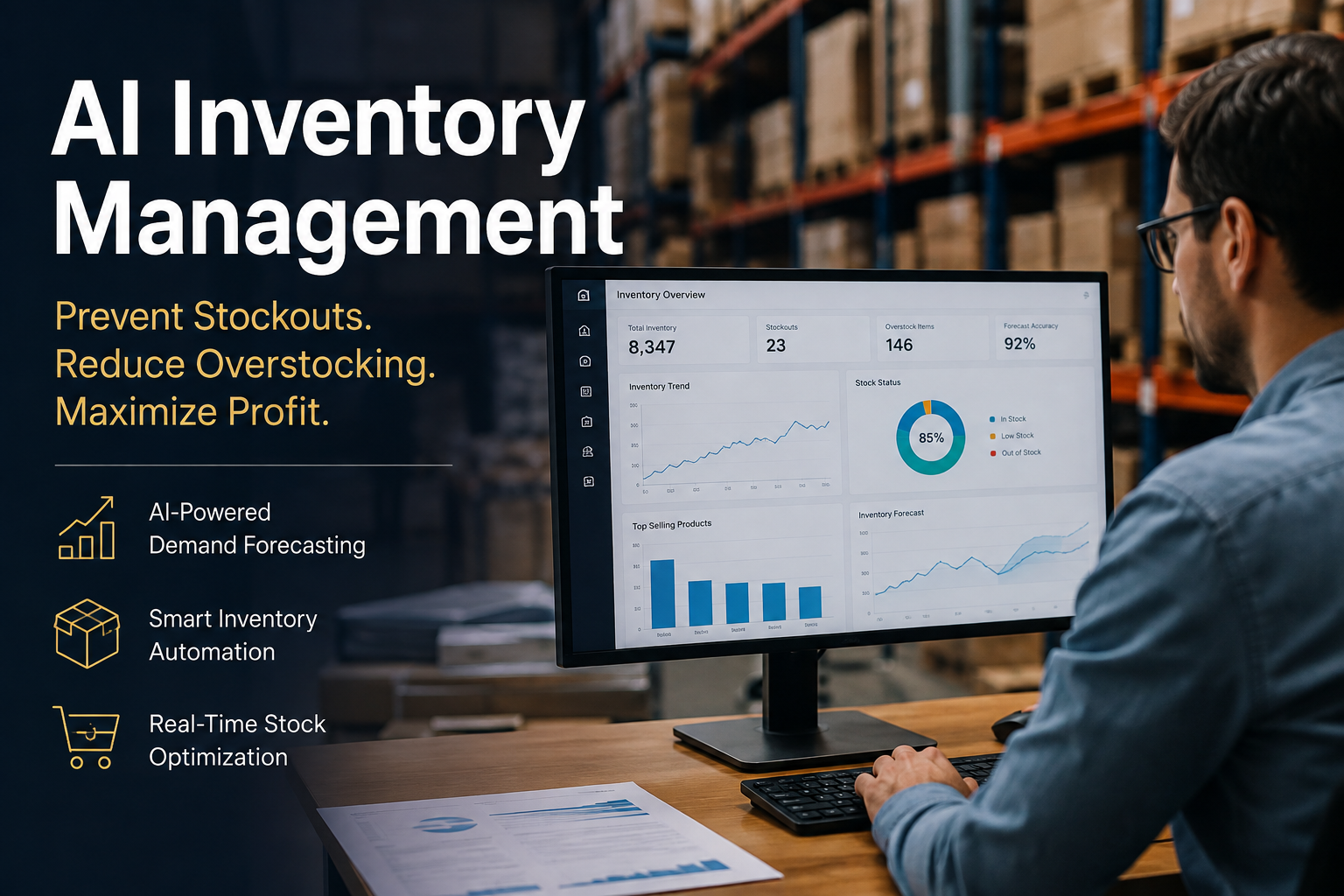
AI Inventory Management: How Automation Helps Prevent Stockouts and Overstocking

Imagine a customer finds your best-selling product, adds it to the cart, and then reaches checkout—only to see “Out of Stock.”

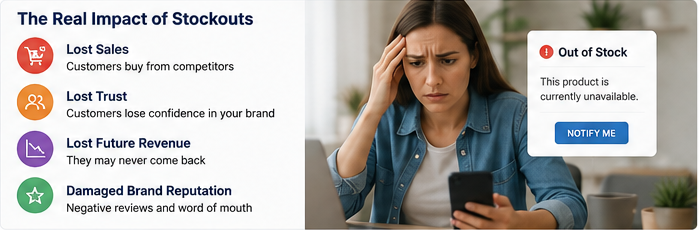
That single message can cost more than one order. The customer may move to a competitor, lose confidence in your store, and remember the poor experience the next time they shop.

Now consider the opposite problem.

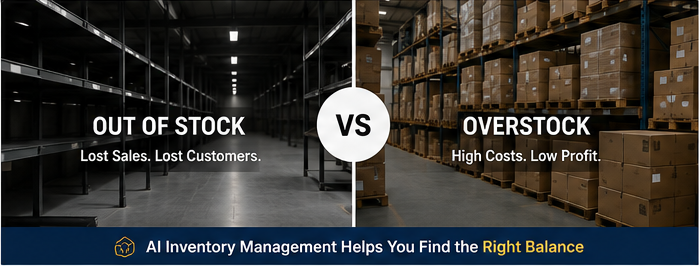
Your warehouse is full of products that looked like a good investment three months ago. Meanwhile, sales may slow down, storage costs can rise, and cash can remain tied up in inventory. Eventually, you may need to discount those products just to sell them..

This is the inventory problem modern e-commerce businesses are trying to solve.

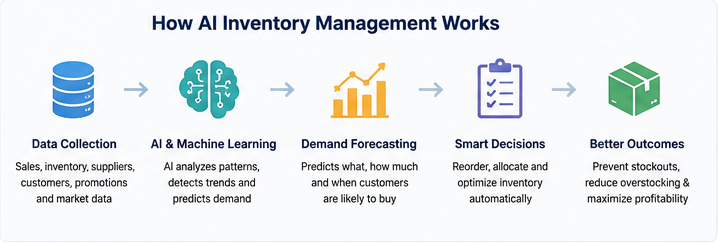
AI inventory management changes the approach from reacting to inventory problems to predicting demand and taking action before issues become costly. For example, AI demand forecasting can analyze historical sales, customer behavior, promotions, market conditions, and other signals to support better inventory decisions. As a result, businesses can make more informed stocking decisions and reduce the risk of stockouts and excess inventory.

AI automation in e-commerce is also helping businesses improve inventory planning, customer experiences, and day-to-day operations.

According to Shopify’s 2026 analysis, one cited research paper reported 19.4% lower safety stock and 28.6% fewer stockouts compared with traditional time-series forecasting.

For an e-commerce business, that can mean fewer lost orders, less money trapped in slow-moving products and better control over working capital.

Looking to build smarter inventory automation for your online store? A customized AI-powered e-commerce solution can connect forecasting, inventory data and automated replenishment into one workflow.

Why Inventory Problems Are Quietly Eating Into E-commerce Revenue

Inventory mistakes rarely appear on a profit-and-loss statement as one obvious line item.

They show up as:

  • Lost sales from stockouts
  • Excess warehouse costs
  • Emergency supplier orders
  • Discounting slow-moving products
  • Expired or obsolete stock
  • Poor cash flow
  • Delayed fulfillment
  • Unhappy customers
  • Missed seasonal demand
  • Manual work for operations teams

The difficult part is that these problems are connected.

Poor inventory forecasting can cause stockouts, excess inventory, and higher costs. AI inventory management helps businesses predict demand and keep the right products in the right place at the right time.

.

If demand is overestimated, you purchase too much.

Netstock’s inventory benchmark research also found that nearly 80% of surveyed SMBs faced insufficient planning and overstocking. In addition, 72% reported unpredictable supplier delivery times.

That is why inventory management is no longer simply a warehouse responsibility.

It is a revenue, customer experience and profitability issue.

What Is AI Inventory Management?

AI inventory management uses artificial intelligence, machine learning and automation to analyze inventory and demand data and help businesses decide:

  • What products are likely to sell
  • How much stock should be available
  • When inventory should be reordered
  • Which products may become overstocked
  • Which SKUs are at risk of going out of stock
  • Where inventory should be positioned
  • How seasonal demand may change
  • How promotions could affect demand

Traditional inventory systems often tell you what happened.

AI-powered inventory systems can help answer a more valuable question:

“What is likely to happen next, and what should we do about it?”

That difference is important for fast-moving e-commerce businesses.

Stockouts Don’t Just Lose One Sale

A stockout creates a frustrating moment for the customer.

They wanted the product. You had the traffic. You had the opportunity to convert.

But there was no inventory.

The customer now has three choices:

  1. Wait for your product to return.
  2. Search for an alternative.
  3. Buy from your competitor.

However, most businesses don’t know exactly how much future revenue they lose when customers choose a competitor.

As a result, stockouts can become a serious threat to e-commerce sales and customer retention.

For example, a 2025 research paper published in the Journal of Digital Economy highlighted how machine learning can improve retail stockout prediction by analyzing multiple factors instead of relying only on historical sales.

AI inventory forecasting helps identify warning signs before inventory reaches zero.

For example, the system could detect:

Sales velocity is increasing + supplier lead time is rising + a promotion is scheduled = higher stockout risk.

Instead of discovering the problem after the product disappears from your store, your team gets an opportunity to respond.

The commercial impact

Better stock availability can mean:

More products available → more purchase opportunities → fewer lost customers → stronger revenue potential.

That’s why AI inventory management for e-commerce should be viewed as a growth investment rather than simply an operational tool.

Overstocking Creates a Different Kind of Revenue Problem

Stockouts are visible.

Overstocking is often much quieter.

A product can remain in your warehouse for months without creating an obvious crisis.

But the money invested in that product is still locked away.

You may continue paying for:

  • Storage
  • Handling
  • Insurance
  • Warehouse space
  • Inventory management
  • Returns processing
  • Discount campaigns

Eventually, the product may need to be sold below the original expected margin.

Netstock’s 2024 benchmark found excess stock represented 38% of inventory for its surveyed SMBs, illustrating how significant the overstock problem can become when planning and inventory control are weak.

This is where AI demand forecasting becomes valuable.

Instead of asking:

“How much did we sell last month?”

AI can evaluate a wider set of signals to estimate future demand.

How AI Demand Forecasting Prevents Stockouts and Overstock

This is where the real difference between basic inventory software and intelligent automation becomes clear.

1. AI Studies Historical Sales

Historical sales provide the foundation.

AI can analyze:

  • Previous orders
  • SKU-level sales
  • Sales velocity
  • Seasonal patterns
  • Product lifecycle
  • Customer purchasing behavior
  • Repeat purchases

But historical data alone isn’t enough.

A product that sold 1,000 units last December does not automatically need 1,000 units this December.

Something may have changed.

That’s why modern AI-powered inventory forecasting combines historical data with additional signals.

2. AI Detects Seasonal Demand

E-commerce demand can change dramatically around:

  • Diwali
  • Black Friday
  • Christmas
  • New Year
  • Valentine’s Day
  • Back-to-school periods
  • Summer and winter seasons
  • Regional festivals
  • Major promotional events

A manual spreadsheet may show last year’s numbers.

AI can identify patterns and combine them with current demand signals.

For Indian e-commerce brands, this becomes particularly important because demand can vary significantly by region, festival and customer segment.

The goal isn’t simply to keep more inventory.

The goal is to keep the right inventory at the right time.

3. AI Monitors Sales Velocity

Suppose one product normally sells 20 units per day.

Suddenly it starts selling 45.

A traditional reorder rule may not react quickly enough.

An AI system can detect the change in sales velocity and reassess the expected demand.

This can trigger an alert such as:

High-demand SKU detected → inventory risk increasing → replenishment recommended.

That is the foundation of automated inventory replenishment.


4. AI Considers Supplier Lead Times

Inventory planning isn’t only about customer demand.

You also need to know how long it takes to receive new stock.

If a supplier normally takes seven days but recent deliveries are taking twelve, your reorder point needs to change.

AI can analyze historical supplier performance and incorporate lead-time variability into inventory planning.

This can help businesses avoid the dangerous assumption that:

“The supplier usually delivers on time.”

5. AI Identifies Slow-Moving Products

AI doesn’t only look for products that are about to sell out.

It can also identify products that are losing momentum.

For example:

Sales declining + inventory increasing + low customer interest = potential overstock risk.

That gives the business time to respond.

Possible actions include:

  • Creating a bundle
  • Running a targeted promotion
  • Adjusting pricing
  • Moving stock to another location
  • Reducing future purchase quantities
  • Promoting the product to a relevant customer segment

This is far better than discovering six months later that a warehouse is full of unsold inventory.

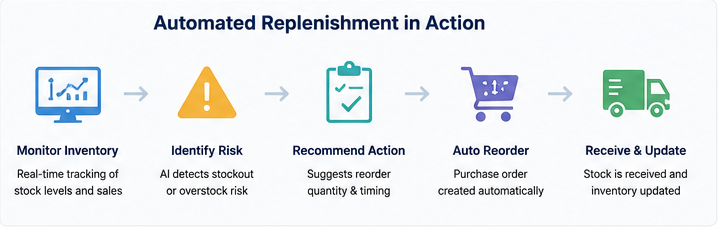
Automated Replenishment: From Prediction to Action

Forecasting tells you what may happen.

Automation helps you do something about it.

That’s an important distinction.

A sophisticated AI inventory management system can be designed to:

  1. Monitor inventory levels.
  2. Analyze demand.
  3. Identify stock risk.
  4. Calculate replenishment requirements.
  5. Consider supplier lead times.
  6. Recommend purchase quantities.
  7. Generate alerts or purchase workflows.
  8. Update inventory information across connected systems.

The exact level of automation depends on the business.

Some companies want AI to make recommendations.

Others want approved replenishment rules to execute automatically.

For larger e-commerce operations, this can dramatically reduce repetitive manual work.

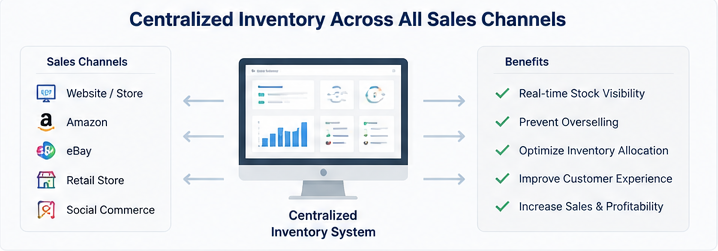
AI Inventory Management for Multi-Channel E-commerce

Inventory becomes much harder when you sell through multiple channels.

For example:

  • Your own e-commerce website
  • Amazon
  • Walmart
  • eBay
  • Social commerce
  • Physical stores
  • Marketplaces
  • Mobile applications

A product may appear available on one channel while another channel has already sold the remaining units.

That creates overselling, cancellation and fulfillment problems.

AI-powered inventory management can work alongside centralized inventory systems to improve visibility across channels. For Shopify-based businesses, Shopify Development Services can help integrate inventory management and automated workflows into the e-commerce ecosystem.

The objective is simple:

One reliable view of inventory instead of disconnected spreadsheets and systems.

For businesses operating on platforms such as Shopify Development Services, BigCommerce or custom e-commerce systems, inventory automation can also be integrated with existing commerce infrastructure.

If your current store struggles with fragmented inventory data, custom e-commerce development services can help connect your storefront, ERP, warehouse, marketplace and inventory workflows.

How AI Inventory Management Can Improve Profitability

Inventory optimization doesn’t generate revenue simply because you installed an AI tool.

The business value comes from better decisions.

Consider the chain:

Better demand prediction

↓

Better purchasing decisions

↓

Fewer stockouts

↓

More products available for customers

↓

Fewer lost sales

At the same time:

Better demand prediction

↓

Less unnecessary purchasing

↓

Less excess inventory

↓

Less discounting and storage pressure

↓

Healthier cash flow

That is why businesses should measure AI inventory management ROI using commercial KPIs—not just technical metrics.

Useful measurements include:

  • Stockout rate
  • Inventory turnover
  • Forecast accuracy
  • Days of inventory on hand
  • Excess inventory percentage
  • Carrying cost
  • Fill rate
  • Gross margin
  • Lost sales
  • Order fulfillment time
  • Working capital tied to inventory

What About Forecast Accuracy?

AI isn’t magic.

No forecasting model can predict every sudden event perfectly.

A viral product can explode overnight.

A supplier can suddenly shut down.

A new competitor can change market demand.

A trend can disappear.

That’s why businesses should not choose an AI inventory management solution simply because a vendor promises an impressive accuracy percentage.

Look at the complete system.

Ask:

  • What data does it use?
  • How frequently is the model updated?
  • Can it handle SKU-level forecasting?
  • Can it incorporate promotions?
  • Can it account for supplier lead times?
  • Can it work with multiple warehouses?
  • Can it integrate with your e-commerce platform?
  • Can humans review recommendations?
  • Does it provide useful alerts?
  • Can performance be measured against real business outcomes?

A strong solution should make your operations team more informed and faster, not remove human judgment completely.

AI Inventory Management vs Traditional Inventory Management

Traditional Inventory ManagementAI-Powered Inventory Management
Relies heavily on historical dataUses multiple demand signals
Manual forecastingPredictive forecasting
Fixed reorder rulesDynamic recommendations
Reactive stock monitoringPredictive risk detection
Manual purchase planningAutomated replenishment workflows
Limited demand visibilityReal-time demand analysis
Difficult to manage large SKU catalogsBetter suited to complex catalogs
Spreadsheet-heavy processesConnected, automated workflows

The biggest advantage isn’t that AI removes every manual task.

It is that it helps teams spend less time finding inventory problems and more time solving business problems.

How Businesses Can Start Using AI for Inventory

You don’t need to automate everything on day one.

A smarter approach is to identify the inventory problem that is costing the business the most.

Start with your highest-value SKUs

Find the products that generate the most revenue or experience the most stock issues.

Connect your data

Bring together:

  • Orders
  • Product data
  • Inventory
  • Supplier information
  • Returns
  • Promotions
  • Customer behavior
  • Warehouse data

Build forecasting

Start with demand prediction for important products.

Add inventory alerts

Identify products approaching critical stock levels or showing overstock risk.

Automate replenishment

Once the forecasting becomes reliable, introduce automated purchase recommendations or workflows.

Measure the business result

Compare stockouts, inventory costs, fulfillment performance and revenue before and after implementation.

This approach reduces unnecessary complexity and gives management a clearer view of AI inventory management ROI.

Why E-commerce Brands Are Moving Toward AI-Powered Inventory

The market is moving quickly.

Shopify reported in 2026 that 75% of store owners surveyed in 2025 were already using AI tools, while citing another 2025 study in which 91% of supply-chain leaders planned to adopt AI forecasting within two years.

Meanwhile, large retailers are already using AI for inventory prediction. Target’s Inventory Ledger, for example, makes billions of product-availability predictions each week, according to reporting cited by Shopify.

This matters for growing e-commerce companies because inventory intelligence is becoming part of the competitive advantage.

If two brands have similar products, pricing and marketing, the business that consistently has the right products available can have an important advantage.

The Real Business Question: How Much Is Poor Inventory Costing You?

Before investing in AI inventory automation, ask yourself:

How many sales did we lose due to stockouts last year?

How much cash is tied up in slow-moving inventory?

What amount of time does our team spend manually checking stock and creating purchase orders?

How often do inventory levels differ across our website, warehouse, and marketplaces?

What discount is needed to clear over-purchased products?

A real-world example is the Automotive Superstore project, where intelligent stock management was implemented alongside advanced search, filtering, and a Year-Make-Model Part Finder for a large automotive e-commerce catalog.

These questions turn AI from a technology discussion into a business discussion.

And that is where the investment conversation becomes much easier.

Build an AI Inventory Management System Around Your Business

Off-the-shelf tools can solve common inventory problems.

But growing e-commerce businesses often have workflows that don’t fit neatly into a standard solution.

You may need:

  • Custom demand forecasting
  • AI-powered replenishment
  • Multi-warehouse inventory management
  • Marketplace synchronization
  • ERP integration
  • Real-time stock visibility
  • Automated purchase-order workflows
  • Custom inventory dashboards
  • Predictive stockout alerts
  • AI-driven product demand analysis

This is where custom e-commerce development becomes valuable.

Instead of forcing your business processes into a generic tool, a development team can design an AI-powered inventory management solution around your products, sales channels, suppliers and operational requirements.

If you’re already using BigCommerce, integrating intelligent inventory workflows into your store can also be part of a broader BigCommerce development solution.

Want to know what AI inventory automation could look like for your e-commerce business? Contact our e-commerce experts to discuss your inventory workflow, data sources, and growth goals. Talk to an experienced e-commerce development team about your current inventory workflow, data sources and growth goals.

From Inventory Management to Revenue Management

The future of inventory management isn’t simply about knowing how many products are sitting in a warehouse.

It’s about understanding what customers are likely to buy, when they are likely to buy it, where demand is coming from and how much inventory the business should hold to serve that demand profitably.

That’s the real opportunity behind AI inventory management.

A stockout can send a customer to a competitor.

From Inventory Management to Revenue Management

Overstock can trap cash.

Manual inventory processes can slow your team down.

AI automation brings these decisions closer to real time.

And when inventory decisions become faster and more accurate, the impact can reach far beyond the warehouse—it can influence sales, customer experience, cash flow, margins and long-term e-commerce growth.

Ready to Make Your E-commerce Inventory Smarter?

If your business is dealing with frequent stockouts, excess inventory, manual forecasting or disconnected inventory systems, now is a good time to evaluate automation.

A customized AI inventory management solution can help you connect demand forecasting, inventory monitoring, replenishment and e-commerce operations into a more intelligent workflow.

Don’t wait until your best-selling product goes out of stock—or your warehouse fills up with products nobody wants.

👉 Talk to an e-commerce development expert to discuss your inventory challenges and explore a practical AI automation strategy for your business.

What is AI inventory management?

AI inventory management uses artificial intelligence and machine learning to analyze sales, inventory, customer and operational data to forecast demand, identify inventory risks and automate or recommend replenishment decisions.

How does AI prevent stockouts?

AI can monitor sales velocity, current inventory, expected demand and supplier lead times to identify products that may run out before the next replenishment arrives. Businesses can then reorder earlier or adjust inventory allocation.

Can AI reduce overstocking?

Yes. AI demand forecasting can identify declining demand and potential excess inventory, allowing businesses to adjust purchasing, promotions, pricing or inventory allocation before stock becomes difficult to sell.

Is AI inventory management suitable for small e-commerce businesses?

Yes. The solution does not have to begin with a large enterprise system. A growing business can start with high-value SKUs, demand forecasting, inventory alerts and automated replenishment before expanding into more advanced workflows.

Can AI inventory management integrate with Shopify or BigCommerce?

Yes. Depending on the architecture and available APIs, an AI inventory management solution can be integrated with Shopify, BigCommerce, ERP systems, warehouse systems, marketplaces and other business applications.

How much does AI inventory management cost?

The cost depends on the number of SKUs, data sources, integrations, forecasting requirements, automation level and customization required. A discovery and technical assessment is usually the best way to determine the right architecture and investment.

How can I calculate AI inventory management ROI?

Track measurable business indicators before and after implementation, including stockout rate, excess inventory, inventory carrying costs, forecast accuracy, inventory turnover, lost sales, working capital and fulfillment performance.

Final Takeaway

AI inventory management isn’t about putting more technology between your business and its customers. It’s about removing the uncertainty that causes lost sales and unnecessary inventory costs.

When AI can identify demand changes earlier, predict inventory requirements, detect stockout risks and support automated replenishment, your team can make decisions before inventory problems become expensive.

For e-commerce businesses focused on sustainable growth, that means one important shift:

Stop managing inventory only after something goes wrong. Start using data to anticipate what comes next.

Enquiry Now

When We Work Together

We can create something incredible

arrow
HQ INDIA
HQ INDIA
C-31, Milap Nagar,
Uttam Nagar, New Delhi,
Delhi 110059
USA
USA
6715 Backlick Rd Suite 202
Springfield,
VA 22150, USA
AUSTRALIA
AUSTRALIA
2/51, Lane Cres,
Reservoir, VIC
3037, Australia
CANADA
CANADA
61 Payzant Bog Road, Falmouth, NS, B0P 1P0, CANADA
UK
UK
3rd Floor, 131 City Road, London, EC1V 2NX, United Kingdom
UAE
UAE
Boutik Mall, Al Reem Island - Abu Dhabi, UAE
X

Let Us Call You Back

  • India+91
  • United States+1
  • United Arab Emirates+971

Your phone number is kept confidential
and not shared with others.