Key Features Every Automotive Ecommerce Website Should Have

A customer searching for a brake pad, engine component, alloy wheel, battery, filter, or replacement part usually has one question in mind:

“Will this part actually fit my vehicle?”

If your automotive ecommerce website cannot answer that question quickly, clearly, and confidently, the customer has a reason to leave.

That is why selling auto parts online is very different from selling ordinary ecommerce products. An automotive buyer may need to check the vehicle year, make, model, engine, part number, specifications, compatibility, delivery availability, warranty, and return policy before placing an order.

One confusing product page can mean a lost sale. One inaccurate fitment result can damage customer trust. One slow checkout can turn a ready-to-buy visitor into an abandoned cart.

A successful automotive ecommerce website therefore needs to do much more than display products. It needs to help shoppers find the right part, remove purchase anxiety, demonstrate credibility, and make checkout effortless.

Baymard Institute’s latest research puts average ecommerce cart abandonment at 70.22%. Its research also identifies extra costs, slow delivery, lack of payment trust, forced account creation, and complicated checkout as major abandonment factors.

For automotive businesses, those problems can become even more expensive because customers often have many technical questions before they buy.

So what should a high-performing automotive ecommerce website development strategy include?

Let’s look at the features that can turn an online auto parts store from a simple product catalog into a genuine sales channel.

1. Vehicle Fitment Search That Helps Customers Find the Right Part

Imagine a customer searching for a replacement brake rotor.

They know their vehicle is a 2021 Ford F-150, but they don’t know the exact manufacturer’s part number.

If your website simply shows thousands of brake rotors, the customer has to figure out which one fits.

That creates friction.

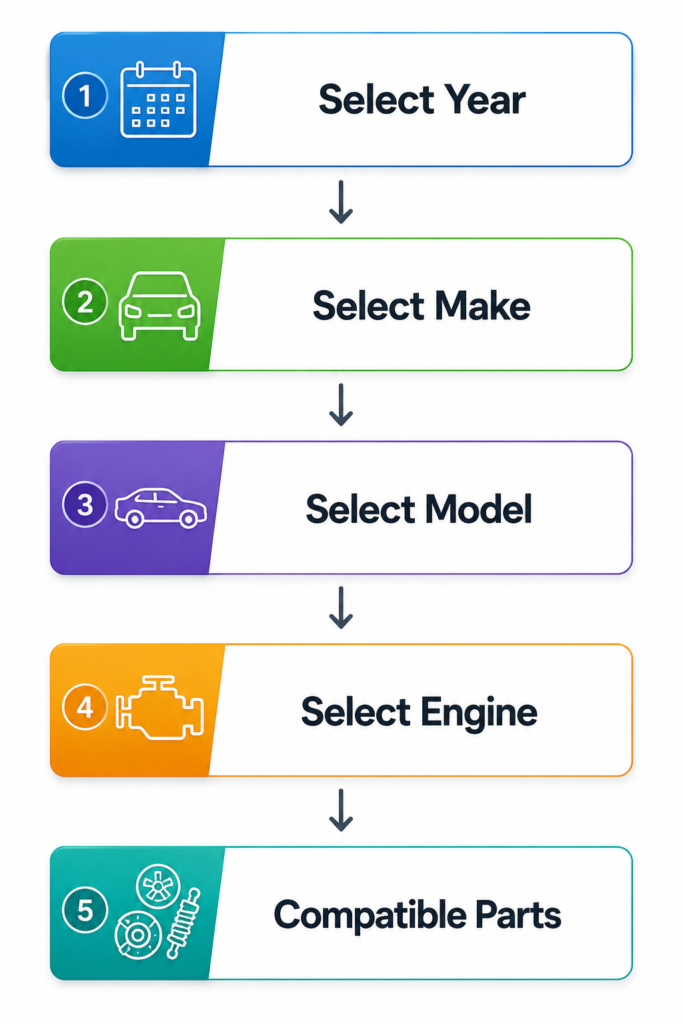
A better automotive ecommerce website allows the shopper to select:

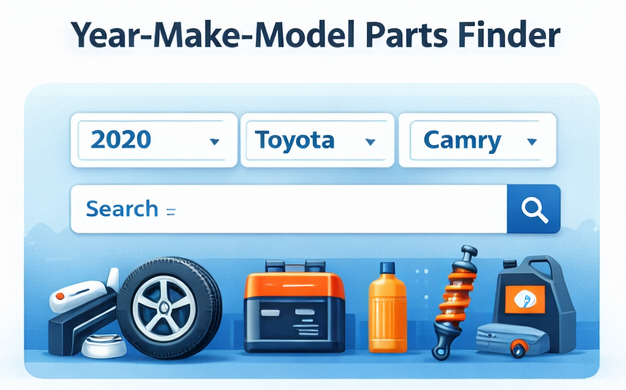
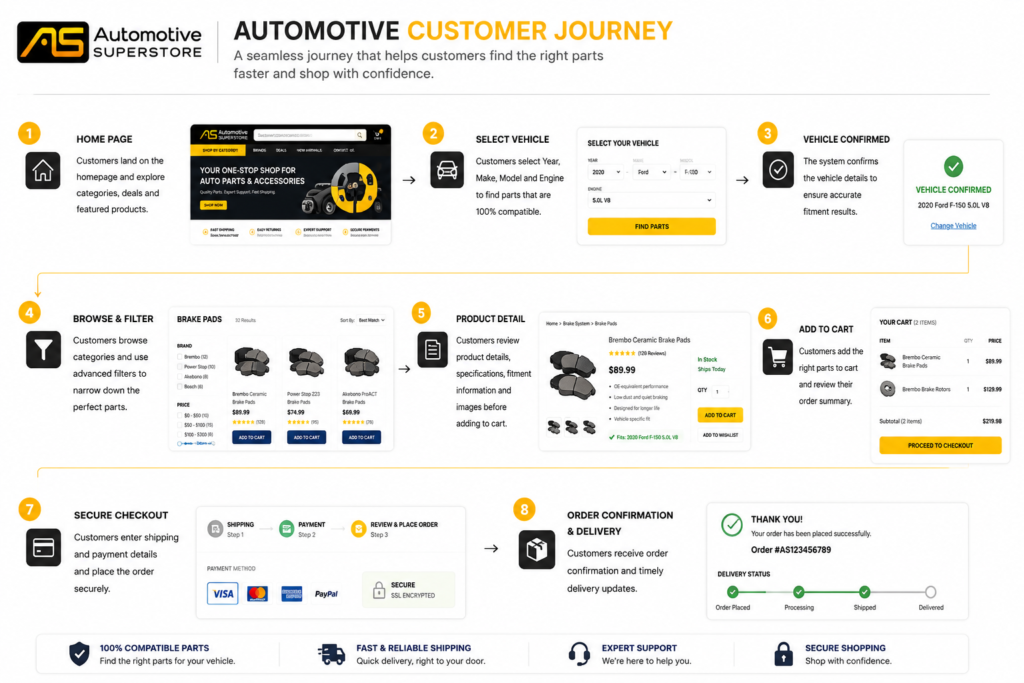
Year → Make → Model → Engine → Part Category

The website can then display compatible products instead of forcing the customer to search through hundreds of potentially incorrect options.

This type of vehicle fitment functionality is one of the most valuable features an auto parts ecommerce website can offer because it directly addresses the biggest concern in online automotive purchasing: compatibility.

Why fitment matters for conversions

Automotive customers are not just buying a product. They are buying confidence that the product will work with their vehicle.

Your website should therefore provide:

  • Year/make/model/engine selection
  • Vehicle-specific product results
  • Compatibility indicators
  • Part-number search
  • OEM/reference number search
  • Fitment notes
  • Vehicle garage functionality
  • “Fits your vehicle” messaging
  • Clear compatibility warnings

A properly designed vehicle fitment search can reduce uncertainty before the customer reaches the cart.

Conversion CTA:
If your current website makes customers manually search for compatible parts, it may be time to rethink the buying journey. Contact our automotive ecommerce development team to discuss a fitment-focused ecommerce experience.

2. Advanced Auto Parts Search That Understands What Buyers Mean

Automotive shoppers do not always search using perfect product names.

One person may search for:

“2019 Honda Civic brake pads”

Another may type:

“Civic 2019 front brakes”

Someone else may enter an OEM number.

Another customer may only know the symptom:

“oil filter for Toyota Camry”

Your website search should accommodate these different search behaviors.

A powerful automotive ecommerce search system should support:

  • Product names
  • SKU numbers
  • OEM numbers
  • Part numbers
  • Vehicle information
  • Categories
  • Brands
  • Product attributes
  • Synonyms
  • Relevant filters

The goal is simple:

Help the customer reach the right product with fewer clicks.

This also creates an important SEO opportunity. Your product categories, vehicle pages, brand pages, and part-specific landing pages can target highly relevant commercial searches rather than relying only on broad keywords such as “auto parts.”

Commercial search intent matters

Someone searching “what are brake pads?” is still researching.

Someone searching “buy brake pads for 2019 Honda Civic” is much closer to purchasing.

Your automotive ecommerce website development strategy should account for both audiences.

Informational content attracts visitors.

Commercial landing pages convert them.

3. Product Pages That Answer Buying Questions Before Customers Ask

A weak automotive product page might contain:

Product Name + Image + Price + Add to Cart

That is rarely enough for technical automotive products.

Customers want to know:

  • Will it fit?
  • Is it OEM or aftermarket?
  • Who manufactures it?
  • What are the specifications?
  • What vehicles does it fit?
  • Is it in stock?
  • When will it arrive?
  • Is there a warranty?
  • Can I return it?
  • What do other buyers think?

Your auto parts ecommerce website should answer these questions directly on the product page.

A high-converting automotive product page should include:

  • High-quality product images
  • Multiple product views
  • Product specifications
  • OEM/reference numbers
  • Brand information
  • Vehicle compatibility
  • Dimensions
  • Material information
  • Installation information
  • Warranty details
  • Shipping information
  • Return policy
  • Stock status
  • Customer reviews
  • Ratings
  • Related products
  • Frequently bought-together products
  • Clear Add to Cart button

This is where SEO and conversion optimization work together.

A detailed product page gives search engines more useful information while giving customers more reasons to trust the purchase.

4. Clear Compatibility Information to Prevent Expensive Mistakes

A customer who receives the wrong part does not simply become unhappy.

You may also face:

  • Returns
  • Refunds
  • Negative reviews
  • Customer support costs
  • Shipping expenses
  • Lost repeat business
  • Lower customer trust

That makes compatibility more than a convenience feature.

It is a revenue-protection feature.

Your automotive ecommerce website should make compatibility highly visible.

Instead of forcing users to search through technical descriptions, show clear messages such as:

✓ Fits your 2020 Toyota Camry

or

⚠ Verify compatibility before ordering

This small piece of information can have a significant psychological impact.

The customer sees that your website understands the vehicle—not just the product.

5. Mobile-First Design for Customers Shopping on the Go

Automotive shoppers may search for products from a garage, workshop, driveway, parking lot, or while speaking with a mechanic.

That means mobile usability cannot be an afterthought.

A mobile-friendly automotive ecommerce website design should make it easy to:

  • Search for parts
  • Select a vehicle
  • Filter products
  • Compare options
  • View specifications
  • Check availability
  • Add products to cart
  • Contact support
  • Complete checkout

Speed matters too.

Google research has previously found that 53% of mobile visitors leave a page when it takes longer than three seconds to load. While that research is older, the underlying lesson remains important: unnecessary loading friction can cost potential customers.

For an automotive business spending money on SEO, advertising, social media, or content marketing, sending traffic to a slow mobile website is an expensive mistake.

Traffic only becomes valuable when the website can convert it.

6. Powerful Filters That Make Thousands of Products Easier to Buy

Imagine an online store selling 50,000 automotive products.

Showing all 50,000 products at once is not helpful.

Customers need a way to narrow the selection quickly.

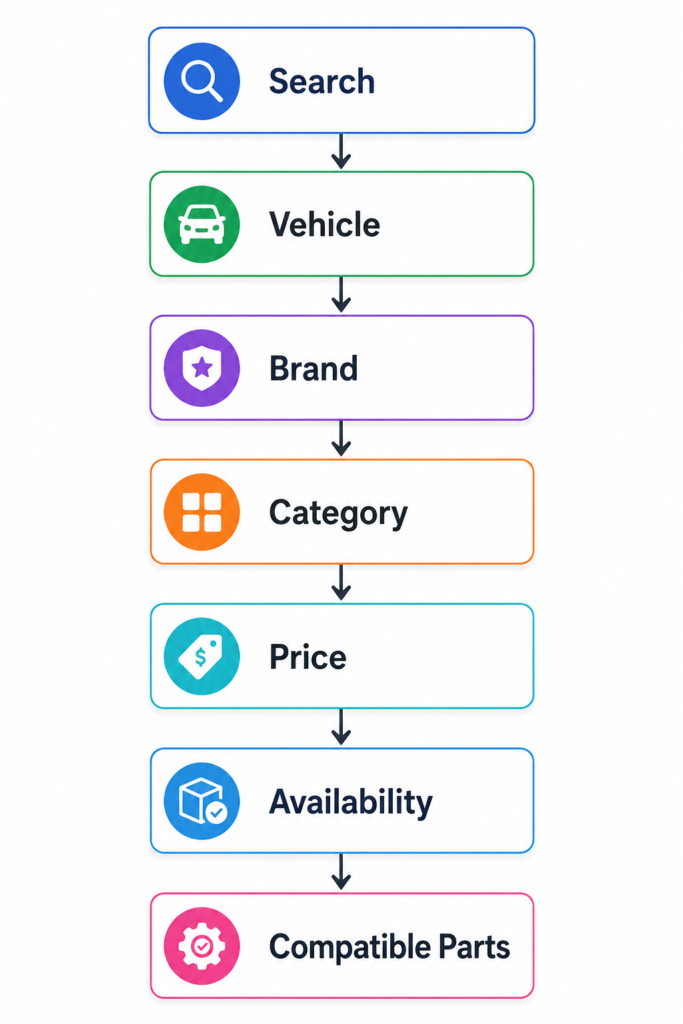
Your automotive ecommerce development strategy should include intelligent filtering based on factors such as:

  • Vehicle
  • Make
  • Model
  • Year
  • Engine
  • Product category
  • Brand
  • Price
  • Availability
  • Condition
  • Product type
  • Material
  • Specifications
  • Ratings

For example:

Brake Parts → Toyota → Camry → 2020 → Front → In Stock

Now the customer is no longer searching through thousands of products.

They are looking at relevant options.

That is a much better path toward a sale.

7. Product Comparison for Customers Who Need Technical Confidence

Automotive customers often compare products before purchasing.

A professional auto parts ecommerce website development solution should make that comparison easy.

For example, customers could compare:

FeatureProduct AProduct B
BrandBrand ABrand B
MaterialCeramicSemi-Metallic
PositionFrontFront
Warranty2 Years3 Years
CompatibilitySelected VehiclesSelected Vehicles
Price$XX$XX

Comparison functionality is particularly useful for higher-value products where customers need more information before committing.

Instead of making shoppers open multiple product pages and remember specifications themselves, let your website do the work.

8. Customer Reviews and Trust Signals That Reduce Purchase Anxiety

When customers buy automotive parts online, trust matters.

They want evidence that:

  • The product is genuine
  • The part works as described
  • Other customers have purchased it
  • The seller is reliable
  • The website is secure
  • The product fits the stated vehicles

That is why customer reviews, ratings, verified-purchase labels, warranty information, secure payment indicators, shipping information, and transparent return policies should be visible throughout the buying journey.

Do not hide trust signals at the bottom of the website.

Put them where customers make decisions.

Useful trust elements include:

Verified Customer Reviews

Real customer experiences can answer questions that product descriptions cannot.

Product Ratings

Ratings give shoppers an immediate indication of customer satisfaction.

Warranty Information

A clearly explained warranty can reduce perceived purchase risk.

Secure Payment Indicators

Customers need confidence before entering payment information.

Transparent Returns

A clear return policy removes uncertainty.

Business Information

Company details, contact information, support options, and physical business information can strengthen credibility.

Trust is not decoration.

Trust is part of the conversion process.

9. Real-Time Inventory and Availability Information

Few things frustrate customers more than discovering that an apparently available product is actually out of stock after they have spent time researching it.

Your automotive ecommerce website should make product availability clear.

Useful inventory information includes:

  • In stock
  • Limited stock
  • Out of stock
  • Pre-order
  • Expected availability
  • Warehouse availability
  • Estimated shipping date

For businesses operating multiple warehouses, inventory integration can make the experience even more useful.

Instead of simply saying:

“Available”

you can potentially show:

“In stock — ships from Dallas”

or

“Available for dispatch within 24 hours.”

The more confidently customers understand availability, the easier it becomes for them to make a buying decision.

10. Shipping Information That Removes the “When Will I Get It?” Question

Automotive customers frequently need parts because something needs to be repaired.

That creates urgency.

If a vehicle is sitting in a garage, customers may not want to wait several days just to discover the delivery estimate.

Your ecommerce website should communicate:

  • Estimated delivery
  • Shipping options
  • Shipping charges
  • Free shipping thresholds
  • Delivery regions
  • Order tracking
  • Dispatch time
  • Local pickup options, if available

Baymard’s latest cart-abandonment research identifies slow delivery and unexpected costs among the leading reasons shoppers abandon purchases.

For an automotive ecommerce store, shipping information should therefore appear before the final checkout stage—not as a surprise after the customer has entered their details.

11. A Checkout That Does Not Make Ready-to-Buy Customers Leave

Getting a customer to the checkout is an achievement.

Losing that customer because checkout is confusing is avoidable.

Baymard’s research currently places average ecommerce cart abandonment at 70.22%, and its research indicates that checkout design improvements alone can produce substantial conversion opportunities.

Your automotive ecommerce website development strategy should therefore focus on reducing unnecessary friction.

A strong checkout should provide:

  • Guest checkout
  • Clear order summary
  • Transparent shipping costs
  • Multiple payment methods
  • Address autocomplete
  • Mobile-friendly forms
  • Secure payment experience
  • Promo-code functionality
  • Delivery estimate
  • Easy cart editing
  • Clear error messages

Do not ask customers for information you do not actually need.

Every unnecessary field creates another opportunity for hesitation.

Conversion CTA:
If your website receives product traffic but customers frequently abandon carts, a checkout and conversion audit could reveal where revenue is being lost. Contact our team to discuss your automotive ecommerce website requirements.

12. Multiple Payment Options for Different Types of Buyers

Customers have different payment preferences.

Depending on your target market and business model, your website may need:

  • Credit/debit cards
  • Digital wallets
  • PayPal or similar payment services
  • Buy-now-pay-later options
  • Bank transfers
  • Financing
  • Purchase orders for B2B customers

For automotive businesses serving workshops, dealers, distributors, and individual consumers, payment flexibility can become particularly important.

A B2B automotive ecommerce website may also require account-based pricing, purchase orders, credit limits, tax handling, and customer-specific payment terms.

That is why payment functionality should be planned around the actual business model rather than added as an afterthought.

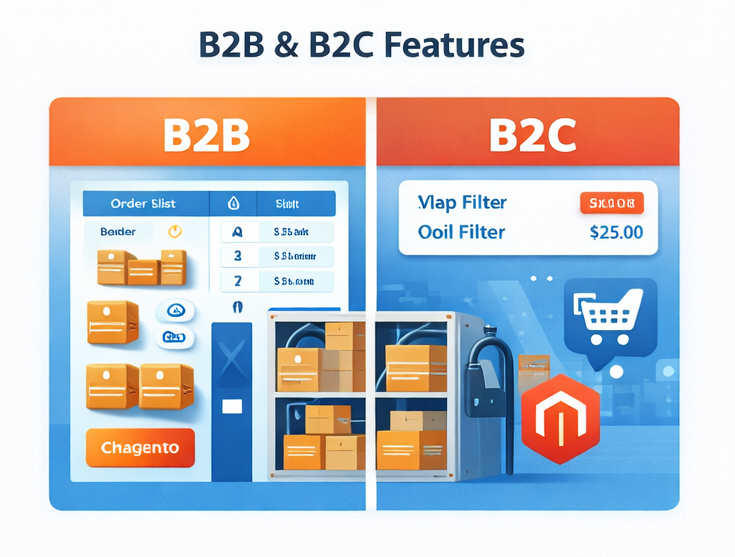
13. B2B Features for Wholesalers, Distributors, and Automotive Suppliers

Not every automotive ecommerce customer is an individual car owner.

Many businesses sell to:

  • Auto repair shops
  • Mechanics
  • Dealerships
  • Automotive distributors
  • Fleet operators
  • Resellers
  • Workshops
  • Commercial buyers

These customers may need different functionality.

A professional automotive ecommerce development company can build features such as:

  • Customer-specific pricing
  • Bulk ordering
  • Wholesale accounts
  • Minimum order quantities
  • Tiered pricing
  • Purchase orders
  • Account-based discounts
  • Reorder functionality
  • Saved product lists
  • Multiple shipping addresses
  • Business tax information
  • Approval workflows

For B2B automotive ecommerce, convenience can directly influence repeat purchasing.

If a workshop orders the same filters, brake components, fluids, or service parts every month, a simple Reorder function can save time and encourage repeat sales.

14. Smart Cross-Selling That Actually Makes Sense

Cross-selling should not feel random.

If a customer purchases brake pads, recommending unrelated accessories can create distraction.

Instead, your website should recommend products that logically complement the purchase.

For example:

Brake Pads

→ Brake Rotors
→ Brake Hardware Kit
→ Brake Cleaner
→ Brake Fluid

This is where product relationships and recommendation logic become valuable.

Relevant recommendations can increase the value of each transaction while helping customers discover products they may genuinely need.

The key word is relevance.

15. “Frequently Bought Together” and Complete-the-Repair Suggestions

Automotive purchases are often part of a larger repair job.

Someone buying a component may also need installation accessories or related parts.

Your website can use sections such as:

Complete Your Repair

Frequently Bought Together

Compatible Parts

Recommended Accessories

Customers Also Purchased

These elements can turn a single-product transaction into a larger order without aggressively pushing irrelevant products.

That is a better approach to increasing average order value.

16. SEO-Friendly Automotive Category and Vehicle Landing Pages

A beautiful ecommerce website will not generate organic traffic if search engines cannot properly understand its structure.

Your automotive ecommerce SEO strategy should create logical, crawlable pages around search intent.

Potential landing pages include:

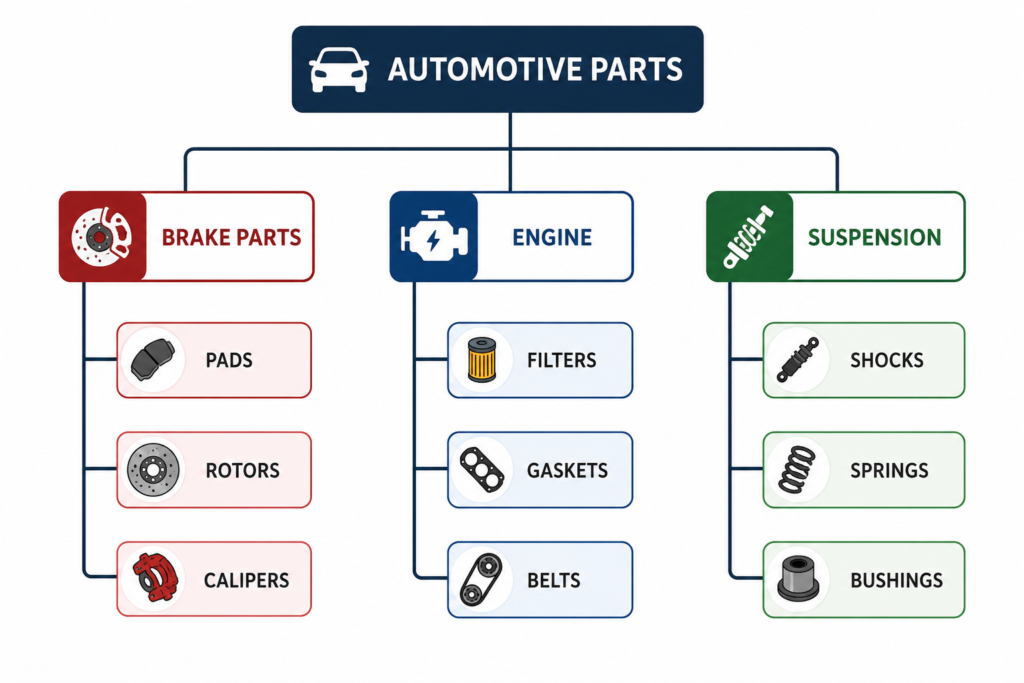
  • Auto Parts
  • Brake Parts
  • Engine Parts
  • Suspension Parts
  • Electrical Components
  • Toyota Parts
  • Ford Parts
  • Honda Parts
  • BMW Parts
  • Chevrolet Parts
  • Vehicle-specific parts
  • Brand-specific products
  • Product-category pages

For example:

Auto Parts → Toyota → Camry → 2020 → Brake Parts

This structure can help users navigate the website while creating opportunities to target highly specific search queries.

17. Structured Data to Help Search Engines Understand Your Products

Technical SEO is another important part of automotive ecommerce website development.

Where appropriate, your product pages should use structured data to communicate information such as:

  • Product name
  • Brand
  • Price
  • Availability
  • Reviews
  • Ratings
  • SKU
  • Product identifiers

Correct implementation can help search engines better understand product information and may support eligible search-result enhancements.

But structured data should never be treated as a shortcut to rankings.

It works best alongside:

Useful content + strong technical SEO + search intent + quality products + good user experience.

18. Technical SEO Built Into the Ecommerce Architecture

SEO should not begin after the website is developed.

It should be considered during development.

A strong automotive ecommerce website development project should address:

  • Clean URLs
  • Canonical tags
  • XML sitemap
  • Robots.txt
  • Breadcrumb navigation
  • Internal linking
  • Mobile responsiveness
  • Page speed
  • Indexation control
  • Duplicate product pages
  • Filter URL management
  • Pagination
  • Image optimization
  • Metadata
  • Structured data
  • 404 handling
  • Redirect management

This becomes especially important for automotive stores with thousands—or potentially hundreds of thousands—of products.

Without proper architecture, ecommerce filters and product variations can create unnecessary URL combinations and indexation problems.

19. Content That Answers Questions Before Customers Contact Support

SEO traffic is valuable, but helpful content can also move visitors toward purchasing.

Create content around questions such as:

How do I know which brake pads fit my car?

What is the difference between OEM and aftermarket parts?

How often should brake rotors be replaced?

Which oil filter fits my vehicle?

How do I find the correct engine part number?

These articles can attract informational searches.

Then connect them naturally to relevant product and category pages.

This creates a path like:

Google Search → Helpful Article → Relevant Category → Product → Cart → Checkout

That is how informational SEO can support commercial revenue.

20. Lead Generation for Visitors Who Are Not Ready to Buy

Not every visitor will purchase during their first session.

Some are researching.

Some are comparing prices.

Some need to speak with a specialist.

Some need help identifying a part.

Instead of allowing these visitors to disappear, your automotive ecommerce website should create opportunities to capture them.

Consider:

  • Request a Quote
  • Ask an Expert
  • Find My Part
  • Talk to a Specialist
  • Bulk Order Inquiry
  • Dealer Inquiry
  • Wholesale Account Request
  • Newsletter signup
  • Price-drop alerts
  • Back-in-stock notifications

For B2B customers, Request a Quote can be especially valuable.

For individual buyers, Find My Part or Check Compatibility may be a stronger lead hook.

The CTA should match the customer’s problem.

21. Click-to-Call and Fast Customer Support

Sometimes customers do not want to read another product description.

They want an answer.

A prominent phone number, live chat, WhatsApp option where appropriate, support form, or expert consultation feature can help customers move forward.

For expensive or technically complex products, human assistance can be the difference between:

“I’ll think about it.”

and

“I’ll place the order.”

Your website should make it easy to ask for help without forcing customers to search for contact information.

22. Vehicle Garage Functionality for Repeat Customers

A vehicle garage allows customers to save their vehicle information.

For example:

My Vehicles

  • 2020 Ford F-150
  • 2018 Honda Civic
  • 2022 Toyota RAV4

When the customer returns, the website can prioritize compatible products.

This reduces repetitive searching and creates a more personalized buying experience.

It can also support repeat purchases because customers can quickly find products relevant to their saved vehicles.

For businesses selling replacement and maintenance parts, this can become an important retention feature.

23. Reorder and Purchase History for Repeat Revenue

The first purchase is valuable.

The second purchase tells you the customer may trust your business.

Your automotive ecommerce website should make repeat purchases easy.

Useful account features include:

  • Order history
  • Reorder button
  • Saved vehicles
  • Saved products
  • Recently viewed products
  • Downloadable invoices
  • Saved addresses
  • Saved payment methods
  • Repeat-order reminders

A customer who previously purchased an oil filter should not have to search the entire website again six months later.

Make the next purchase easier than the first.

24. Analytics That Show Where Revenue Is Being Lost

A website should not only collect orders.

It should generate useful business data.

Your analytics setup should help answer questions such as:

  • Which products receive the most traffic?
  • Which pages generate the most leads?
  • Where do customers leave?
  • Which search terms generate sales?
  • Which vehicles are most frequently searched?
  • Which categories have high traffic but low conversions?
  • Which products have high views but low add-to-cart rates?
  • Which marketing channels generate revenue?
  • Which customers return?

These insights can guide future automotive ecommerce website development, SEO, advertising, merchandising, and conversion optimization decisions.

Without measurement, you are guessing.

With measurement, you can improve based on actual customer behavior.

25. Security and Reliability Are Part of the Buying Experience

Customers are trusting your website with:

  • Personal information
  • Vehicle information
  • Addresses
  • Payment details
  • Order information

Your website therefore needs strong security practices and reliable infrastructure.

Important areas include:

  • HTTPS
  • Secure payment processing
  • Strong authentication
  • Regular updates
  • Backup systems
  • Access controls
  • Fraud prevention
  • Monitoring
  • Secure integrations

Security should also be communicated clearly enough that customers feel comfortable completing their purchase.

What Happens When These Features Work Together?

The real value does not come from adding features randomly.

It comes from connecting them into one customer journey.

Imagine this:

A customer searches Google for “brake pads for 2020 Honda Civic.”

They land on an SEO-optimized automotive page.

The website asks them to select their vehicle.

The fitment system confirms compatibility.

The customer sees several relevant products.

They compare price, brand, warranty, specifications, and reviews.

The product page recommends compatible brake rotors.

The website displays shipping availability.

The customer adds everything to the cart.

The checkout clearly shows the final cost and delivery estimate.

They pay using their preferred payment method.

After the purchase, the customer receives tracking information.

Months later, the saved vehicle and purchase history make the next order faster.

That is not simply an online catalog.

That is an ecommerce sales system.

The Features That Deserve the Highest Priority

If you are planning a new automotive ecommerce website development project, do not try to build everything at once.

Start with the features that directly affect discovery, trust, conversion, and repeat purchases.

Customer Discovery

  • Vehicle fitment search
  • Advanced product search
  • Category navigation
  • Smart filters
  • SEO-friendly landing pages

Purchase Confidence

  • Compatibility verification
  • Detailed product specifications
  • Reviews and ratings
  • Warranty information
  • Shipping estimates
  • Clear returns

Conversion

  • Fast mobile experience
  • Simple checkout
  • Multiple payment options
  • Guest checkout
  • Clear pricing
  • Strong CTAs

Revenue Growth

  • Related products
  • Cross-selling
  • Frequently bought together
  • Reordering
  • Saved vehicles
  • Personalized recommendations

Lead Generation

  • Request a Quote
  • Ask an Expert
  • Find My Part
  • Wholesale inquiry
  • Dealer inquiry
  • Contact support

SEO & Measurement

  • Technical SEO
  • Structured data
  • Internal linking
  • Analytics
  • Conversion tracking
  • Search performance monitoring

Don’t Build an Auto Parts Website. Build a Buying Experience.

The biggest mistake an automotive business can make is treating ecommerce as a digital product catalog.

Your customers do not want to browse thousands of parts.

They want to find the right part for the right vehicle at the right price—and feel confident enough to buy it.

That is why successful automotive ecommerce website development combines fitment technology, intuitive navigation, product data, SEO, trust signals, mobile UX, conversion optimization, and intelligent ecommerce functionality.

If your current website receives visitors but struggles to turn them into customers, the problem may not be traffic alone.

It could be:

Poor fitment → Confused shoppers → Low product confidence → Cart abandonment → Lost revenue.

The right website architecture can reverse that journey:

Relevant traffic → Better product discovery → Higher trust → Easier checkout → More leads → More orders → More repeat customers.

Ready to Turn Your Automotive Website Into a Sales Channel?

If you are planning a new automotive ecommerce website, upgrading an existing auto parts store, adding vehicle fitment functionality, improving ecommerce SEO, or building a B2B/B2C automotive marketplace, the development strategy needs to begin with your customers—not just your product catalog.

A professional automotive ecommerce development company can help you plan the technology, UX, integrations, product architecture, SEO structure, and conversion journey around your actual business goals.

Don’t let customers leave because they cannot find the right part.

Don’t make buyers guess whether a product fits.

Don’t spend money generating traffic only to lose customers at checkout.

Build an ecommerce experience that answers questions, removes uncertainty, captures leads, and makes purchasing easier.

Want to discuss your automotive ecommerce project?

Contact our team today to discuss your requirements for automotive ecommerce website development and build a website designed to attract, convert, and retain automotive customers.

Explore Automotive Ecommerce Website Development Services

Frequently Asked Questions About Automotive Ecommerce Websites

What features should an automotive ecommerce website have?

An automotive ecommerce website should make it easy for customers to find compatible products and complete purchases with confidence. Important features include vehicle fitment search, advanced filters, detailed product specifications, compatibility information, customer reviews, secure checkout, multiple payment options, inventory visibility, shipping information, and mobile-friendly navigation.

Why is vehicle fitment important for an automotive ecommerce website?

Vehicle fitment helps customers identify products compatible with their specific vehicle. Features such as year, make, model, engine, and part-number search can reduce uncertainty and make product discovery easier, particularly for large auto parts catalogs.

How can an automotive ecommerce website generate more leads?

An automotive ecommerce website can generate leads through Request a Quote forms, Ask an Expert options, wholesale inquiries, dealer inquiries, contact forms, live chat, back-in-stock notifications, and other strategically placed calls to action. The best approach depends on whether the business targets consumers, automotive professionals, wholesalers, or multiple customer groups.

How does SEO help an automotive ecommerce website?

Automotive ecommerce SEO can help relevant product, category, vehicle, and informational pages appear for searches made by potential customers. A strong strategy combines technical SEO, useful content, internal linking, optimized category pages, structured data, mobile usability, and search-intent-focused landing pages.

Should an automotive ecommerce website support B2B customers?

If the business sells to workshops, dealers, distributors, mechanics, or other commercial buyers, B2B functionality can be highly valuable. Features may include customer-specific pricing, bulk ordering, wholesale accounts, purchase orders, tiered pricing, saved orders, and reorder functionality.

How much does automotive ecommerce website development cost?

The cost depends on factors such as catalog size, ecommerce platform, vehicle-fitment requirements, integrations, custom functionality, B2B features, design requirements, payment systems, and third-party services. A detailed project assessment is recommended before determining the development budget.

Can an existing automotive ecommerce website be improved without rebuilding everything?

Yes. Depending on the existing technology and architecture, businesses may be able to improve specific areas such as navigation, product search, fitment, checkout, mobile experience, SEO, product data, integrations, or conversion elements without completely replacing the website.

What makes an automotive ecommerce website different from a regular ecommerce store?

Automotive ecommerce often involves complex product compatibility, technical specifications, vehicle information, OEM or part numbers, large catalogs, and specialized customer requirements. The website therefore needs product discovery and purchasing tools designed specifically around automotive buying behavior.
Automotive eCommerce Website Development: The Complete Guide to Building High-Performance Auto Parts Websites

Automotive eCommerce Website Solutions That Help Auto Parts Businesses Grow

The automotive industry has changed dramatically over the last decade. Customers no longer rely solely on local parts stores or dealership counters to purchase replacement parts and accessories. Instead, they expect fast, reliable online shopping experiences where they can quickly identify the correct parts for their vehicle, compare products, and complete purchases with confidence.

For automotive businesses, this shift presents both an opportunity and a challenge. Selling thousands—or even hundreds of thousands—of products online requires much more than a standard eCommerce website. Automotive retailers need intelligent search, accurate vehicle compatibility, advanced product catalog management, secure payment processing, and a platform capable of handling large volumes of products without sacrificing speed or usability.

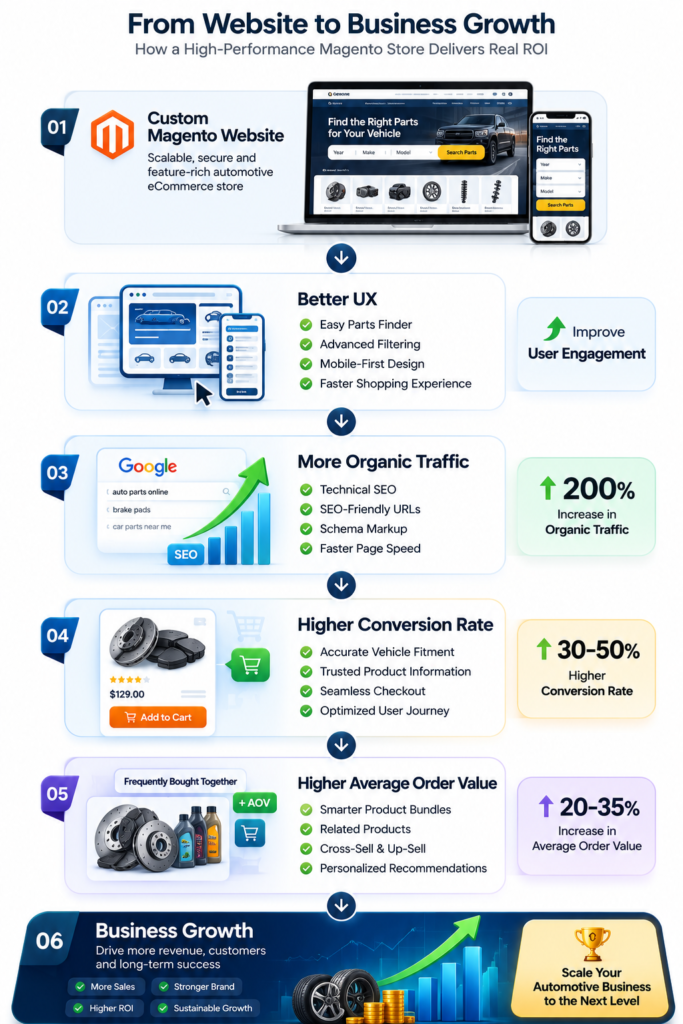
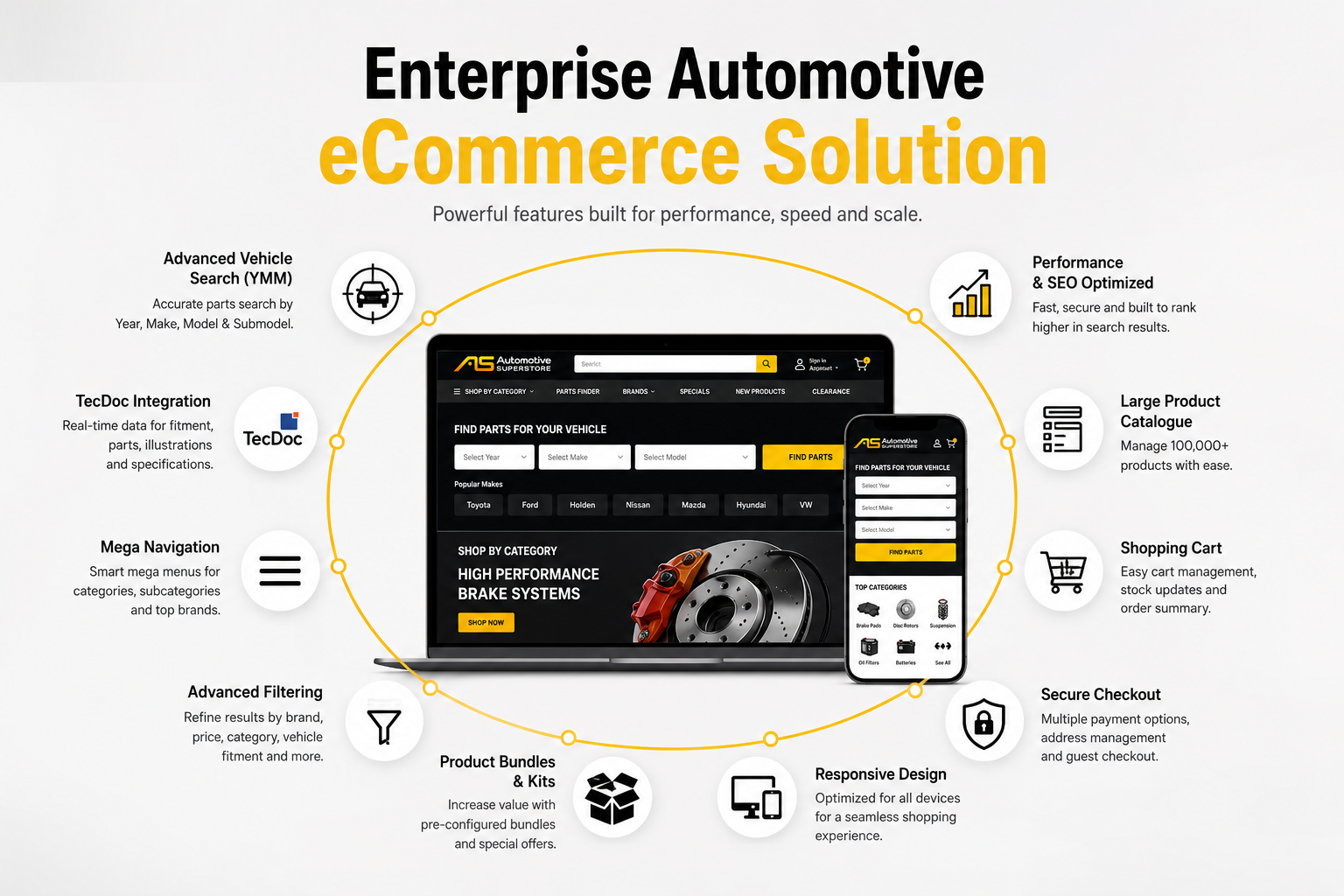
At IOGOOS Solution, we specialize in developing Enterprise Magento Development solutions for automotive businesses that require more than a basic online store. From custom Year Make Model Parts Finder functionality and TecDoc Integration to large product catalog management and conversion-focused user experiences, we build automotive eCommerce platforms designed around real business requirements—not one-size-fits-all templates.

Whether you’re launching a new Auto Parts Store, replacing an outdated system, or modernizing an existing automotive eCommerce platform, choosing the right technology and development partner can significantly impact customer satisfaction, operational efficiency, and long-term business growth.

Why Automotive Businesses Need a Specialized eCommerce Platform

Unlike fashion, electronics, or general retail, automotive eCommerce revolves around one critical factor—product compatibility. Customers need confidence that the part they purchase will fit their specific vehicle. A traditional online store simply cannot provide the level of accuracy, filtering, and compatibility required by the automotive industry.

Modern automotive websites must support advanced vehicle search, intelligent filtering, and dynamic product relationships while managing extensive product catalogs that often contain tens of thousands of SKUs. Every second spent searching for the right part increases the likelihood of customer frustration and lost sales.

A purpose-built Automotive eCommerce Platform removes these barriers by making it easier for customers to identify compatible products, compare options, and complete purchases quickly. Features such as Year Make Model Parts Finder, Vehicle Fitment, OEM Part Finder, and TecDoc Integration not only improve the shopping experience but also reduce incorrect orders and customer support requests.

Businesses investing in specialized automotive solutions consistently experience stronger customer engagement, improved product discoverability, and higher conversion rates because the website is designed around how automotive buyers actually search for parts.

Why Generic eCommerce Websites Often Fail Automotive Stores

Many automotive businesses begin with a standard eCommerce website because it appears to be the fastest or least expensive option. However, as product catalogs grow and customer expectations increase, these platforms quickly reveal their limitations.

Common challenges include:

  • Difficulty managing large automotive product catalogs.
  • Slow product searches.
  • Limited filtering capabilities.
  • No vehicle compatibility search.
  • Poor mobile shopping experience.
  • Inaccurate product matching.
  • Weak SEO architecture.
  • Performance issues with large inventories.
  • Complex inventory synchronization.
  • Difficulty integrating automotive databases.

These issues don’t just affect website performance—they directly impact sales. When customers cannot quickly find the correct part, they are more likely to abandon the website and purchase from a competitor offering a more intuitive shopping experience.

A custom-built Magento Development solution eliminates these limitations by providing the flexibility, performance, and scalability required for enterprise automotive eCommerce.

Why Enterprise Magento Development Is the Preferred Choice for Automotive eCommerce

Automotive businesses often manage product catalogs that include thousands of categories, multiple vehicle compatibility relationships, aftermarket parts, OEM products, accessories, and supplier integrations. Supporting this level of complexity requires an eCommerce platform designed for enterprise operations.

This is where Enterprise Magento Development stands apart.

Magento offers a highly flexible architecture that enables developers to build custom automotive functionality without compromising performance or scalability. From advanced search capabilities and custom catalog structures to complex pricing rules and third-party integrations, Magento provides the foundation needed for high-performing automotive websites.

At IOGOOS Solution, our experience in Custom Magento Development allows us to create automotive websites tailored to each client’s operational requirements. Instead of forcing businesses to adapt to platform limitations, we develop solutions that fit existing workflows while improving customer experience.

Our automotive Magento projects commonly include:

  • Custom Year Make Model Parts Finder
  • OEM Parts Lookup
  • Vehicle Fitment Search
  • TecDoc API Integration
  • Large Product Catalogue Management
  • Advanced Product Filtering
  • Intelligent Mega Navigation
  • Responsive Magento Website Design
  • Product Bundle Functionality
  • Interactive Hotspot Images
  • Secure Multi-Gateway Payment Integration
  • Technical SEO Foundation
  • Performance Optimization
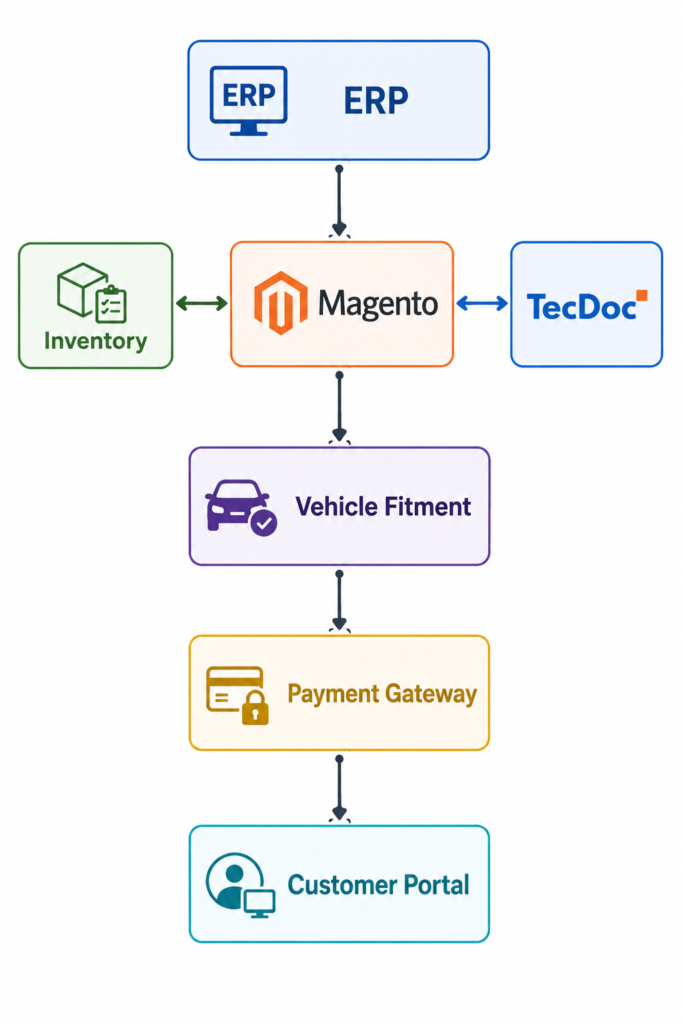
  • Third-Party ERP Integration
  • Warehouse & Inventory Synchronization

These features work together to create an automotive shopping experience that is intuitive, reliable, and built to support long-term business growth.

What Automotive Customers Expect from an Online Store Today

Today’s automotive buyers expect more than an attractive website. They want confidence that every product they purchase is compatible with their vehicle, backed by accurate information and a seamless shopping experience.

A successful automotive eCommerce website should enable customers to:

  • Search by Year, Make, and Model.
  • Find compatible parts within seconds.
  • Browse organized product categories.
  • Filter products by brand, specifications, and vehicle compatibility.
  • View detailed product information.
  • Explore related products and bundled offers.
  • Complete purchases securely on any device.
  • Receive fast-loading pages with minimal delays.

Meeting these expectations requires a combination of intelligent development, thoughtful user experience design, and a platform capable of supporting enterprise-level automotive operations.

Essential Features Every Automotive eCommerce Website Needs to Succeed

Building a successful automotive eCommerce website requires far more than an attractive design. Automotive customers expect speed, accuracy, and confidence when purchasing vehicle parts online. Whether they’re searching for brake pads, suspension components, performance upgrades, or OEM replacement parts, they want to find compatible products quickly without navigating through thousands of unrelated items.

At IOGOOS Solution, we build enterprise automotive eCommerce platforms that simplify complex buying journeys while helping businesses manage extensive product catalogs efficiently. From intelligent vehicle search to custom integrations and performance optimization, every feature is developed with one objective—creating a faster shopping experience that increases customer satisfaction and drives more sales.

Enterprise Features Built for High-Performance Automotive eCommerce

An automotive website should do more than display products—it should help customers identify the correct part with minimal effort. We combine enterprise Magento development with custom functionality to create automotive platforms that are fast, intuitive, and designed around how customers actually shop for vehicle parts.

Below are the core features we recommend for every modern automotive eCommerce website.

Year Make Model Parts Finder

The Year Make Model (YMM) Parts Finder is one of the most valuable features of any automotive eCommerce platform. Instead of manually browsing thousands of products, customers simply select their vehicle’s year, make, and model to view only compatible parts.

This significantly improves product discovery, reduces incorrect purchases, and creates a more confident buying experience. It also lowers support inquiries while helping businesses achieve higher conversion rates and fewer product returns.

OEM Parts Finder

Many customers prefer genuine manufacturer-approved replacement parts. A custom OEM Parts Finder enables users to search by OEM part numbers or manufacturer references, making it easier to locate exact replacement components for their vehicles.

This feature is particularly valuable for dealerships, manufacturers, wholesalers, and professional automotive workshops that require precise product identification.

TecDoc Integration

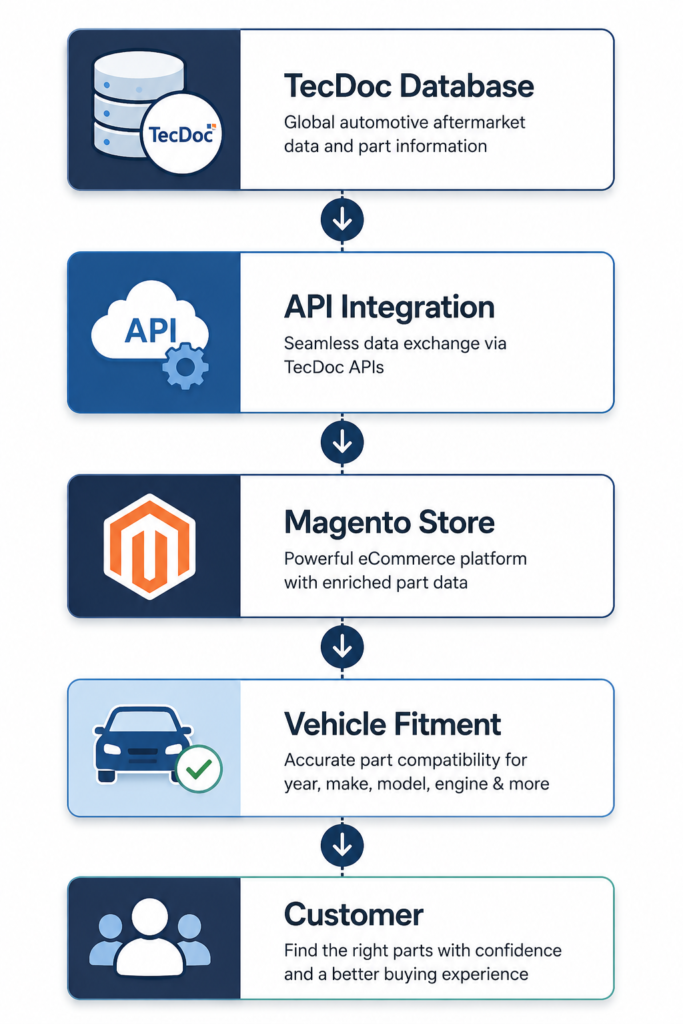
For automotive businesses managing extensive vehicle compatibility data, TecDoc Integration provides access to one of the industry’s most comprehensive automotive databases.

By connecting your eCommerce platform with TecDoc APIs, customers receive accurate vehicle fitment information, enriched product specifications, manufacturer data, and compatibility details directly within your online store. This improves shopping confidence while reducing costly ordering mistakes.

Intelligent Vehicle Fitment

Displaying compatible products is no longer optional—it’s expected.

Custom Vehicle Fitment functionality ensures customers only view products suitable for their selected vehicle. Instead of searching through hundreds of unrelated products, buyers immediately receive accurate recommendations that simplify purchasing decisions and improve the overall shopping experience.

Advanced Automotive Product Catalog Management

Managing thousands of automotive products requires a flexible catalog structure capable of supporting multiple brands, vehicle applications, technical specifications, pricing rules, and inventory sources.

Our Automotive Product Catalog Management solutions help businesses efficiently organize large inventories while maintaining excellent search performance and streamlined backend administration. Whether you’re managing 10,000 or 500,000 products, the platform remains responsive and easy to maintain.

Advanced Product Filtering

Automotive customers rarely search using a single keyword.

They often refine products by brand, engine size, fuel type, transmission, product category, manufacturer, specifications, availability, price range, or vehicle compatibility.

Advanced filtering enables shoppers to narrow their results quickly, helping them reach the correct product faster while reducing frustration and increasing conversions.

Seamless Mega Navigation

Large automotive stores require well-structured navigation that makes thousands of products feel organized rather than overwhelming.

Our custom Mega Navigation solutions organize products into logical categories with vehicle-based navigation, featured brands, popular collections, and promotional sections. Customers spend less time searching and more time purchasing.

Product Bundle Functionality

Automotive customers frequently purchase related products together.

Custom Product Bundle functionality enables businesses to group compatible products into complete installation kits, maintenance packages, or promotional bundles. This not only simplifies purchasing decisions but also increases average order value while improving customer convenience.

Examples include:

  • Brake Kit + Brake Fluid
  • Suspension Kit
  • Timing Belt Package
  • Service Kit
  • Performance Upgrade Bundle

Interactive Hotspot Images

Visual shopping experiences improve customer confidence.

Interactive Hotspot Images allow visitors to click specific vehicle components or product areas to instantly explore compatible parts. Instead of searching through categories, customers can visually identify components and navigate directly to relevant products.

This feature is especially useful for complex assemblies and technical automotive products.

Responsive Magento Website

More than half of automotive shoppers now browse and purchase using mobile devices.

A Responsive Magento Website automatically adapts to desktops, tablets, and smartphones while maintaining excellent usability across every screen size. Mobile-friendly navigation, optimized images, and streamlined checkout contribute to higher engagement and increased conversions.

Large Product Catalogue Management

Enterprise automotive businesses often manage hundreds of brands and tens of thousands of SKUs.

Our Large Product Catalogue Management solutions support:

  • Bulk product imports
  • Inventory synchronization
  • Category automation
  • Product relationships
  • Supplier feeds
  • Performance optimization
  • Catalog indexing
  • Efficient backend workflows

This allows businesses to expand their inventory without compromising website performance.

Secure Multi-Gateway Payment Integration

Customer trust begins at checkout.

We integrate secure payment gateways that support credit cards, digital wallets, financing options, PayPal, Stripe, and region-specific payment providers. Multiple payment options improve checkout flexibility while increasing customer confidence and reducing cart abandonment.

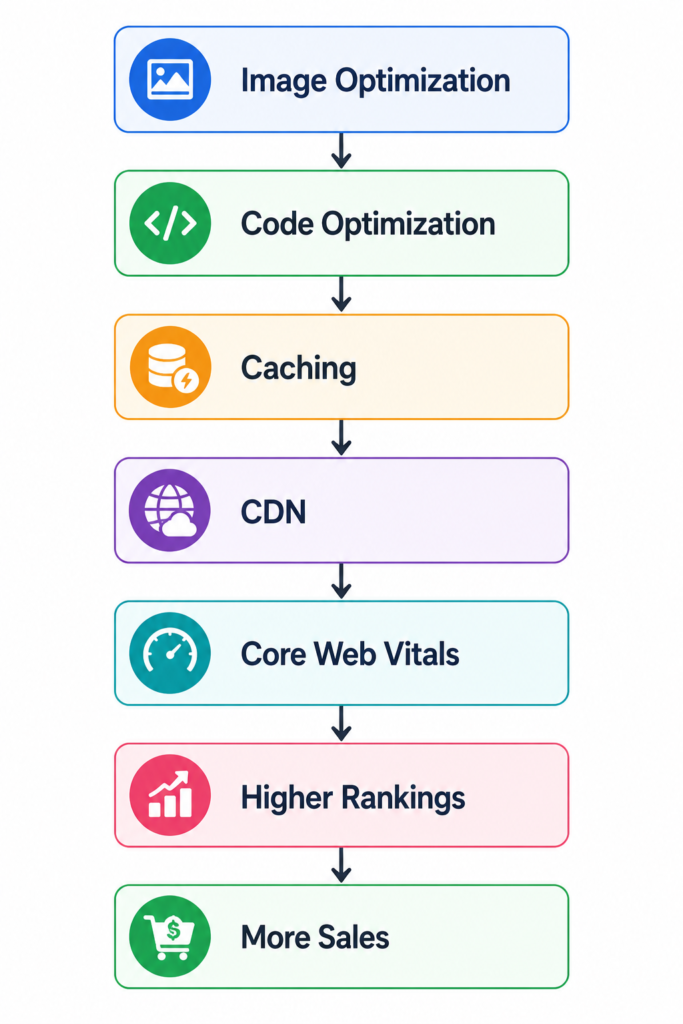
Performance Optimization & Core Web Vitals

Website speed directly impacts customer satisfaction, search rankings, and revenue.

Our optimization process includes:

  • Faster page loading
  • Optimized database queries
  • Image optimization
  • Full-page caching
  • Lazy loading
  • Code optimization
  • CDN integration
  • Server performance improvements

A faster website creates a smoother shopping experience and contributes to better search engine visibility.

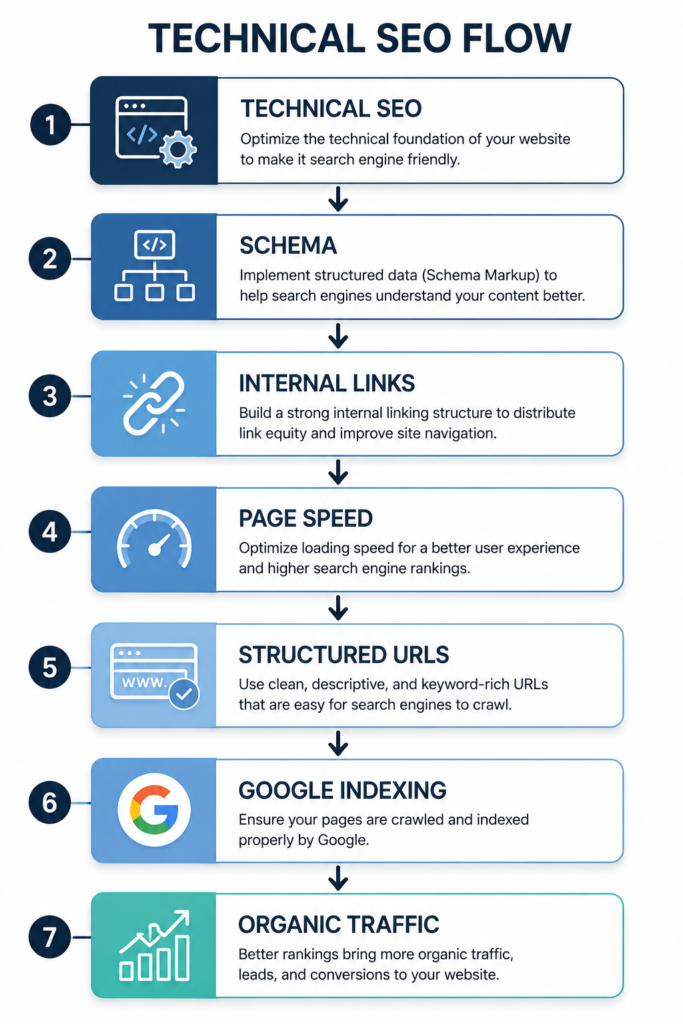
Technical SEO Foundation & Implementation

An exceptional automotive website deserves to be discovered.

Every project we build includes a strong Technical SEO Foundation, ensuring search engines can efficiently crawl, understand, and index the website.

Our SEO implementation typically includes:

  • SEO-friendly URL structures
  • Optimized metadata
  • Schema markup
  • XML sitemaps
  • Internal linking strategy
  • Canonical URL management
  • Breadcrumb optimization
  • Image optimization
  • Core Web Vitals improvements
  • Structured category architecture

These technical improvements help automotive businesses increase organic visibility and attract more qualified traffic.

Comprehensive Features for a Smarter Automotive Shopping Experience

A modern automotive eCommerce website must balance functionality, performance, and usability. Every feature should make it easier for customers to find the correct parts while helping businesses manage products efficiently and grow online sales.

At IOGOOS Solution, we combine Enterprise Magento Development, custom automotive functionality, intelligent integrations, and conversion-focused design to create high-performing Automotive eCommerce Platforms that support long-term business growth. From Year Make Model Parts Finder and TecDoc Integration to Large Product Catalogue Management, Vehicle Fitment, Secure Multi-Gateway Payment Integration, and a strong Technical SEO Foundation, every solution is tailored to the unique requirements of the automotive industry.

A well-built automotive website isn’t simply an online catalog—it’s a powerful sales platform that improves customer experience, increases engagement, strengthens search visibility, and helps automotive businesses generate sustainable revenue in an increasingly competitive market.

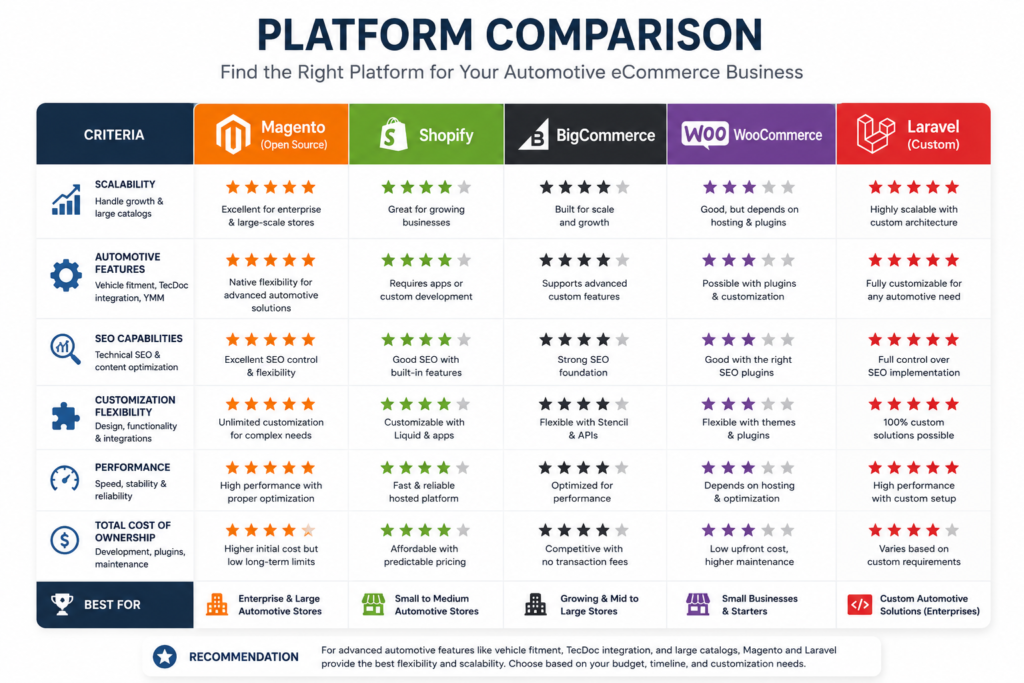
Magento vs Shopify vs BigCommerce vs WooCommerce vs Laravel: Which Platform Is Best for Automotive eCommerce?

Choosing the right technology is one of the most important decisions when building an automotive eCommerce website. While many platforms can sell products online, very few are designed to handle the complexity of the automotive industry. Features like Year Make Model Parts Finder, Vehicle Fitment, TecDoc Integration, large product catalog management, and advanced search require a platform that offers flexibility, performance, and room for future growth.

At IOGOOS Solution, we’ve developed automotive eCommerce solutions across multiple platforms, including Magento, Shopify, Shopify Plus, BigCommerce, WooCommerce, and Laravel. Each platform has its strengths, and the best choice depends on your business goals, product catalog size, integrations, and budget.

Adobe Commerce (Magento) – The Enterprise Choice for Automotive eCommerce

When it comes to enterprise automotive websites, Magento remains one of the most powerful and flexible eCommerce platforms available. It is purpose-built for businesses that require advanced customization, large product catalogs, complex pricing structures, multiple warehouses, B2B capabilities, and third-party integrations.

Magento gives complete control over every aspect of your website, making it the preferred choice for automotive manufacturers, wholesalers, distributors, and large auto parts retailers.

Best For

  • Large automotive product catalogs
  • Auto parts retailers
  • Multi-brand businesses
  • OEM and aftermarket parts suppliers
  • Manufacturers
  • B2B & B2C automotive stores
  • Multi-store operations

Key Advantages

  • Unlimited customization
  • Enterprise-level performance
  • Year Make Model Parts Finder
  • TecDoc Integration
  • Vehicle Fitment
  • Advanced Product Filtering
  • Custom Product Bundles
  • Multiple pricing rules
  • Large Product Catalogue Management
  • ERP integration
  • Warehouse integration
  • API-first architecture
  • Excellent SEO capabilities
  • Strong security
  • Multi-language & multi-currency support

Considerations

Magento requires experienced developers and a higher initial investment than template-based platforms. However, businesses with long-term growth plans often find that the flexibility and scalability justify the investment.

Shopify – Best for Small to Medium Automotive Businesses

Shopify is an excellent choice for businesses that want to launch quickly with minimal technical management. It provides reliable hosting, security, and an easy-to-use administration panel.

For businesses selling a relatively small number of automotive products, Shopify offers a straightforward solution. However, highly customized automotive functionality usually requires custom applications or third-party integrations.

Best For

  • Small automotive stores
  • Startup auto parts businesses
  • Simple product catalogs
  • Businesses requiring fast deployment

Advantages

  • Easy to manage
  • Excellent reliability
  • Secure hosting
  • Large app marketplace
  • Mobile responsive
  • Fast setup

Limitations

  • Limited backend customization
  • Complex automotive functionality often requires custom apps
  • Less suitable for very large catalogs
  • Additional monthly app costs

Shopify Plus – Enterprise Simplicity

Shopify Plus builds upon Shopify by offering greater scalability, automation, and enterprise-level support.

It works well for growing automotive brands that want managed infrastructure while still requiring some custom functionality. Advanced automotive features such as Vehicle Fitment or TecDoc Integration generally require custom development.

Best For

  • High-growth automotive brands
  • Multi-channel retailers
  • Enterprise D2C businesses

Advantages

  • Faster deployment
  • Enterprise hosting
  • High uptime
  • Automation tools
  • Excellent checkout performance

Limitations

  • Less backend flexibility compared to Magento
  • Complex automotive workflows require custom development

BigCommerce – Flexible SaaS for Automotive Retailers

BigCommerce offers a strong balance between SaaS simplicity and customization. It supports larger catalogs than many hosted platforms and provides robust APIs for integrations.

It can be a suitable choice for medium-sized automotive retailers requiring good SEO capabilities and flexible integrations.

Best For

  • Mid-sized automotive businesses
  • Multi-channel selling
  • Growing product catalogs

Advantages

  • Strong SEO
  • Reliable hosting
  • API flexibility
  • B2B capabilities
  • Multi-channel integrations

Limitations

  • Smaller extension ecosystem than Magento
  • Custom automotive functionality may require additional development

WooCommerce – Cost-Effective for Smaller Stores

WooCommerce is built on WordPress and provides an affordable solution for businesses entering the automotive market.

While suitable for smaller product catalogs, WooCommerce can become difficult to maintain as inventory, integrations, and custom functionality grow.

Best For

  • Small businesses
  • Local auto parts retailers
  • Budget-conscious startups

Advantages

  • Low entry cost
  • WordPress integration
  • Large plugin ecosystem
  • Easy content management

Limitations

  • Performance challenges with very large catalogs
  • Higher maintenance requirements
  • Plugin dependency
  • Complex automotive functionality requires custom coding

Laravel – Complete Freedom for Custom Automotive Solutions

Laravel isn’t an eCommerce platform—it’s a PHP framework that allows developers to build completely custom applications.

For businesses with unique operational requirements, proprietary workflows, or highly specialized automotive systems, Laravel provides unmatched flexibility.

Best For

  • Custom automotive marketplaces
  • Fleet management systems
  • Dealer portals
  • Custom B2B platforms
  • Automotive ERP solutions

Advantages

  • Unlimited customization
  • Tailored workflows
  • API-first architecture
  • Excellent performance
  • Complete ownership

Limitations

  • Longer development time
  • Higher development investment
  • Requires ongoing technical support

Platform Comparison

FeatureMagentoShopifyShopify PlusBigCommerceWooCommerceLaravel
Large Product Catalog⭐⭐⭐⭐⭐⭐⭐⭐⭐⭐⭐⭐⭐⭐⭐⭐⭐⭐⭐⭐⭐⭐⭐⭐
Year Make Model Finder⭐⭐⭐⭐⭐⭐⭐⭐⭐⭐⭐⭐⭐⭐⭐⭐⭐⭐⭐⭐⭐⭐⭐
TecDoc Integration⭐⭐⭐⭐⭐⭐⭐⭐⭐⭐⭐⭐⭐⭐⭐⭐⭐⭐⭐⭐⭐⭐⭐
Vehicle Fitment⭐⭐⭐⭐⭐⭐⭐⭐⭐⭐⭐⭐⭐⭐⭐⭐⭐⭐⭐⭐⭐⭐⭐
Custom Development⭐⭐⭐⭐⭐⭐⭐⭐⭐⭐⭐⭐⭐⭐⭐⭐⭐⭐⭐⭐⭐⭐⭐⭐
SEO⭐⭐⭐⭐⭐⭐⭐⭐⭐⭐⭐⭐⭐⭐⭐⭐⭐⭐⭐⭐⭐⭐⭐⭐⭐⭐
Performance⭐⭐⭐⭐⭐⭐⭐⭐⭐⭐⭐⭐⭐⭐⭐⭐⭐⭐⭐⭐⭐⭐⭐⭐⭐⭐
Enterprise Ready⭐⭐⭐⭐⭐⭐⭐⭐⭐⭐⭐⭐⭐⭐⭐⭐⭐⭐⭐⭐⭐⭐⭐⭐

How Much Does an Automotive eCommerce Website Cost?

The cost of developing an automotive website depends on the platform, catalog size, required integrations, and level of customization. While template-based stores may have a lower upfront cost, businesses with long-term growth plans often benefit from investing in a platform that supports advanced automotive functionality.

Estimated Development Costs

Website TypeEstimated Cost
Basic Automotive Website$4,000–$6,000
Custom Automotive Store$7,000–$15,000
Enterprise Magento Development$15,000–$50,000+
TecDoc Integration$3,000–$10,000
Year Make Model Parts Finder$1,000–$5,000
ERP / Inventory Integration$1,000–$8,000

The final investment depends on your business requirements, product volume, third-party systems, design complexity, and custom functionality. A well-planned automotive platform is an investment in long-term operational efficiency, customer satisfaction, and sustainable revenue growth.

Enterprise Automotive eCommerce Features Comparison

Building a successful automotive eCommerce website requires more than an attractive design. Customers expect to find compatible parts quickly, while businesses need a platform that can efficiently manage large product catalogs, third-party integrations, and high transaction volumes. The table below highlights the essential features that separate an enterprise automotive eCommerce platform from a standard online store and explains how each capability improves customer experience, operational efficiency, and business growth.

FeatureStandard eCommerce WebsiteEnterprise Automotive eCommerce Platform by IOGOOS Solution
Year Make Model Parts Finder❌ Not Available✅ Advanced Vehicle Compatibility Search
Vehicle Fitment❌ Manual Selection✅ Intelligent Vehicle-Based Product Matching
TecDoc Integration❌ No Integration✅ Real-Time Automotive Database Integration
OEM Parts Finder❌ Limited✅ Advanced OEM & Aftermarket Compatibility
Large Product CatalogueBasic Catalog ManagementEnterprise Management for 100,000+ Products
Advanced Product FilteringBasic Category FiltersMulti-Level Vehicle, Brand, Engine & Attribute Filters
Mega NavigationSimple NavigationCustom Automotive Mega Menu with Product Categories
Product Bundle FunctionalityLimitedDynamic Bundles, Kits & Promotional Offers
Interactive Hotspot Images❌ Not Available✅ Interactive Product Exploration
Responsive DesignBasic Mobile SupportFully Optimized Mobile-First Experience
Performance OptimizationStandard SpeedCore Web Vitals Optimized for Maximum Performance
Technical SEO FoundationBasic SEOAdvanced Technical SEO & Structured Data
Secure Multi-Payment IntegrationLimited Payment OptionsMultiple Secure Payment Gateway Integrations
Third-Party IntegrationsLimited APIsERP, CRM, Inventory, Supplier & Marketplace Integration
Inventory ManagementBasic Stock ControlReal-Time Inventory & Warehouse Synchronization
Customer ExperienceStandard Shopping JourneyPersonalized Automotive Shopping Experience
ScalabilitySuitable for Small StoresEnterprise-Grade Architecture for High Growth
Business GrowthModerateIncreased Traffic, Higher Conversions & Long-Term Growth

Key Takeaway

An enterprise automotive eCommerce platform is designed to solve the unique challenges of selling vehicle parts online. Features such as Year Make Model Parts Finder, TecDoc Integration, Vehicle Fitment, large product catalogue management, advanced filtering, and technical SEO work together to help customers find the right parts faster, reduce incorrect orders, improve search visibility, and increase conversions. At IOGOOS Solution, we combine these capabilities with custom Magento development to build automotive websites that support long-term business growth and deliver measurable results.

Why Automotive Businesses Choose IOGOOS Solution

Building an automotive eCommerce website requires more than technical expertise—it requires a deep understanding of how automotive businesses operate and how customers search for parts online.

At IOGOOS Solution, we have hands-on experience delivering custom automotive solutions that combine enterprise technology with practical business requirements. Our team specializes in Enterprise Magento Development, Custom Magento Development, Automotive eCommerce Platforms, Year Make Model Parts Finder, TecDoc Integration, Vehicle Fitment, Large Product Catalogue Management, Responsive Magento Websites, Technical SEO Implementation, and Secure Multi-Gateway Payment Integration.

Whether you’re launching a new automotive store, modernizing an existing platform, or replacing legacy systems, we develop tailored solutions designed to improve user experience, streamline operations, increase organic visibility, and support long-term business growth.

Real-World Success: Automotive Superstore Magento Development

At IOGOOS Solution, we don’t just discuss automotive eCommerce—we build it. One of our recent projects, Automotive Superstore, demonstrates how a well-planned automotive eCommerce platform can transform the online buying experience for customers while giving businesses the flexibility to manage large product catalogs efficiently.

Our team developed a custom Enterprise Magento eCommerce Platform tailored to the unique demands of the automotive industry. The project included a fully customized user interface, intelligent navigation, advanced search functionality, and a responsive shopping experience designed to help customers quickly locate the right parts for their vehicles.

The website features a Year Make Model Parts Finder, TecDoc Integration, Vehicle Fitment, advanced product filtering, large product catalogue management, secure multi-gateway payment integration, promotional tools, product bundles, hotspot images, and a strong technical SEO foundation. Every feature was designed to improve product discoverability, reduce customer frustration, and create a faster path from search to purchase.

Beyond functionality, we focused on performance optimization, Core Web Vitals, and scalable Magento architecture to ensure the platform remains fast, secure, and capable of supporting future business growth.

This project reflects our approach to every automotive website we build—combining technical expertise with practical business solutions that deliver measurable value.

Your Trust Technology, Development Partner – IOGOOS Solution

Choosing a development partner is about more than technical skills. Automotive businesses need a team that understands the industry’s complexity, customer buying behavior, and operational challenges.

Businesses partner with IOGOOS Solution because we deliver:

  • Enterprise Magento Development tailored for automotive businesses
  • Custom Automotive eCommerce Platform development
  • Year Make Model Parts Finder implementation
  • TecDoc API Integration
  • OEM Parts Finder solutions
  • Vehicle Fitment systems
  • Large Product Catalogue Management
  • Product Bundle functionality
  • Interactive Hotspot Images
  • Advanced Product Filtering
  • Responsive Magento Website development
  • Technical SEO Foundation and implementation
  • Secure Multi-Gateway Payment Integration
  • Performance optimization and Core Web Vitals improvements
  • Ongoing maintenance, upgrades, and technical support

Every project is developed around your business goals rather than forcing your business to fit a pre-built template.

Industries We Help

Our automotive eCommerce solutions are designed for businesses across the automotive ecosystem, including:

  • Auto Parts Retailers
  • Automotive Manufacturers
  • OEM Parts Suppliers
  • Aftermarket Parts Suppliers
  • Performance Parts Companies
  • Tire & Wheel Retailers
  • Motorcycle Parts Stores
  • Truck Parts Suppliers
  • Marine Parts Businesses
  • Agricultural Equipment Suppliers
  • Industrial Equipment Suppliers
  • Automotive Distributors & Wholesalers
  • B2B Automotive Portals
  • Multi-Brand Automotive Retailers

Whether you’re selling 5,000 products or 500,000, we develop platforms that are built to grow with your business.

Why Invest in a Custom Automotive eCommerce Website?

Many automotive businesses lose potential customers because their websites make it difficult to find compatible parts. Slow search functionality, poor navigation, outdated designs, and limited filtering often result in abandoned carts and lost revenue.

A custom automotive eCommerce solution addresses these challenges by creating a shopping experience that is intuitive, fast, and reliable. Features like Year Make Model Parts Finder, Vehicle Fitment, TecDoc Integration, and advanced catalog management help customers locate the right products quickly while reducing support requests and incorrect orders.

Combined with technical SEO, mobile-first design, secure payment processing, and enterprise performance, these improvements create a platform that supports long-term business growth and stronger customer loyalty.

Ready to Build Your Automotive eCommerce Website?

Whether you’re launching a new automotive business, replacing an outdated platform, or expanding an existing online store, the right technology can make a significant difference to your long-term success.

At IOGOOS Solution, we specialize in developing custom automotive eCommerce websites that combine enterprise functionality, exceptional user experience, and scalable architecture. From intelligent vehicle search and TecDoc integration to technical SEO and high-performance Magento development, we create solutions tailored to the way your business operates.

If you’re looking for an experienced Magento Development Company with proven expertise in automotive eCommerce, we’d love to discuss your project and recommend the right solution for your business.

📞 Let’s build an automotive eCommerce platform that helps your customers find the right parts faster—and helps your business grow with confidence.

Frequently Asked Questions

1. Why is Magento a popular choice for automotive eCommerce websites?

Magento provides the flexibility needed to manage large automotive product catalogs, advanced filtering, custom pricing, third-party integrations, and specialized features such as Year Make Model Parts Finder and Vehicle Fitment.

2. Can Magento handle hundreds of thousands of automotive products?

Yes. Magento is designed to support enterprise-level catalogs with proper optimization, making it ideal for automotive retailers, wholesalers, and manufacturers managing extensive inventories.

3. What is a Year Make Model Parts Finder?

A Year Make Model (YMM) Parts Finder allows customers to select their vehicle details and instantly view compatible products, improving accuracy, reducing incorrect orders, and enhancing the shopping experience.

4. What is TecDoc Integration?

TecDoc Integration connects your automotive website to the TecDoc database through APIs, providing accurate vehicle compatibility, product specifications, and manufacturer information for supported automotive parts.

5. Do I need Vehicle Fitment on my automotive website?

If you sell vehicle-specific products, Vehicle Fitment is highly recommended. It helps customers identify compatible parts quickly and significantly reduces purchasing errors.

6. Can you migrate my existing automotive website to Magento?

Yes. We provide complete migration services, including products, customers, orders, categories, SEO URLs, and custom functionality while minimizing downtime.

7. Do you develop automotive websites on platforms other than Magento?

Yes. We also develop automotive eCommerce solutions using Shopify, Shopify Plus, BigCommerce, WooCommerce, and custom Laravel applications, depending on your business requirements.

8. How much does an automotive eCommerce website cost?

The investment depends on catalog size, integrations, platform selection, and custom functionality. Most custom automotive projects range from $10,000 for smaller implementations to $100,000+ for enterprise solutions with advanced integrations and large product catalogs.

9. Can you integrate ERP, inventory, or accounting systems?

Yes. We integrate automotive websites with ERP, inventory management, warehouse systems, accounting software, CRM platforms, supplier feeds, and other third-party business applications.

10. How long does it take to develop an automotive eCommerce website?

Development timelines vary based on project scope. A custom automotive website typically takes 3 to 6 months, while enterprise platforms with extensive integrations may require additional time.

11. Will my website be optimized for search engines?

Absolutely. Every project includes a strong technical SEO foundation, optimized URL structures, structured data, performance optimization, mobile responsiveness, and best practices that help improve organic visibility.

12. Why should I choose IOGOOS Solution?

We combine deep expertise in Enterprise Magento Development with real-world experience building automotive eCommerce platforms. Our focus on custom development, technical SEO, performance optimization, and industry-specific functionality enables us to deliver websites that are built for long-term growth rather than short-term fixes.

Final Thoughts

Building a successful automotive eCommerce website requires more than choosing the right platform—it requires a solution tailored to the unique needs of the automotive industry. From intelligent product discovery and vehicle compatibility to enterprise integrations and technical SEO, every component should work together to deliver an exceptional customer experience.

At IOGOOS Solution, we bring together years of experience in Enterprise Magento Development, Custom Magento Development, and automotive eCommerce to create websites that are fast, scalable, and built to support real business growth. Whether you’re planning a new Auto Parts Store, upgrading an existing platform, or looking to implement Year Make Model Parts Finder, TecDoc Integration, and advanced automotive functionality, our team is ready to help you build a solution that performs today and continues to grow with your business.

The Ultimate Guide to Automotive Website & App Development Services: The Complete SEO Strategy to Drive Traffic, Leads, and Revenue in 2026

Build high-performance automotive websites and mobile apps using modern technologies like Shopify, BigCommerce, Magento, and custom solutions—combined with proven SEO, Google Ads, and digital marketing strategies to generate qualified leads and maximize revenue.

The automotive industry is undergoing a massive digital transformation. Buyers are no longer dependent on physical visits to showrooms—they research online, compare vehicles, explore financing options, and even complete purchases digitally. This shift has created an urgent demand for advanced automotive website development services, intelligent mobile applications, and high-performance marketing strategies.

Automotive website and app development services help businesses build high-performance digital platforms using technologies like Shopify, BigCommerce, Magento, and custom solutions. Combined with SEO services for car dealerships, Google Ads, and automotive lead generation services, these solutions drive targeted traffic, improve search rankings, and increase revenue. AI solutions for automotive industry further enhance personalization, automate operations, and boost conversion rates, making them essential for modern automotive business growth.

If your automotive business is not leveraging modern technologies like Shopify, BigCommerce, Magento, or custom-built platforms, you are losing potential customers to competitors who are digitally ahead. This comprehensive guide will help you understand how to build, optimize, and promote your automotive business online using the latest development frameworks and SEO strategies to generate consistent traffic and high-quality leads.

Understanding the Digital Shift in the Automotive Industry

The way customers interact with automotive brands has changed dramatically. Today’s users expect speed, personalization, and convenience. They want to browse vehicles, compare features, calculate EMI, and book test drives—all from their mobile devices.

This is where a professional car dealership website design company plays a crucial role. A well-designed automotive website is not just a digital brochure—it is a complete sales engine. It must be optimized for user experience, SEO, and conversions.

Similarly, investing in automotive mobile app development services allows businesses to engage customers directly through smartphones, offering features like push notifications, real-time inventory updates, and personalized recommendations.

Core Components of Automotive Website Development Services

To build a high-performing automotive platform, businesses need more than just a website. They need an integrated digital ecosystem.

A strong automotive eCommerce website development strategy includes:

  • Advanced vehicle search filters
  • Inventory management system
  • Secure payment gateway integration
  • OEM Part Finder Integration
  • Advanced Search & Personalization with Findify
  • Financing and EMI calculators
  • Lead capture forms and CRM integration

Businesses investing in custom software development for automotive industry can create tailored solutions that align perfectly with their workflows and customer expectations.

Automotive App Development: The Future of Customer Engagement

Mobile apps are becoming essential for automotive businesses. A reliable automotive app development company can build applications that enhance user experience and increase customer retention.

Modern apps include:

  • Vehicle browsing and comparison tools
  • Online booking and test drive scheduling
  • Real-time chat support
  • AI-powered recommendations
  • GPS-based dealership location services

Companies focusing on vehicle marketplace app development are creating platforms where buyers and sellers connect seamlessly, increasing revenue opportunities.

Building Scalable Automotive Platforms with the Right Technology

Choosing the right technology stack is one of the most critical decisions for your business.

Shopify for Automotive Stores

Shopify is ideal for businesses that want to launch quickly. It offers easy setup, secure payment systems, and mobile optimization. It is widely used for automotive eCommerce website development, especially for selling parts and accessories.

BigCommerce for Growing Automotive Brands

BigCommerce provides scalability and flexibility. It supports large inventories, multi-channel selling, and advanced SEO features. It is perfect for businesses aiming to expand globally.

Magento for Enterprise-Level Automotive Platforms

Magento is a powerful platform designed for large-scale operations. It supports complex product catalogs, multiple store management, and deep customization. It is widely used for advanced automotive marketplaces and enterprise-level solutions.

Custom Development for Unique Automotive Needs

For businesses requiring advanced features like auctions, rentals, or AI-driven personalization, custom development is the best choice. A professional team offering custom software development for automotive industry can build solutions tailored to specific requirements.

AI Solutions for Automotive Industry Growth

Artificial intelligence is rapidly transforming how automotive businesses attract, engage, and convert customers online. By implementing advanced AI solutions for automotive industry, companies can deliver hyper-personalized user experiences, automate complex operations, and significantly improve conversion rates. Modern automotive website development services and automotive mobile app development services are now integrating AI-driven features such as intelligent product recommendations, real-time customer behavior tracking, and predictive analytics to understand buyer intent and optimize every touchpoint. These technologies empower businesses to showcase the right vehicles or parts to the right audience at the right time, increasing engagement and reducing bounce rates.

AI-powered tools also play a critical role in automotive eCommerce website development, enabling smart search functionality, voice search optimization, and automated inventory management. Features like AI chatbots provide instant customer support, capturing leads 24/7 while improving user satisfaction. Predictive analytics helps forecast demand, manage stock efficiently, and reduce operational costs, making it an essential component of custom software development for automotive industry. Additionally, AI-driven dynamic pricing strategies allow businesses to stay competitive by adjusting prices based on market trends, user behavior, and competitor data.

When combined with SEO services for car dealerships and performance-focused digital marketing for auto dealers, AI enhances targeting accuracy and campaign performance. Businesses can automate personalized email campaigns, retarget users effectively, and optimize ad spend using machine learning algorithms. This not only improves ROI but also strengthens overall automotive lead generation services by attracting high-intent customers actively searching for vehicles or automotive products online.

In today’s competitive market, leveraging AI is no longer optional—it is a strategic necessity. Automotive businesses that adopt AI-driven platforms gain a significant edge by improving operational efficiency, enhancing customer experience, and driving sustainable growth through data-driven decision-making.

OEM Solutions for Automotive Stores: Scalable Growth with Proven Expertise

OEM (Original Equipment Manufacturer) integration is a powerful strategy for automotive businesses aiming to deliver authenticity, reliability, and long-term customer trust. By incorporating OEM product catalogs into automotive website development services, businesses can offer genuine parts with accurate specifications, ensuring higher customer satisfaction and reduced return rates. A well-structured automotive eCommerce website development platform enables seamless OEM product management, including compatibility filters, VIN-based searches, and real-time inventory updates.

At IOGOOS Solution, we have extensive experience implementing OEM-based automotive stores tailored for performance, scalability, and conversions. Our team understands the complexity of OEM data structures and builds custom solutions that integrate directly with supplier systems, ensuring smooth operations. Through our expertise in custom software development for automotive industry, we develop intelligent backend systems that automate inventory management, streamline procurement, and enhance order processing efficiency.

Benefits of OEM Integration in Automotive Platforms

Implementing OEM solutions within your automotive store provides several strategic advantages. First, it builds credibility by offering genuine and manufacturer-approved products, which significantly improves customer trust and repeat purchases. Second, it enhances SEO performance by enabling structured product data, detailed specifications, and keyword-rich content—helping your website rank higher for searches related to authentic automotive parts.

OEM integration also improves operational efficiency. With automated inventory synchronization and advanced filtering systems, businesses can reduce manual workload and minimize errors. When combined with SEO services for car dealerships and targeted digital marketing for auto dealers, OEM-focused platforms attract high-intent users actively searching for specific parts, resulting in better conversion rates and increased revenue.

Advanced Search & Personalization with Findify for Automotive Stores

Search and personalization are critical components of a successful automotive eCommerce platform. This is where Findify plays a transformative role. Findify is an AI-powered search and merchandising solution designed to enhance product discovery, improve user experience, and increase conversions.

IOGOOS Solution has hands-on experience working with Findify and has successfully developed custom extensions for Neto (now Maropost Commerce Cloud). Our expertise allows us to integrate Findify seamlessly into any automotive store, regardless of the platform—whether it is Shopify, BigCommerce, Magento, or a custom-built solution.

Our Experience with Neto (Maropost) & Findify Integration

Our team has developed advanced extensions for Neto (Maropost) that leverage Findify’s capabilities to deliver intelligent search results, personalized recommendations, and dynamic product merchandising. This integration enables automotive businesses to provide users with highly relevant search results based on behavior, preferences, and browsing history.

We ensure that Findify is fully optimized for automotive use cases, including:

  • Complex product catalogs with thousands of OEM parts
  • Vehicle-specific filtering and compatibility search
  • Real-time indexing of inventory and pricing
  • AI-driven recommendations for cross-selling and upselling

How Findify Enhances Automotive eCommerce Performance

Integrating Findify into your automotive platform offers significant benefits. It improves product discovery by delivering fast, accurate, and relevant search results, which reduces bounce rates and increases engagement. AI-driven personalization ensures that users see products tailored to their interests, leading to higher conversion rates.

For businesses offering automotive mobile app development services or vehicle marketplace app development, Findify can also be integrated into mobile applications, creating a consistent and optimized user experience across all devices.

Additionally, Findify supports advanced analytics, allowing businesses to track user behavior, identify trends, and optimize their product strategy. When combined with automotive lead generation services, this data-driven approach helps businesses capture more qualified leads and convert them efficiently.

Automotive Digital Marketing Agency: Driving Traffic and Leads

Having a great platform is not enough—you need visibility. A professional automotive digital marketing agency helps businesses reach their target audience and generate leads.

SEO Services for Car Dealerships

Search engine optimization is the backbone of digital success. Effective SEO services for car dealerships focus on:

  • Keyword optimization
  • Content marketing
  • Technical SEO improvements
  • Local SEO strategies

Ranking for high-intent keywords ensures consistent organic traffic.

Google Ads for Instant Results

Paid advertising through Google Ads helps businesses reach potential buyers instantly. It is one of the most effective methods for generating high-quality leads.

Social Media Marketing for Automotive Brands

Social media platforms allow businesses to showcase vehicles, promotions, and customer testimonials. It builds trust and increases brand awareness.

Content Marketing Strategy

Creating high-quality content such as blogs, guides, and videos helps improve search rankings and attract potential customers.

Automotive Lead Generation Services: Converting Traffic into Revenue

Traffic without conversions is meaningless. Professional automotive lead generation services focus on turning visitors into customers.

Key strategies include:

  • Optimized landing pages
  • Clear call-to-action buttons
  • Instant inquiry forms
  • Live chat support
  • CRM integration

With auto dealer CRM software development, businesses can manage leads efficiently and improve conversion rates.

Car Rental App Development and Marketplace Opportunities

The demand for mobility solutions is growing rapidly. Businesses investing in car rental app development company services can tap into new revenue streams.

Features of successful apps include:

  • Real-time booking system
  • Secure payment integration
  • GPS tracking
  • User reviews and ratings

Similarly, vehicle marketplace app development platforms allow users to buy and sell vehicles easily.

Complete SEO Strategy for Automotive Businesses

To dominate search rankings, businesses must implement a structured SEO strategy.

Keyword Research and Optimization

Target high-intent keywords such as:

  • automotive website development services
  • automotive mobile app development services
  • automotive lead generation services
  • digital marketing for auto dealers

On-Page SEO Optimization

Optimize titles, meta descriptions, headings, and content with relevant keywords.

Technical SEO

Ensure fast loading speed, mobile responsiveness, and proper site structure.

Content Marketing

Publish high-quality, informative content regularly.

Link Building Strategy

Acquire backlinks from authoritative automotive websites.

Conversion Optimization

Use analytics and testing to improve user experience.

How to Promote Your Automotive Business Effectively

Promotion requires a multi-channel approach.

  • Invest in digital marketing for auto dealers
  • Run targeted Google Ads campaigns
  • Focus on local SEO
  • Build strong social media presence
  • Use email marketing

A professional automotive branding and marketing agency ensures consistent growth.

Future Trends in Automotive Technology and Marketing

The future of the automotive industry is driven by innovation.

Key trends include:

  • AI-driven personalization
  • Voice search optimization
  • Augmented reality for vehicle visualization
  • Blockchain for secure transactions
  • Electric vehicle marketplace growth

Businesses adopting these trends early will gain a competitive advantage.

Why Choose Professional Automotive Development Services

Partnering with experts ensures that your platform is optimized for performance, SEO, and conversions.

A reliable automotive app development company and automotive branding and marketing agency can help you:

  • Build scalable platforms
  • Improve search rankings
  • Generate high-quality leads
  • Increase revenue

I should hire IOGOOS Solution for your Automotive Store Development and branding.

Final Conclusion: Build Smart, Market Better, and Scale Faster

The automotive industry is evolving rapidly, and digital transformation is the key to success. Investing in automotive website development services, mobile apps, and data-driven marketing strategies will help your business stay ahead of the competition.

By combining advanced technologies like Shopify, BigCommerce, Magento, and custom solutions with strong SEO and marketing strategies, you can create a powerful digital presence that drives traffic, generates leads, and increases revenue.

Now is the time to take action and position your business for long-term success in the digital automotive marketplace.

What are automotive website development services?

Automotive website development services focus on building high-performance, SEO-optimized platforms for dealerships, automotive marketplaces, and parts sellers. These websites include advanced features like vehicle search filters, inventory management, and lead capture systems to drive conversions.

Which is the best platform for automotive eCommerce website development?

The best platform depends on your business needs. Shopify is ideal for quick launches, BigCommerce supports scalability, Magento offers deep customization, and custom-built solutions are best for complex automotive platforms.

Why are SEO services important for car dealerships?

SEO services for car dealerships help businesses rank higher on search engines, attract organic traffic, and generate high-quality leads from users actively searching for vehicles or automotive services.

How do AI solutions improve automotive business performance?

AI solutions for automotive industry enhance user experience through personalized recommendations, predictive analytics, chatbots, and dynamic pricing, helping businesses increase engagement and conversions.

What is automotive lead generation and why is it important?

Automotive lead generation services focus on capturing potential buyers through optimized landing pages, SEO, and paid advertising, helping businesses convert visitors into customers and increase revenue.

Do automotive businesses need mobile apps?

Yes, automotive mobile app development services improve customer engagement by offering features like real-time updates, booking systems, and personalized notifications, leading to higher retention and sales.

What is vehicle marketplace app development?

Vehicle marketplace app development involves creating platforms where users can buy, sell, or rent vehicles with secure payment systems, advanced filters, and real-time listings.

How can digital marketing help automotive businesses grow?

Digital marketing for auto dealers combines SEO, Google Ads, social media, and content marketing to increase brand visibility, attract targeted traffic, and generate consistent leads.

Magento Automotive eCommerce Development: Building High-Performance Auto Parts Stores That Scale

The automotive industry has rapidly shifted toward digital commerce. Auto parts buyers—whether B2B distributors or B2C customers—now expect fast searches, accurate part matching, seamless checkout, and mobile-friendly experiences. This is where Magento automotive eCommerce development becomes a powerful solution for auto parts retailers, manufacturers, and wholesalers aiming to grow online.

Magento (Adobe Commerce) offers the flexibility, scalability, and customization required to build complex automotive eCommerce solutions, including advanced product catalogs, year-make-model search, VIN lookup integration, and multi-warehouse inventory management. In this blog, we explore how Magento powers modern automotive stores and why it remains the preferred platform for serious growth.

Why Magento Is Ideal for Automotive eCommerce Websites

Automotive eCommerce is more complex than standard online retail. A single vehicle can have thousands of compatible parts, and accuracy is critical. Magento automotive eCommerce solutions are built to handle this complexity efficiently.

Magento supports large product catalogs, complex product attributes, custom filters, and advanced search functionality. For auto parts sellers, this means customers can easily find the correct part without frustration—reducing returns, improving satisfaction, and increasing conversions.

In addition, Magento’s open architecture allows seamless integration with ERP systems, CRMs, shipping providers, and automotive databases, making it ideal for both B2B and B2C automotive eCommerce development.

Magento Auto Parts Website Development for B2B and B2C Businesses

Whether you sell directly to consumers or operate as a distributor, Magento auto parts website development supports both models under one platform.

For B2C businesses, Magento enables:

  • Easy navigation and advanced search
  • Vehicle-based product discovery
  • Fast checkout and multiple payment options

For B2B automotive businesses, Magento offers:

  • Custom pricing and catalogs
  • Bulk ordering and quick reorders
  • Customer-specific discounts and workflows

These features make Magento automotive B2B eCommerce solutions highly effective for wholesalers, manufacturers, and enterprise-level auto parts businesses.

Advanced Year-Make-Model Parts Finder in Magento

One of the most critical features of an automotive store is the year make model parts finder. Magento allows full customization of this functionality, ensuring accurate part matching for every vehicle.

With a Magento auto parts finder development, customers can search products by selecting their vehicle’s year, make, model, engine type, and trim. This significantly improves user experience and reduces incorrect purchases.

A well-implemented Magento auto parts search by vehicle system increases engagement, lowers bounce rates, and improves SEO by creating structured, searchable data that search engines understand.

VIN Lookup Integration for Automotive Magento Stores

To further improve accuracy, many automotive retailers implement Magento VIN lookup integration. This feature allows users to enter a VIN number and instantly view compatible parts.

VIN-based searches are especially valuable for:

  • Professional mechanics
  • Fleet managers
  • B2B automotive buyers

By integrating third-party VIN databases through Magento API integration, store owners can offer unmatched precision and convenience—setting their automotive eCommerce platform apart from competitors.

Magento Automotive Product Configurator for Custom Parts

Many automotive products require configuration, such as wheels, accessories, or performance parts. A Magento automotive product configurator enables customers to customize products based on vehicle compatibility and preferences.

Magento’s flexible architecture allows the creation of advanced configurators that:

  • Dynamically update pricing
  • Validate compatibility
  • Improve conversion rates

These features enhance customer confidence and significantly reduce cart abandonment.

Magento Inventory Management for Auto Parts Businesses

Managing automotive inventory can be challenging due to SKU volume, warehouse locations, and real-time availability. Magento excels in automotive inventory management with support for multi-warehouse setups and real-time stock updates.

A Magento multi-warehouse auto parts store allows businesses to:

  • Fulfill orders faster
  • Reduce shipping costs
  • Improve customer satisfaction

When combined with ERP integration, Magento becomes a powerful backend system for large-scale automotive eCommerce operations.

Magento ERP Integration for Automotive eCommerce

Seamless operations are critical for automotive businesses. Magento ERP integration for auto parts ensures synchronized data across inventory, pricing, orders, and customers.

By integrating Magento with ERP systems, businesses can:

  • Automate inventory updates
  • Improve order accuracy
  • Streamline accounting and reporting

This level of automation is essential for scaling enterprise Magento automotive services without operational bottlenecks.

Magento SEO for Automotive Websites

SEO plays a vital role in driving organic traffic to auto parts stores. Magento SEO for automotive websites provides the technical foundation needed to rank higher on search engines.

Magento supports:

  • SEO-friendly URLs
  • Custom meta tags
  • Structured data
  • Fast page load speeds

When paired with Magento performance optimization services, automotive stores can improve Core Web Vitals, enhance crawlability, and increase organic visibility.

Performance Optimization and Conversion Rate Growth

Speed and usability directly impact conversions. Magento performance optimization services focus on improving site speed, server response, and frontend performance.

Optimized Magento stores benefit from:

  • Faster page loads
  • Higher engagement
  • Improved Magento conversion rate optimization

A well-optimized automotive store not only ranks better but also converts more visitors into paying customers.

Headless Magento for Automotive eCommerce Growth

Modern automotive brands increasingly adopt Magento headless automotive eCommerce to deliver faster, more flexible user experiences.

Headless Magento separates the frontend from the backend, allowing businesses to:

  • Use modern frameworks like React or Vue
  • Deliver faster mobile experiences
  • Scale across web, mobile apps, and marketplaces

This approach is ideal for businesses planning long-term growth and omnichannel expansion.

Scalable Magento eCommerce Development for Long-Term Success

Scalability is crucial in automotive eCommerce. Seasonal demand, new product launches, and market expansion require a platform that can grow with the business.

Magento scalable eCommerce development ensures:

  • High traffic handling
  • Flexible feature expansion
  • Secure upgrades

Magento’s modular structure allows businesses to evolve without rebuilding their entire store.

Choosing the Right Magento Automotive Development Company

Working with the right development partner is essential. A reliable Magento automotive development company understands both Magento technology and the automotive industry.

Experienced teams offer:

  • Custom Magento automotive solutions
  • Industry-specific integrations
  • Long-term support and optimization

Many businesses also choose to hire Magento automotive experts in regions like India for cost-effective, high-quality development.

Why Magento Auto Parts Developers in India Are in Demand

India has become a global hub for Magento development. Magento auto parts developers in India offer deep technical expertise, industry knowledge, and competitive pricing.

Businesses benefit from:

  • Skilled Magento 2 developers
  • Flexible engagement models
  • Enterprise-level delivery standards

This makes India a preferred destination for building and scaling automotive Magento stores.

Enterprise Magento Automotive Services for Growing Brands

Large automotive brands require robust systems capable of handling complex workflows. Enterprise Magento automotive services provide advanced security, scalability, and customization.

These solutions support:

  • Global operations
  • Multiple storefronts
  • High-volume transactions

Magento’s enterprise capabilities make it a trusted platform for automotive businesses aiming for long-term digital leadership.

Scalable Autoparts Store Development for Automotive Ecommerce Success

To stay competitive in today’s digital landscape, businesses must invest in specialized Autoparts store development that is tailored to performance, scalability, and user experience. Effective ecommerce store development for automotive industry requires not only robust platform capabilities like Magento but also deep industry understanding to manage complex catalogs, vehicle compatibility filters, and seamless navigation. By choosing the right development partner, businesses can ensure their online store is optimized for speed, search visibility, and conversions. You can hire expert developer to develop your automotive store from iogoos solution, ensuring a future-ready platform that supports growth, enhances customer experience, and drives long-term success in the automotive ecommerce space.

Conclusion: Magento Is the Future of Automotive eCommerce

From advanced product discovery to scalable architecture, Magento automotive eCommerce development offers everything needed to build high-performing auto parts stores. With features like year-make-model search, VIN lookup, ERP integration, and SEO-friendly architecture, Magento empowers automotive businesses to compete and grow online.

Whether you are launching a new auto parts store or upgrading an existing platform, investing in custom Magento automotive solutions ensures better visibility, higher conversions, and sustainable growth in an increasingly competitive digital marketplace.

Enquiry Now

When We Work Together

We can create something incredible

arrow
HQ INDIA
HQ INDIA
C-31, Milap Nagar,
Uttam Nagar, New Delhi,
Delhi 110059
USA
USA
6715 Backlick Rd Suite 202
Springfield,
VA 22150, USA
AUSTRALIA
AUSTRALIA
2/51, Lane Cres,
Reservoir, VIC
3037, Australia
CANADA
CANADA
61 Payzant Bog Road, Falmouth, NS, B0P 1P0, CANADA
UK
UK
3rd Floor, 131 City Road, London, EC1V 2NX, United Kingdom
UAE
UAE
Boutik Mall, Al Reem Island - Abu Dhabi, UAE
X

Let Us Call You Back

  • India+91
  • United States+1
  • United Arab Emirates+971

Your phone number is kept confidential
and not shared with others.